If you're concerned about the environment, you're aware that planting trees is one of the most effective things you can do. Trees absorb carbon dioxide and provide oxygen, which helps to preserve the environment. If a tree has to be removed, then be sure it's a last resort. Pensacola Tree Services provides stump grinding, tree trimming, and stump removal.
This story was originally published by States Newsroom and is reproduced here with permission.
The U.S. Department of Agriculture will begin to administer two loan and grant programs worth nearly $11 billion to boost clean energy systems in rural areas, administration officials said Tuesday.
Congress approved the federal spending — $9.7 billion for a grant and loan program the department is calling the New Empowering Rural America program, or New ERA, and $1 billion for a Powering Affordable Clean Energy program that will provide partly forgivable loans — in the energy, health, and taxes law Democrats passed last summer.
The funding “continues an ongoing effort to ensure that rural America is a full participant in this clean energy economy,” Agriculture Secretary Tom Vilsack told reporters on a teleconference in advance of the announcement.
Rural areas can have more difficulty than more urban ones in attracting private sector investment, White House National Climate Advisor Ali Zaidi said. The programs are intended to allow those rural areas to take advantage of an industry-wide trend to invest in clean energy production.
“There’s a favorable wind blowing here,” he said. “This allows rural communities to put up a sail.”
The programs are meant to put rural electric cooperatives on equal footing with larger privately owned companies that have already put major funding into clean energy deployment, Vilsack said.
The programs represent the largest single funding effort for rural electrification since President Franklin Roosevelt signed the Rural Electrification Act in 1936, a USDA press release said.
The money is meant not only to address the climate impacts of fossil fuel energy and reduce home energy costs, but to act as an economic engine for rural areas, Zaidi said.
Zaidi cited a Stateline analysis that showed seven of the top 10 largest gross domestic product growth increases between 2019 and 2021 had significant wind farm production.
“This is a proven driver of economic growth on the ground,” Zaidi said. “We want more folks to be able to tap into that opportunity. We’re seeing this not only translates into lower energy costs, but, to places that had been shut down, turning back on as sources of economic opportunity.”
Rural electric cooperatives are eligible for the New ERA program. Up to 25 percent of the funding in that program can be in the form of direct grants. Utilities can use the money to build renewable energy systems, zero-emission systems, and carbon capture facilities, according to the department release.
The climate law allows “the stacking of benefits,” Vilsack said. That means utilities that receive loans and grants through the program can also use the clean energy tax credits that were approved in the law, he said.
The USDA will begin to accept initial applications for funding on July 31. Applicants are expected to write more detailed proposals for funding after the USDA accepts their initial applications.
The PACE program provides loans to renewable energy developers and electric service providers “to help finance large-scale solar, wind, geothermal, biomass, hydropower projects and energy storage in support of renewable energy systems,” the release said.
The program is targeted to “vulnerable, disadvantaged, Tribal and energy communities,” the release said. It’s in line with a Biden administration goal to give at least 40 percent of the overall benefits of certain federal spending to disadvantaged communities.
The USDA can forgive up to 40 percent of most of the loans in the program. Up to 60 percent of loans to applicants in some U.S. territories and tribal communities can be forgiven.
Initial applications for that program will open June 30.
This story is a product of States Newsroom, a network of news bureaus supported by grants and a coalition of donors as a 501c(3) public charity, and was shared with permission through the Mississippi River Basin Ag & Water Desk, an editorially independent reporting network based at the University of Missouri.
This story was originally published by Grist with the headline Rural electric co-ops to get nearly $11 billion in federal funds for clean energy grants, loans on May 21, 2023.
If you're concerned about the environment, you're aware that planting trees is one of the most effective things you can do. Trees absorb carbon dioxide and provide oxygen, which helps to preserve the environment. If a tree has to be removed, then be sure it's a last resort. Tree Removal in Pensacola provides stump grinding, tree trimming, and stump removal.
This story was originally published byInside Climate Newsand is reproduced here as part of the Climate Desk collaboration.
Montana Republican lawmakers have passed legislation that bars state agencies from considering climate change when permitting large projects that require environmental reviews, including coal mines and power plants. Gov. Greg Gianforte signed the bill last week, marking what could be considered the nation’s most aggressive anti-climate law.
Under House Bill 971, Amanda Eggert reports for the Montana Free Press, the Montana Department of Environmental Quality and other state regulators can’t consider greenhouse gas emissions and climate impacts when conducting environmental reviews for large projects. The move builds off a decade-old state law that already banned the state from considering “actual or potential impacts that are regional, national, or global in nature” in such reviews.
The law comes as a Montana judge weighs a case brought by 16 youth plaintiffs who are suing the state government for its pro-fossil fuel energy policies, which they argue violates their right to a “clean and healthful environment” as guaranteed by Montana’s 50-year-old constitution. The hearing for that case is set to begin next month.
Proponents of Montana’s new law, including its sponsor, Rep. Josh Kassmier, argued the legislation was necessary to restore authority over setting policy to state lawmakers after a district judge revoked a permit back in April for a proposed natural gas power plant that state regulators had already approved.
But the measure was met by fierce opposition from environmentalists, who accused the Republican-led Montana Legislature of “hiding its head in the sand” and argued that the majority of Montanans believe in human-caused climate change and want to take meaningful action to address it. A 2022 poll conducted by Colorado College found that nearly 60 percent of Montanans believe in climate change and want to address it, including by transitioning to renewable energy. Of the more than 1,000 comments submitted by local residents on House Bill 971, a whopping 95 percent opposed it.
“Our families are already suffering from an increase in the number of sweltering summer days, longer wildfire and smoke seasons, and historic drought,” Winona Bateman, executive director of Families for a Livable Climate, told the Montana Free Press. “I am not sure how Gov. Gianforte imagines we will do our part to address these growing impacts, or pay for them, if we’re not working to eliminate the root cause.”
Montana’s climate has changed notably over the past century, according to the Environmental Protection Agency, leading to snowpacks melting earlier in the year, more frequent heat waves and increased risk of wildfires. In fact, Montana’s own 2015 climate assessment found that the state’s annual average temperatures have increased between 2 and 3 degrees Fahrenheit from 1950 to 2015, with winter and spring temperatures rising upwards of 3.9 degrees. That report also found that between 1951 and 2010, the state’s average winter precipitation decreased by roughly an inch and the number of days exceeding 90 degrees Fahrenheit in any given year grew by an average of 11.
But despite those impacts, Montana Republicans have fought tirelessly to thwart policies that could threaten the bottom line of coal, oil and gas companies in the state. The Treasure State—a nickname referring to the wealth of minerals found in Montana’s mountains, including coal—has long benefited from a bustling fossil fuel industry. The Bakken formation, one of the largest onshore oil and gas fields in the United States, lies partially in eastern Montana. The state also contains the largest recoverable coal reserves in the U.S., with six coal mines still active and nearly half the state’s electricity coming from coal-burning power plants.
Several GOP state lawmakers also have close ties to the fossil fuel industry. Both Montana Rep. Gary Parry, a member of the House Natural Resources Committee, and recently retired state Sen. Duane Ankney worked for the coal industry before serving in office. U.S. Rep. Ryan Zinke, the Montana Republican who served as Secretary of the Interior under former President Donald Trump, was also a board member of the oil pipeline company QS Energy before he helped facilitate oil and gas development on federal lands for the Trump administration.
Still, the bill that Gov. Greg Gianforte signed into law last week could set a new precedent for anti-climate policy. Not since North Carolina passed its 2012 law, which prohibited government agencies from using anything but historical data on sea level rise when drafting development policy, has a state legislature so aggressively sought to squelch modern climate science. By the time North Carolina’s law passed, opponents had successfully weakened it so that agencies were only banned from considering scientific climate projections for four years. Montana’s law contains no such amendment and extends to all climate-related impacts, not just sea level rise.
Several other red states have introduced or passed legislation that also limits government consideration of climate change, but mostly in public education and investing. Texas passed a law that bars the state from doing business with financial firms that have divested from fossil fuel companies for climate reasons, with state lawmakers now hoping to extend that ban to climate-conscious insurance companies. Nearly two dozen red states have passed or are considering similar actions.
Ohio Republican lawmakers are considering legislation that would force colleges to teach “both sides” of the debate over whether human-made climate change is real, despite the fact that 99.9 percent of scientific literature agrees that burning fossil fuels is accelerating global warming at an unprecedented rate. Tennessee and Louisiana have already passed similar laws.
North Carolina’s law could also conflict with federal policy, including the EPA’s recent draft rule that would require coal-fired power plants, along with some natural gas plants, to use new technologies to capture 90 percent of their carbon emissions by 2038.
In a statement to Montana Free Press, Gianforte spokesperson Kaitlin Price said the new law would allow state agencies to analyze greenhouse gas emissions “if it is required under federal law or if Congress amends the Clean Air Act to include carbon dioxide as a regulated pollutant.” But Congress did just that last year, when it passed the Inflation Reduction Act, which amended the Clean Air Act’s Title VI to include new sections on clean vehicles, greenhouse gas emissions and port pollution.
“There’s a tapestry that is woven throughout the fabric of the Clean Air Act under this legislation that makes it abundantly clear it is EPA’s responsibility to address climate pollution,” Vickie Patton, general counsel at the environmental advocacy nonprofit Environmental Defense Fund, told Bloomberg Law. That includes “greenhouse gases or air pollutants.”
This story was originally published by Grist with the headline Montana’s new anti-climate law may be the most aggressive in the nation on May 20, 2023.
Before we get into today's post, I want to remind you that climate change is real. Big governments continue to poison and pollute. One of the things we all can do is plant more trees as well as saving our existing trees whenever possible. That's why Pensacola Tree Services is doing everything to benefit the environment, while also beautifying your home's landscaping.
The flood-prone city of Hoboken, New Jersey, sued Exxon, Chevron, and other oil companies three years ago, hoping to put them on trial for deceiving the public. Like other lawsuits set in motion by “Exxon Knew” investigations, Hoboken made the case that they breached state consumer protection laws by hiding the risks of burning fossil fuels.
But the lawsuit recently took a novel twist. Hoboken’s lawyers amended the complaint in late April, alleging that Big Oil had violated the state’s Racketeer Influenced and Corrupt Organizations Act, known as RICO, as first reported by the accountability site ExxonKnews. New Jersey’s statute is modeled after a federal RICO law passed in 1970 designed to take down organized crime. These racketeering lawsuits aren’t just for the Mafia anymore; they’ve also been successful against tobacco companies, such as Philip Morris, and pharmaceutical executives tied to the opioid epidemic.
It could be the start of a new wave of climate lawsuits, said Korey Silverman-Roati, a fellow at Columbia Law School. Thirty-three states and two U.S. territories have RICO laws, and judgments in these cases can award plaintiffs triple the damages. The use of RICO is another sign that cities and states are trying to learn from “the successes and failures of the tobacco litigation movement and the opioid litigation movement,” Silverman-Roati said.
It’s already proving to be a big year for climate court cases. Last month, the Supreme Court rejected petitions from Chevron, Shell, BP, and other companies in many cases filed by cities and states, unleashing lawsuits to proceed in state courts that had been stuck in limbo for years. This week, the court also allowed Hoboken’s case to move forward, potentially toward a jury trial. The city aims to make the oil giants pay hundreds of millions of dollars for updating local infrastructure to withstand stronger storms, rising seas, and other effects of climate change.
Hoboken’s lawsuit is the second to argue that Big Oil colluded in a “fraudulent scheme” to conceal how their products contribute to climate change. In November, cities across Puerto Rico accused Chevron, ExxonMobil, Shell, and other fossil fuel companies of violating the federal RICO law. The towns seek to make companies pay billions of dollars for the extensive damages suffered during hurricanes Maria and Irma in 2017.
Both lawsuits argue that evidence of a conspiracy traces back to 1989, just as governments around the world started talking about reining in global warming. That year, ExxonMobil, Shell, and the industry’s largest trade group, the American Petroleum Institute, helped form a group to block climate action audaciously named the Global Climate Coalition. Even though these companies had privately understood the risks of climate change for decades, they developed a robust public relations campaign that cast doubt on the science. The corporate coalition lobbied politicians, reviewed international climate science reports, and gave the industry a voice in global climate negotiations.
The latest lawsuits also point to the American Petroleum Institute’s creation of a front group called “Global Climate Science Communications Team” in 1998, mirroring the tobacco industry’s efforts to discredit the science that linked cigarette smoke to cancer. (The oil industry’s “science” team did not include a single scientist.) It had the stated goal of getting a majority of Americans to recognize “that significant uncertainties exist in climate science,” declaring that “victory will be achieved” when uncertainty became part of the “conventional wisdom.”
“They’ve made it easy to prove,” Melissa Sims, an attorney at Milberg, the Tennessee-based law firm representing the Puerto Rican cities, told Grist earlier this year, “because unlike all the other racketeering cases that have been on file, none of them included a written battle plan with a detailed division of labor on how they were going to accomplish their deception.”
In response, oil companies say that courtrooms aren’t the right place to address the big question of climate change. After Puerto Rico’s suit was filed, a lawyer for Chevron told Reuters said it was “a baseless distraction from the serious challenge of global climate change, not an attempt to find an effective solution.” An Exxon spokesperson said that these kinds of cases “waste millions of dollars of taxpayer money.”
Hoboken, on the other hand, says that the campaign of deception that started 40 years ago never stopped. Today, advertisements showcasing oil companies’ clean energy ventures “dupe consumers into believing that they are committed to addressing climate change,” the city’s complaint says.
Both RICO lawsuits highlight “this decades-long pattern of fossil fuel companies knowing that their products are harmful, deceptively marketing them to the public as safe, and then public communities being on the hook for huge sums to pay for those harms,” Silverman-Roati said. “It’s really a way of underlining that pattern aspect of the behavior, the conspiratorial aspect of the behavior, and tying that to criminal violations like fraud.”
This story was originally published by Grist with the headline The laws that took down mobsters are now being turned against Big Oil on May 19, 2023.
If you're serious about the environment, we all know planting trees is one of the best solutions and tree removal should be a last resort which is why we're committed at Pensacola Tree Services to provide the very best for your home as well as the environment. Read more by going here.
Forecasters are predicting the formation of an El Niño later this summer, a natural weather phenomenon that fuels above-average global heat and more intense natural disasters in parts of the world. A new study reveals that there are also strong economic repercussions to an El Niño — the pattern threatens to slow the global economy by as much as $3 trillion.
The planet’s weather over the past three years has been dominated by El Niño’s opposite extreme, La Niña, which has had a cooling effect on the globe despite the warming effects of climate change. The shift to El Niño, which is characterized by warmer-than-normal sea surface temperatures in the eastern Pacific Ocean, in conjunction with accelerating climate change, means a wide array of exacerbated hazards may be coming down the pike. Those impacts come with a surprisingly steep price tag, according to the study, which was published in Science on Thursday. By the end of the century, El Niño cycles may spur a whopping $84 trillion in economic losses.
“El Niño is more costly than we realized,” Christopher W. Callahan, one of the authors of the study, told Grist. “The primary reason for these high costs is that the effect of El Niño is persistent. It hits and lasts for a while.”
The researchers analyzed two previous El Niño cycles in 1982 and 1997. They found that in the five years following each of those El Niños, the weather phenomena depressed global economic growth by $4.1 trillion and $5.7 trillion in 2017 dollars, respectively.
The mechanisms by which the weather cycle affects economic development are varied because El Niño’s impacts differ by region In South America, for example, Callahan said he and his colleagues found that extreme rainfall fueled by El Niño floods infrastructure and leads to financial damages that stretch on for years, since rebuilding damaged infrastructure is often a multi-year, if not multi-decade, process. Drought in Indonesia and Southeast Asia during and directly after an El Niño event leads to wildfires, which also damage homes and other infrastructure and lead to economic losses.
While these trillions of dollars in depressed growth are significant, they are not felt as acutely as a global pandemic. The COVID-19 crisis ground entire sectors of the global economy to a halt and led to hundreds of millions of lost jobs. The economic consequences of El Niño are more subtle, because the weather event leads to slower economic growth overall.
“If society has to divert itself toward recovery and reconstruction and rebuilding, it might divert that kind of money and energy away from more productive technology, innovation, or research and development, the kind of things we theoretically associate with longer-term economic growth,” Callahan said.
He did note, however, that tropical countries where the effects of El Niño are most intense — Peru, Ecuador, Indonesia, Bangladesh, and the Philippines — see radical declines in economic growth following an El Niño “comparable in size to financial crises or other disasters.”
The study’s findings, the authors said, point to the need for more global investment in climate resilience and adaptation, particularly in low-income countries that are most vulnerable to the effects of climate change and El Niño.
This story was originally published by Grist with the headline El Niño could cost the global economy $3 trillion on May 18, 2023.
If you're serious about the environment, we all know that planting trees is one of the most effective measures, and tree removal should be a last resort. We at Pensacola Tree Services are dedicated to offering the best for your home as well as the environment, therefore we're committed to delivering it by making it as simple as possible. For responsible tree removal visit us here Pensacola Tree Removal
Last fall, Marielle Williamson, a senior at Eagle Rock High School in Los Angeles, set up a table just outside her school’s college center. Stocked with free stickers and cartons of Oatly oat milk, she settled in to tell people about the environmental and ethical benefits of plant-based milk. Classmates soon crowded around for samples of oat- or pea protein-based beverages.
“Students loved it,” Williamson told Grist.
But when she began planning a similar event this spring, school administrators pushed back. Citing federal regulations against school-sanctioned activities that could “directly or indirectly restrict the sale or marketing” of cow’s milk, school administrators refused to greenlight Williamson’s second event — unless she agreed to also distribute pro-dairy information.
That would “counter the whole point of the campaign,” Williamson said. “It felt wrong.” So she dropped the idea and opted for an alternative strategy, one that’s already drawing much more attention: a First Amendment legal complaint. On May 2, Williamson filed an unprecedented federal lawsuit against her school district and the U.S. Department of Agriculture, arguing that compelling her to distribute “dairy promotions” violates her right to free speech.
“I didn’t want to just sit there and be like, ‘OK, I guess I can’t do anything,’” she said.
Williamson’s lawsuit, which was endorsed last week by the Los Angeles Times editorial board and is now the subject of national news coverage, has become a platform for her broader criticisms about the dairy industry. It’s part of a growing, youth-led movement against the Agriculture Department’s “milk mandate” — a requirement that public schools offer moo juice at every meal service — and other federal rules that make it difficult for students to access plant-based alternatives.
Some students oppose the rules because they are vegan. Others simply find cow’s milk gross. But they’re generally united by a few common factors: the prevalence of lactose intolerance, particularly among students of color; the way industrial dairy farms treat cows; and the industry’s outsize climate and environmental impacts.
“Animal agriculture produces 14.5 percent of [global] greenhouse gas emissions and nobody’s talking about it,” Williamson said. At last year’s United Nations climate summit in Egypt, she added, “they had one booth on food out of hundreds.”
Marielle Williamson hosted a successful “Scary Dairy” event for her peers in October 2022.
Courtesy of Raven Corps
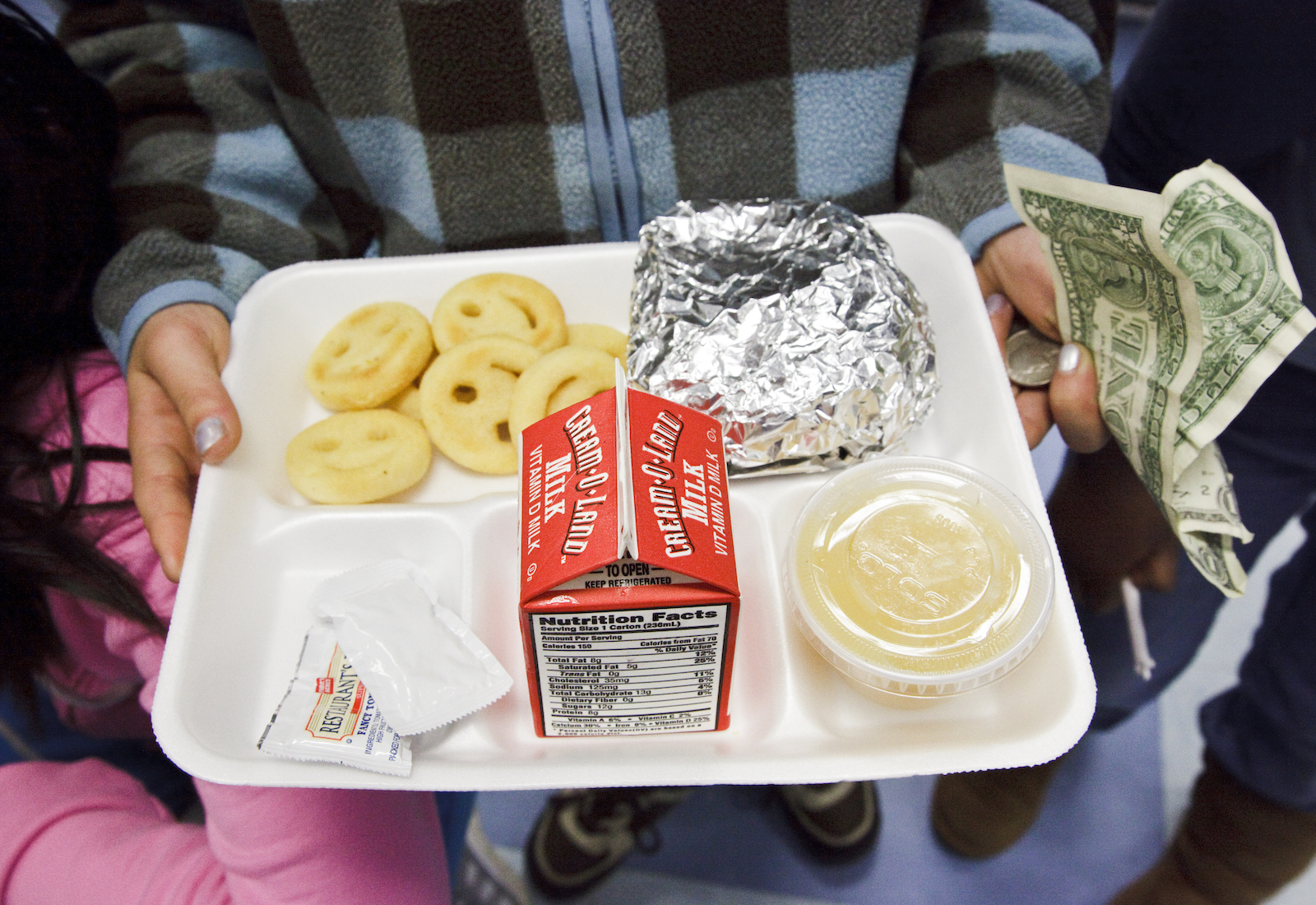
Under federal law, public schools participating in the National School Lunch Program — a child nutrition program established in 1946 — must offer two kinds of unflavored, low- or nonfat “fluid milk,” meaning skim or 1 percent, with every meal. Students can get a nondairy substitute, but only with a doctor’s note saying they have a “disability” restricting their diet.
The U.S. Department of Agriculture, or USDA, says the program is intended to support kids’ healthy development, but experts say its roots are more political than nutritional. During World War II, the U.S. government encouraged farmers to produce more milk that it could send to soldiers overseas. Once the war was over, farmers found themselves with more of the stuff than they knew what to do with — and so the government created programs like the Milk Price Support Program to keep demand from falling.
To many medical groups, the school dairy requirement has become a clear anachronism. Research suggests that cow’s milk is unnecessary for, and even potentially detrimental to, healthy human development, and critics note that no other mammal drinks milk after a brief period at the beginning of life.
“There’s very little high-quality evidence, and no comparable mammalian example, to argue for the specialness of cow’s milk” after about age 2, Aaron Carroll, a professor of pediatrics at the Indiana University School of Medicine, wrote in a 2020 New York Times article.
In fact, most people — about 68 percent of the global population, including the vast majority of people of color — can’t even digest milk after infancy. In the U.S., some 80 percent of all African Americans and Native Americans and more than 90 percent of Asian Americans have a genetic inability to digest lactose. Americans with Northern European heritage are least likely to be lactose intolerant, prompting some lawmakers to call the USDA’s mandatory milk program “dietary racism.”
“There would be reprisals if the United States were to put a product on the trays of white kids that caused potentially widespread adverse reactions,” 31 members of Congress said in a 2022 letter to Agriculture Secretary Thomas Vilsack.
To be clear, the USDA’s dairy rules don’t require students to actually take a carton of cow’s milk with their meals; schools just have to offer it. Fortified soy milk is supposed to be readily available to students who provide a doctor’s note saying they have a “disability,” but critics say this is a burdensome and belittling requirement.
“It’s ridiculous that a condition that affects 68 percent of the world would be considered a ‘disability,’” said Deborah Press, associate general counsel for the Physicians Committee for Responsible Medicine, a nonprofit that helped Williamson file her lawsuit. Press says the USDA’s dairy rules are designed to obstruct students’ access not only to plant-based alternatives, but to any beverage that isn’t cow’s milk. Indeed, schools cannot even offer bottled water in the lunch line, or in any manner that “interferes with or appears to substitute for” cow’s milk.
“The USDA has made [cow’s milk] virtually untouchable,” Press said.
Lunch at a public school lunch in New Jersey.
James Leynse / Corbis via Getty Images
Both the USDA and LA Unified School District, which includes Eagle Rock High School, declined to comment on the pending litigation. The school district did say its food services program follows USDA guidelines. “We continue to support our students with nutritious meals and healthy alternatives for those who have specific dietary requests and requirements,” a district representative said.
Even so, more and more young people are calling out the USDA policy. Williamson’s successful event last fall, for example, was held in conjunction with more than 100 other students across the country as part of a national day of action called “Scary Dairy,” organized by the Portland, Oregon-based nonprofit Raven Corps. The youth-led organization supports anti-dairy student activism through its Mind Over Milk campaign.
“We’re the ones affected, we’re the ones drinking the milk of not being able to access the alternatives,” said Shubhangi Bose, a senior at Westview High School in Portland and Raven Corps’ policy and legislation lead. Other groups supporting young people in this effort include the Physicians Committee for Responsible Medicine, the Factory Farming Awareness Coalition, and more than a dozen additional members of the Healthy Future Students and Planet Coalition.
Students Grist spoke with — including Williamson — said they’re motivated not only by the social justice implications of the USDA’s milk policies, but by the ethical and environmental implications of industrial dairy production. To them, milk’s protected status endorses animal cruelty and fuels the climate crisis.
“Animal agriculture contributes so much to climate change,” said Morgan Greenlaw, a senior at Palo Alto High School in Palo Alto, California, who held a plant-based event at her school this spring. Greenlaw, a self-described “die-hard vegan,” draws a direct line between the massive wildfires and smoky skies of her upbringing and the greenhouse gas emissions associated with raising tens of billions of animals a year for meat and dairy.
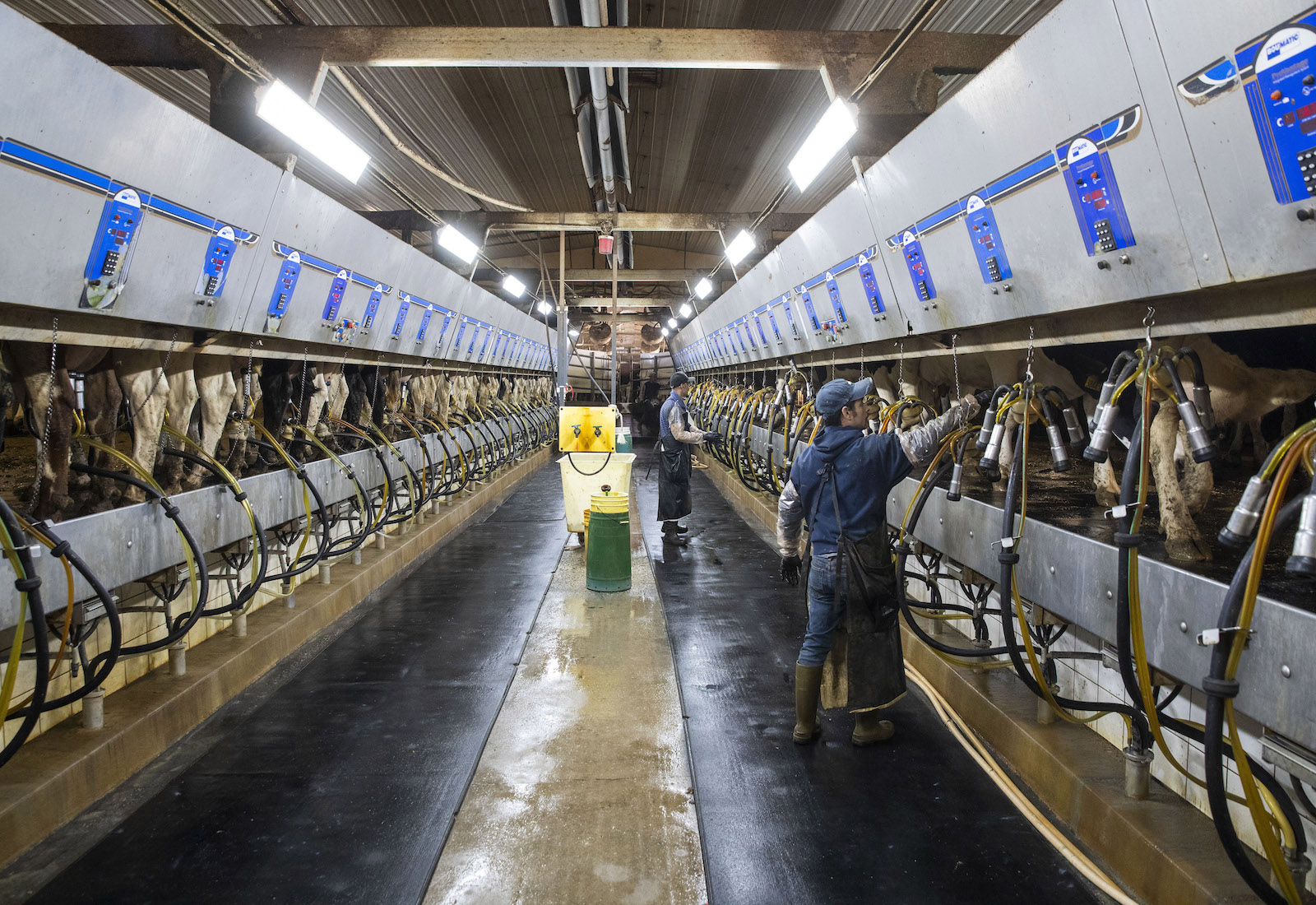
In the U.S., the dairy industry is responsible for about 2 percent of annual greenhouse gas emissions, as well as extensive land and water pollution. Compared to milks made from soy, almonds, oats, or rice, cow’s milk does worse in just about every category: It uses up to 22 times more water and 26 times more land, and generates 10 times more harmful runoff into lakes, rivers, and streams.
Workers at a dairy farm in Iowa.
Wang Ying / Xinhua via Getty Images
Eloísa Trinidad, executive director of the nonprofit Chilis on Wheels — which is part of of the Healthy Future Students and Planet Coalition — says climate and environmental concerns have caused a surge in youth opposition to school milk programs. “A lot of our students … are experiencing climate anxiety,” but feel that they can’t do anything about it, she said. “They don’t feel empowered by most school districts to take charge of their well-being, their health, or climate action.”
Trinidad says one 10th grader, frustrated with the USDA’s school milk policies, recently asked her, “Why doesn’t the government ask us what we want to eat?” A mismatch between how milk is distributed in schools and students’ desire to drink it means that up to 45 million gallons of milk are wasted annually — enough to fill 68 Olympic swimming pools.
For now, getting cow’s milk out of school cafeterias is a political nonstarter; many legislators are loath to challenge the dairy lobby, or risk angering farmers. But Williamson, Raven Corps, and others have submitted comments to the USDA and endorsed federal bills that would at least add soy milk to the lunch menu — without the need for a doctor’s note. These bills include the Addressing Digestive Distress in Stomachs of Our Youth (ADD SOY) Act and the Healthy Future Students and Earth Pilot Program Act. Both would require school districts to provide nondairy milk to any student whose parent or guardian makes a written request.
“Students and their families deserve healthy, plant-based, culturally appropriate meal options at school,” New York Representative Jamaal Bowman, a Democratic co-sponsor of the Healthy Future Students act, told Grist.
Neither bill would eliminate dairy milk from school lunch programs, but many youth activists see them as a first step toward that longer-term goal.
“Ideally in the next dozens of years, I’d love to see [cow’s milk] be replaced, but realistically, that’s not an option right now,” Williamson said. “The goal of the lawsuit is to make plant-based milk an option for anyone who wants it, even if they’re not lactose intolerant. They should be able to choose the more sustainable option.”
This story was originally published by Grist with the headline This LA teen is suing her school district — and the USDA — to promote nondairy milk on May 18, 2023.
Before we get into today's post, I want to remind you that climate change is real. Big governments continue to poison and pollute. One of the things we all can do is plant more trees as well as saving our existing trees whenever possible. That's why Pensacola Tree Services is doing everything to benefit the environment, while also beautifying your home's landscaping.
Record-hot temperatures have scorched the Earth, with recent years numbering among the warmest since records began in 1880. But that’s just the start of the kind of heat we’re headed toward, the World Meteorological Organization warned on Wednesday.
It’s a near certainty that one of the next five years will be the world’s hottest on record, the organization said, the result of human-caused climate change colliding with an “El Niño” weather pattern that warms the globe. Marked by hotter surface waters in the tropical Pacific Ocean, El Niño is replacing La Niña, a cooler pattern that has actually tempered the heat of the last three years.
The meteorological association cautioned that the world could see temperatures that are 1.5 degrees Celsius (2.7 degrees Fahrenheit) warmer than preindustrial times, with a two-thirds chance that at least one of the next five years will breach that threshold. Holding global temperatures below 1.5 degrees has been a rallying point for island nations that threaten to get swallowed by rising seas, and became an aspirational goal of the Paris Agreement that roughly 200 countries negotiated in 2015. While temporarily hitting the 1.5-degree mark is different from seeing an average of 1.5 across many years, the extra heat from El Niño, on top of climate change, could usher us closer to this hotter future.
Every tenth of a degree that the planet warms pushes it toward worrisome tipping points, such as the disintegration of the West Antarctic ice sheet. Surpassing the 1.5C mark could also inch environments closer to irreversible feedback loops: The Amazon, for example, might transform from a rainforest into a grassy savanna, releasing the vast stores of carbon held in its trees.
Even in the short term, a strong El Niño could be devastating for sensitive ecosystems like the Great Barrier Reef. The last year the world saw a powerful El Niño, 2016, was the hottest on record. It ushered in the most devastating coral bleaching event in history, with more than half of corals dying in the northern part of the reef, and brought drought and fires to the Amazon, killing off nearly 2.5 billion trees.
In bad news for public health, El Niño’s arrival could fuel the spread of diseases carried by mosquitoes, bacteria, and toxic algae. Malaria and dengue have spiked during past El Niño years. Warmer temperatures also allow disease-carrying pests like mosquitoes and ticks to expand into new ranges.
The world has already warmed an average of 1.2 degrees C (2.2 degrees F) since the Industrial Revolution initiated the widespread use of fossil fuels, hotter than at any point in the last 125,000 years. Most estimates say that the longer-term average of 1.5C won’t arrive until at least the early 2030s, though the meteorological organization said there’s a 1 in 3 chance the five-year average temperature could top that threshold. It puts things into perspective: Decades from now, the string of hot years the world has recently witnessed will be looked back on as some of the century’s coldest.
This story was originally published by Grist with the headline It’s near certain that the next 5 years will be the hottest yet on May 17, 2023.
I'd like to take this time to remind you that climate change is real. The actions of big governments continue to pollute and poison the environment. Whenever feasible, we should all plant more trees and preserve our existing ones. That's why Tree Services in Pensacola strives to do both while also improving your home's landscaping. Read more about how they're making changes at https://treeservicespensacola.com
The vision
“You can locate the ways that climate and sustainability intersect with any good stories, without explicitly telling a climate change story. Because it frankly intersects with nearly every story.”
Cyle Zezo, executive producer
The spotlight
Last September, cozied up in a hotel room at my very first journalism conference, I watched the Netflix original movie Do Revenge. I love a good over-the-top high school dramedy — especially one with outfits to rival Clueless. But the moment that made my eyes widen the most wasn’t a wardrobe choice, a plot twist, or a reveal. It was about 20 minutes into the movie, when one of the main characters stood watching a group of her fellow students, later referred to as “the Greta Thunberg brigade,” stage a climate protest on their high school campus.
It was just a passing mention. Any number of other social issues could easily have replaced climate change in the script. But they chose to evoke our planetary crisis — and they’re not the only ones. Catching up on the Netflix series Ginny & Georgia, I took notice of a teenage character citing “global warming” as a reason for his depression. And in HBO’s Mindy Kaling-helmed The Sex Lives of College Girls, I nearly leapt out of my seat when season 2 debuted a sexy climate refugee character.
These were all subtle moments in the course of the rest of the drama, but they rang authentic. Teenagers have been protesting climate inaction, in massive numbers, for years now. And even the passing mentions reflect a reality that climate change is present in young people’s minds — along with the name Greta Thunberg (although Do Revenge did, unfortunately, mispronounce it).
These subtle mentions also reflect an intentional push for TV and films to capture this reality. “Of course, we do need new stories like Extrapolations and How to Blow Up a Pipeline where climate is the central focus,” says Anna Jane Joyner, the founder and CEO of Good Energy, a climate storytelling consultancy. “But we also just need to see it acknowledged in any kind of story.”
Fewer than 3 percent of film and TV scripts from 2016 to 2020 included any climate-related terms, according to an analysis by Good Energy and the Norman Lear Center’s Media Impact Project. It’s Good Energy’s mission to change that. Last year, the organization released a playbook for screenwriters, industry executives, and other creatives who want to explore ways of weaving climate themes into their projects — from soap operas to thrillers to rom coms.
“We’re not talking about a new kind of genre or story. We’re just talking about writing about what it feels like to be alive right now,” says Joyner. “And that includes living in a world where there’s a climate crisis.”
Climate placement
During this year’s Super Bowl, Netflix ran an ad announcing that the streaming service will partner with General Motors to feature more electric vehicles in its productions, including the popular reality shows Queer Eye and Love is Blind. That’s an example of what Good Energy would call “climate placement” — the EVs won’t necessarily be a topic of discussion on screen, but showing people, especially beloved characters or TV personalities, exhibiting climate-friendly behaviors can help to normalize them.
“It doesn’t necessarily need to be the ‘A’ story,” says Cyle Zezo, an executive producer specializing in non-scripted content (reality TV, documentaries, and game shows) and the former head of alternative programming at the CW Network. Zezo is now working on an initiative he’s calling Reality of Change, focusing on climate storytelling opportunities in non-scripted shows. He’ll be speaking about the idea at upcoming industry events and conferences, and is also on the board of advisors for this year’s Hollywood Climate Summit, which will feature a reality TV presence for the first time.
“I think non-scripted is such an obvious place to see this play out, because climate change is reality, and we’re talking about reality TV,” he says. In one example, Zezo worked on a cooking show called Recipe for Disaster that will debut on the CW later this year — “It’s this absurd but fun, family-friendly cooking competition show that has nothing to do with climate change,” he says. But without making it the main focus, the show’s format provided opportunities to feature climate-related challenges and plant-based cooking. Zezo says the producers also made sure to cut to shots of the compost bins on set.
“In the normal course of things, there are these elements you can incorporate that reflect where audiences already are and what they’re looking for,” he says.
The impact of climate on screen
While 64 percent of Americans report being worried about climate change, 67 percent also say they “rarely” or “never” discuss it with family and friends, according to research from the Yale Program on Climate Communication. “If we’re not talking about climate, if we’re not facing it, then we’re certainly not doing anything about it,” Joyner says. And one way of encouraging climate conversations is to show them on screen.
She notes how visibility in pop culture has contributed to progress on social issues like LGBTQ justice — President Biden has attributed the profound shift in opinion on marriage equality, including his own, to the show Will & Grace. Seeing a relatable character dealing with climate impacts or fears can help reassure viewers that they are not alone and that their climate concerns are valid, Joyner says. “Those are all really important psychological benefits of even just mentioning it.”
She adds that the climate movement is in some ways catching up to other industries, including Big Oil, that have long understood the importance of pop culture narratives. “The Department of Defense has had people in Hollywood for over a century, directly impacting the stories that are being told about the U.S. military,” Joyner points out. “How we think of World War II is not our history books, it’s the movies that we’ve seen. That is what shapes collective American consciousness around World War II.”
I spoke about this with Samuel Rubin, an impact producer and one of the founders of the Hollywood Climate Summit (and a 2022 Grist 50 honoree). In some of the examples I had come across in my casual viewing, he pointed out even more layers to the climate mentions than what I had initially clocked. In The Sex Lives of College Girls, for instance, he was excited to see the show challenging stereotypes.
The climate refugee character — a ripped, Midwestern blond boy — not only contributes to an awareness that climate disasters are displacing more people, but also challenges notions of what a refugee looks like. “Am I supposed to feel sad for a refugee, just because they lost everything?” Rubin joked. “Or can I actually be like, ‘Oh, I wanna fuck that refugee. He’s so hot.’”
He also pointed to the fact that a climate fundraiser organized by the main characters was depicted as a fun bonding moment on the show — another example of how these climate mentions can change our perceptions.
Rubin knows his work will take time to pay off. “I think people forget that making a movie takes literally three to five years,” he says. The shows and movies that have been greenlit in the past year may not hit screens until 2025 or 2026. Meanwhile, the industry is contending not just with an evolving understanding of climate, justice, and representation, but also with internal struggles, as the current Hollywood writers’ strike highlights. “It’ll take time, but it’s happening,” Rubin says.
“For audiences, we really are starting with a blank page,” Joyner says, “which is both maddening, because we’re behind, but also a really amazing opportunity because this is the moment that will shape our stories for decades to come. And those stories will shape our world for decades to come.”
— Claire Elise Thompson
More exposure
Read: more about the Good Energy playbook and the need for relatable climate storylines (TIME)
Read: more about the Hollywood writers’ strike (Today)
Read: about climate messaging at the Eurovision Song Contest (Energy Monitor)
Watch:Extrapolations (Apple TV) and How to Blow Up a Pipeline (available on Apple TV or Prime Video), if you haven’t already.
See for yourself
What’s your favorite example of a movie or TV show that handles climate themes in an interesting, funny, or thoughtful way? Next week, we’re planning to share a summer watch list, with some recommendations from the folks quoted above. Reply to this email to share your recs!
A parting shot
If the theatre is more your jam than TV, check out the soundtrack for Hadestown — a jazzy take on the myth of Orpheus and Eurydice with some undeniable climate themes. Here’s the Broadway cast celebrating their opening night (the flowers represent a major climate-related motif in the show).
IMAGE CREDITS
Vision: Grist
Parting Shot: Bruce Glikas / Getty Images
This story was originally published by Grist with the headline The next cameo on your favorite TV show could be climate change on May 17, 2023.