Friday, 5 May 2023

Despite what you may think, ethanol isn’t dead yet

If you're serious about the environment, we all know that planting trees is one of the most effective measures, and tree removal should be a last resort. We at Pensacola Tree Services are dedicated to offering the best for your home as well as the environment, therefore we're committed to delivering it by making it as simple as possible. For responsible tree removal visit us here Pensacola Tree Services

Two decades ago, when the world was wising up to the threat of climate change, the Bush administration touted ethanol — a fuel usually made from corn — for its threefold promise: It would wean the country off foreign oil, line farmers’ pockets, and reduce carbon pollution. In 2007, Congress mandated that refiners nearly quintuple the amount of biofuels mixed into the nation’s gasoline supply over 15 years. The Environmental Protection Agency projected that ethanol would emit at least 20 percent fewer greenhouse gasses than conventional gasoline.  

Scientists say the EPA was too optimistic, and some research shows that the congressional mandate did more climatic harm than good. A 2022 study found that producing and burning corn-based fuel is at least 24 percent more carbon-intensive than refining and combusting gasoline. The biofuel industry and Department of Energy vehemently criticized those findings, which nevertheless challenge the widespread claim that ethanol is something of a magic elixir. 

“There’s an intuition people have that burning plants is better than burning fossil fuels,” said Timothy Searchinger. He is a senior researcher at the Center for Policy Research on Energy and the Environment at Princeton University and an early skeptic of ethanol. “Growing plants is good. Burning plants isn’t.”  

Given all that, not to mention the growing popularity of electric vehicles, you’d think ethanol is on the way out. Not so. Politicians across the ideological spectrum continue to tout it as a way to win energy independence and save the climate. The fuel’s bipartisan staying power has less to do with any environmental benefits than with disputed science and the sway of the biofuel lobby, agricultural economists and policy analysts told Grist.  

“The only way ethanol makes sense is as a political issue,” said Jason Hill, a bioproducts and biosystems engineering professor at the University of Minnesota.

President Biden’s landmark climate bill, the Inflation Reduction Act, outlined the biggest federal biofuels spending package in 15 years. Last week, its ethanol subsidies became a sticking point among House Republicans debating a bill over the federal debt limit. Eight Corn Belt Republicans staunchly, and successfully, opposed a proposal to raise the nation’s debt ceiling and curb federal spending because it would have repealed tax credits for the ethanol industry.  

Regulators remain equally enamored. The ethanol industry is celebrating the EPA’s recent announcement that, for the second straight year, it will waive a ban on summertime sales of E15 gasoline. The fuel, which contains as much as 15 percent ethanol, has long been prohibited during warm months amid concerns that it creates smog. And with automakers embracing EVs, the ethanol industry is lobbying the Biden administration to extend federal subsidies to ethanol-based “sustainable” aviation fuel. Ethanol producers also plan to tap into carbon capture subsidies to build pipelines that would carry carbon from refineries to underground storage tanks. 

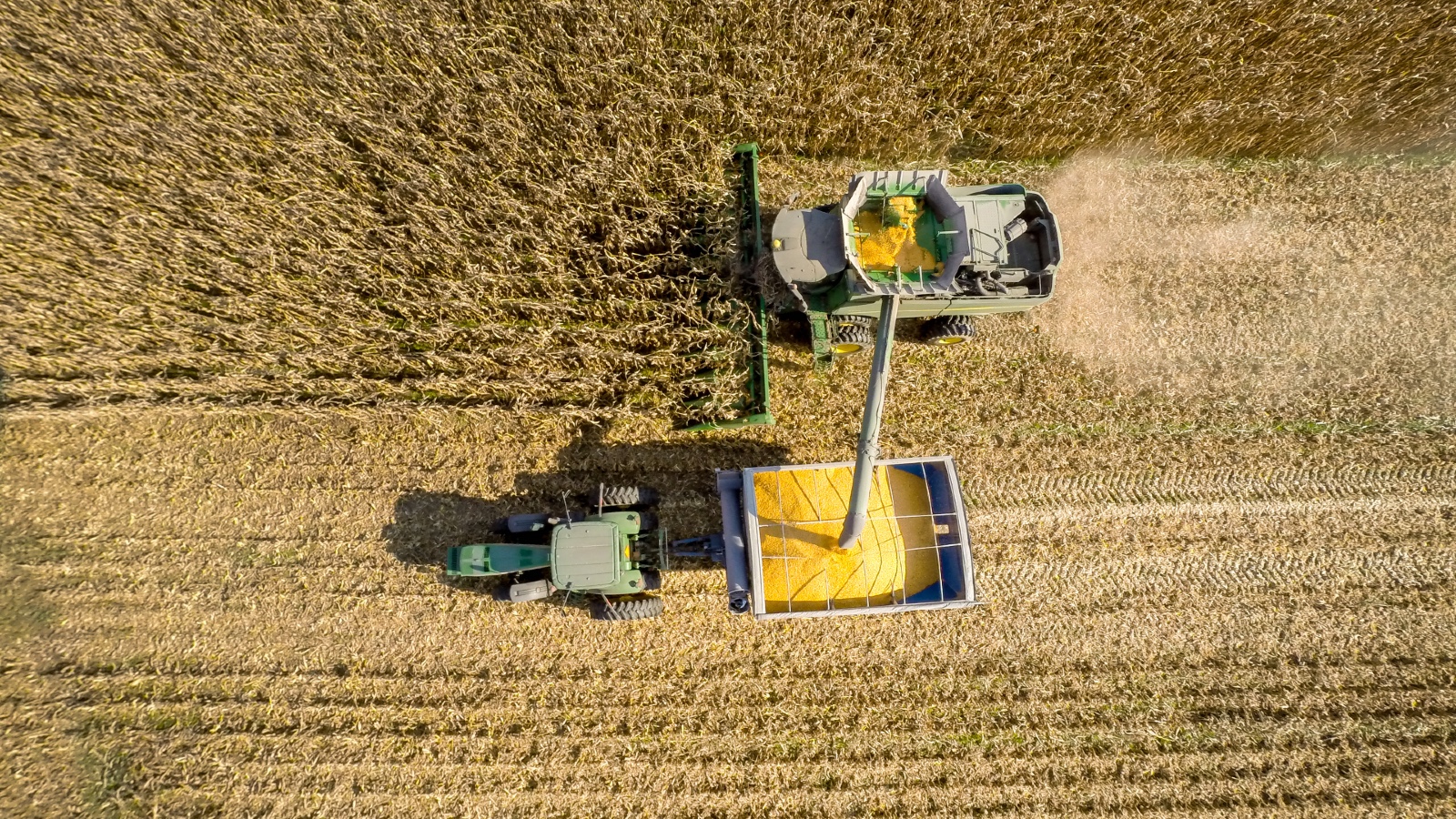
A combine clears a field of corn in Maryland as seen from above
A combine harvests corn. About a third of the corn produced in the U.S. is used to make ethanol.
Edwin Remsburg / VW Pics via Getty Images

A lot of this stems from the fact the U.S. produces more corn than any other country — 13.7 billion bushels last year — and about a third of that, worth some $20 billion, is used to produce ethanol. While biofuels can be made from all kinds of organic material, from soybeans to manure, about 90 percent of the nation’s supply comes from corn. No wonder the ethanol boom has been called the Great Corn Rush. 

And a rush it has been. Although the 15 billion gallons of ethanol mixed into gasoline each year falls well short of the 36 billion that President Bush hoped for, the number of refineries in the United States has nearly doubled to almost 200 since his presidency. Between 2008 and 2016, corn cultivation increased by about 9 percent. In some areas, like the Dakotas and western Minnesota, it rose as much as 100 percent in that time. Nationwide, corn land expanded by more than 11 million acres between 2005 and 2021.

“A quarter of all the corn land in the U.S. is used for ethanol. It’s a land area equivalent to all the corn land in Minnesota and Iowa combined,” said Hill. “That has implications. It’s not just what happens in the U.S. It’s what happens globally.”

As more land at home has been tilled to grow corn for ethanol, commodity prices have gone up worldwide. In turn, growers seeking higher profits have embraced crops used to make biofuels. The expansion of soybeans and palm, in particular, has led to deforestation throughout the tropics, particularly in Indonesia and Brazil. It has also absorbed land that could be used to grow food or capture carbon. “We basically opened the floodgates,” Searchinger said.

Ethanol has failed to meet its climate promises for a number of reasons, which some researchers believe are mostly related to land use. Growing more corn means using more nitrogen fertilizer, which emits nitrous oxide, a potent greenhouse gas. Since 2007, fertilizer use tied to ethanol production has risen nationwide by up to 8 percent, according to the 2022 study denounced by the industry and DOE. More fields set aside for ethanol feedstocks also means less land for carbon-storing trees, climate-friendly food crops, or truly renewable energy sources like solar panels, which are far more efficient than plants at converting sunlight to power.  

Read Next
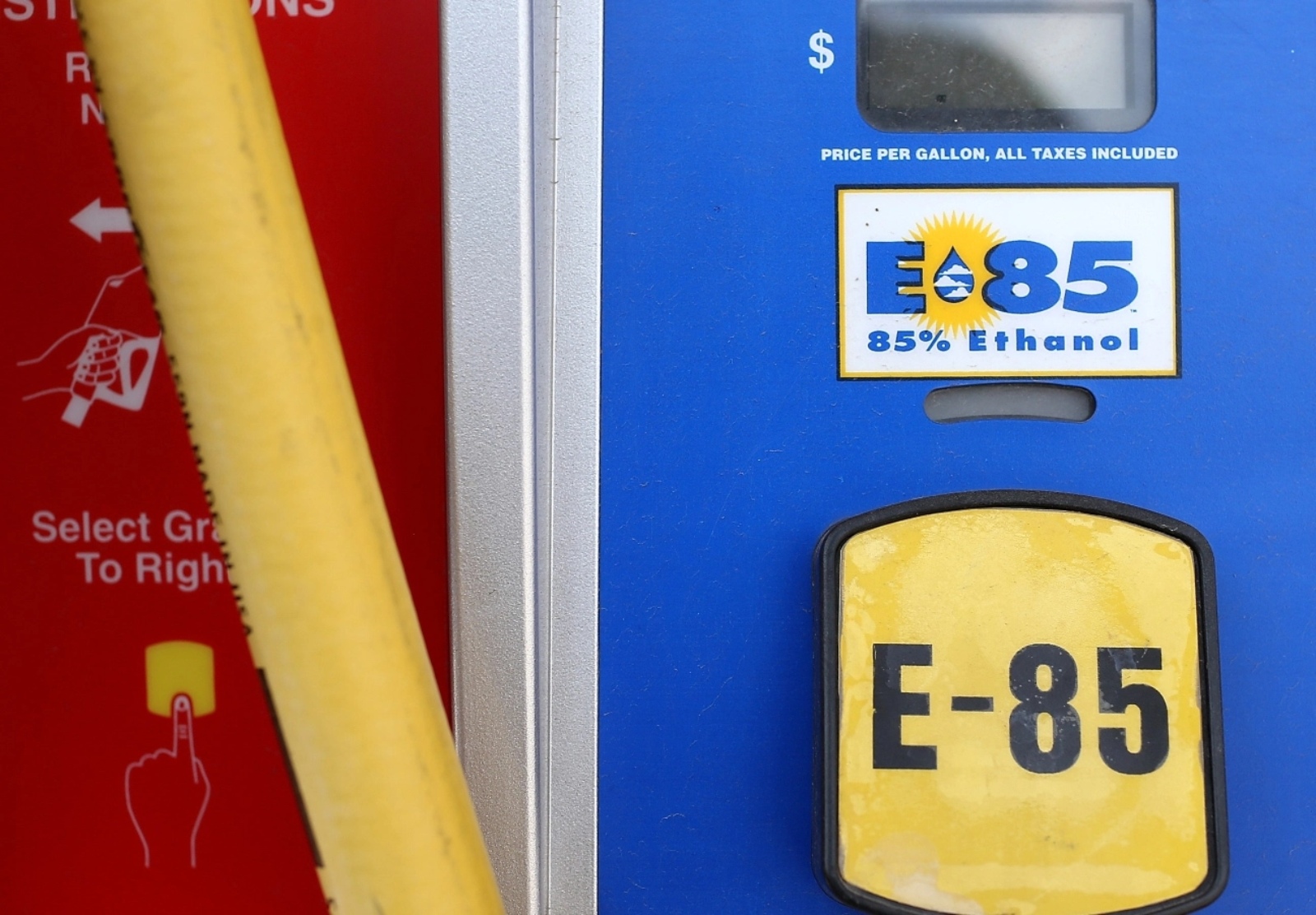
Image of a gas pump with an ethanol symbol on it.
Midwestern leaders want to sell ethanol in summer despite smog risks
John McCracken

Still, many lawmakers, federal agencies, and the biofuel industry continue to insist that ethanol is better for the climate than gasoline. A 2021 Department of Energy report found that the greenhouse gas emissions from grain-based ethanol can be as much as 52 percent lower than gasoline. With more climate-friendly growing practices, that could reach 70 percent, according to a 2018 study funded by the Department of Agriculture. 

“There’s been a lot of talk — and a lot of confusion — recently about corn ethanol’s carbon footprint,” Renewable Fuels Association CEO Geoff Cooper wrote in a blog post last year. He criticized what he called a “flawed and misleading approach to examining ethanol’s carbon footprint” and said that corn ethanol has a 46 percent smaller footprint than gasoline. That number comes from a 2021 analysis by researchers at Harvard University, Tufts University, and Massachusetts Institute of Technology. 

But ethanol critics say such calculations don’t accurately account for the entire ethanol production cycle, from cultivation to processing, and underestimate the emissions caused by land-use changes associated with ethanol. 

“The studies that look at the full life cycle of production and use of ethanol suggest that it results in increased greenhouse gas emissions relative to gasoline. [And] it doesn’t lead to lower emissions that affect air quality, say particulates. In fact, they’re higher,” Hill said. 

Aside from ethanol’s environmental consequences, questions linger over its future in an increasingly electrified world. In 2011, there were 22,000 EVs on U.S. roads. Ten years later, there were 2 million. One in five cars sold around the world this year will be electric, the International Energy Agency reported last week. As electric vehicles become more popular, “you are going to see the ethanol industry looking for ways to sustain itself, and probably sustainable aviation fuel is going to be their big push,” said Aaron Smith, an agricultural economist at University of California, Davis and a co-author of the 2022 study critical of ethanol.

The Department of Energy says ethanol jet fuel could reduce greenhouse gas emissions by as much as 153 percent compared to its petroleum counterpart. Hill said it has the same problems as the ethanol used to power cars. “There’s no reason to think they’re any different,” he said. 

Yet two years ago, the Biden administration set a goal of producing 3 billion gallons of sustainable aviation fuel by 2030. Just last month, two House Democrats — Julia Brownley of California and Brad Schneider of Illinois  — re-introduced the Sustainable Aviation Fuel Act, which would authorize $1 billion of federal funds to spur growth in the industry. To qualify for the subsidies, fuels must emit 50 percent fewer greenhouse gasses during their life cycle than oil-based jet fuel. Only time will tell if the new use of ethanol delivers the future the fuel’s supporters have long promised. 

This story was originally published by Grist with the headline Despite what you may think, ethanol isn’t dead yet on May 5, 2023.

Thursday, 4 May 2023

A California bill could help make EVs a blackout solution

If you're serious about the environment, we all know planting trees is one of the best solutions and tree removal should be a last resort which is why we're committed at Pensacola Tree Services to provide the very best for your home as well as the environment. Read more by going here.

Chris Bowe was preparing for his daughter’s ninth birthday party in February when a drenching storm knocked out power to his neighborhood in Hayward, California. Minutes before the party began, Bowe connected his electric Ford F-150 Lightning to a panel in his garage, sending electricity from the pickup truck to his house. 

“It was dark out, parents were dropping off their kids, and our house was lit up,” said Bowe, who works as a FedEx manager in the Bay Area. “They were like, ‘How do you have power?’”

Bowe kept the lights on using bidirectional charging, which allows electric vehicles to not only receive electricity but discharge it as well. It’s a feature that a proposed California bill would require that all EVs sold in the state offer by model year 2027.

Making an EV bidirectional capable is a matter of equipping it with the right software and hardware, and some, like the Nissan Leaf, Kia EV 6, and the Lightning, already provide the feature. Other manufacturers have been slower to roll out the technology. Tesla, for example, says its cars will be bidirectional by 2025. 

Proponents of Senate Bill 233, which the state’s Senate Appropriations Committee will hear this month, say using electric vehicle batteries to power homes, buildings and even the grid could provide energy resilience and bolster grid reliability. Climate events and growing power demand increasingly stress the state’s energy supplies. Utilities sometimes shut down power lines to prevent ignition when wildfire danger is high. Storms can cause widespread blackouts, and excess demand when people turn up air conditioners during heat waves have prompted rolling blackouts to ration power. 

The solutions to these outages often rely on fossil fuels that only exacerbate the underlying causes. California might turn on a backup natural gas plant to supply more power, and homes and businesses often draw power from diesel generators during blackouts. 

“When the grid is stressed, wouldn’t it be great if instead of firing polluting fossil-fuel peaker plants typically located in disadvantaged communities, we were using our electric vehicles?” said Kurt Johnson, community energy resilience director at the California nonprofit The Climate Center.

Such a solution is called vehicle-to-grid integration, in which EV owners could plug their cars into bidirectional charging stations at home and sell the power in its battery to utilities during peak demand, buttressing the grid and reducing their utility bills. Those batteries can also power a home or building, or even be used to directly plug in a refrigerator or essential medical equipment. “Even the smallest commonly available EV battery is a multi-day energy storage asset for everybody,” said Johnson. “A Nissan Leaf can run your house for days.” 

Read Next
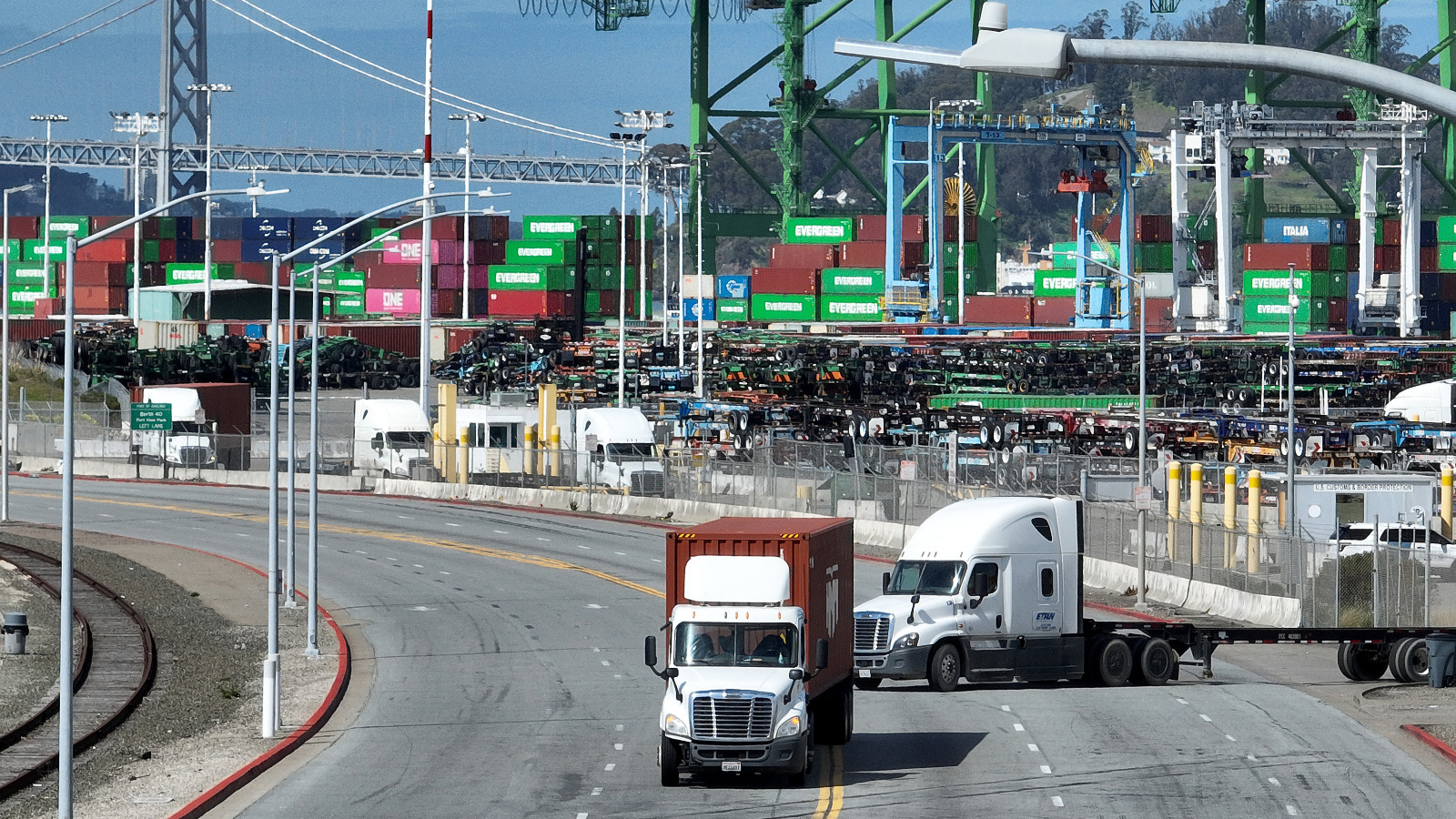
A truck turns onto a road carting a shipping container from a port.
Electrify everything, California says — including trucks and trains
Kate Yoder

The bill comes as the state takes a leading role in vehicle electrification. Last year, California regulators required that all new cars sold in the state be electric by 2035, and it already has 1.5 million EVs on the road. That number is projected to reach 8 million by 2030. All of those cars would have a total capacity of 80 gigawatts of power, according to Johnson.  Plugging in a fraction of them would quickly surpass the capacity of the state’s largest power plant, the Diablo Canyon nuclear plant, which can provide up to 2.3 gigawatts.

The Alliance for Automotive Innovation, an auto-industry advocacy group, opposes the bill. Its representatives declined an interview request, but referred Grist to a letter to state senators in which it said that a mandate is premature and does not consider the associated costs or the regulatory changes needed to make vehicle-to-grid technology work. 

“Mandating bidirectional hardware on the vehicle will not ensure that bidirectional charging will take place or will even be capable of taking place,” it said in the letter. The organization estimates that the technology could add about $3,300 to a vehicle’s cost. 

In a Senate Transportation Committee hearing last week, state Senator Nancy Skinner said the mandate would ensure that vehicles sold in the most pivotal years of the state’s electric transition, which is being driven by generous grants and rebates, can become energy assets. “I appreciate that manufacturers don’t like mandates, but we need to make sure the cars have the capability while the rebates still exist,” said Skinner, who introduced the bill.

The alliance also argued that using an EV to deliver power could adversely impact battery life and undermine battery warranties, which are based on years and mileage. However, the battery warranty on the Nissan Leaf, one of the least expensive fully battery electric cars available, accounts for bidirectional charging use. The bidirectional charger approved for use with the Leaf manages the battery’s levels to preserve battery life. 

Even if every EV had bidirectional capability, getting the energy flowing into a home or the grid requires an expensive array of hardware. In addition to a bidirectional charging station, the car owner would need an inverter to convert the car’s DC power to AC, a switch to isolate the system from the grid, and a small battery to get the system going during an outage. Ford offers an all-in-one package that costs more than $5,000, not including the cost of hiring an electrician to install it. 

That was too expensive for Bowe. “It sounds wonderful, but you’re still talking about an upper-middle class, wealthy person in a single-family home that’s going to be able to afford to do this,” he said. He instead installed a manual transfer switch that he connects to his Lightning with the same type of power cord used for a home generator. It cost him $1,500. 

For those who can afford all the hardware, the framework for connecting with the grid and selling electricity back to the local utility does not yet exist. “We’re not even effectively interconnecting stationary batteries, much less mobile batteries,” said Johnson. Also, for it to make financial sense for EV owners to offer up energy to the grid, there need to be pricing mechanisms for selling the electricity to the utility. While a few California utilities have begun vehicle-to-grid pilot projects, no official programs exist yet.

Johnson said the state is working on both interconnection and pricing –– there are about a dozen bills addressing interconnection woes in the legislature, and the public utilities commission is studying new pricing frameworks. He said that SB 233 is meant to be a starting point. “If the vehicles themselves don’t have the bidirectional capacity, which is the point of the bill, then none of that opportunity can be realized. So it all starts with the vehicles.”

This story was originally published by Grist with the headline A California bill could help make EVs a blackout solution on May 4, 2023.

Wednesday, 3 May 2023

Chile’s national lithium strategy raises questions about the environmental and social costs of EVs

If you're concerned about the environment, you're aware that planting trees is one of the most effective things you can do. Trees absorb carbon dioxide and provide oxygen, which helps to preserve the environment. If a tree has to be removed, then be sure it's a last resort. LinkedIn provides stump grinding, tree trimming, and stump removal.

There are few minerals that play as pivotal a role in the global energy transition as lithium. The silvery white, soft, reactive metal is particularly good at storing energy, which is why it is used in all commercial electric vehicle batteries today and is unlikely to be replaced by another material anytime soon. The demand for lithium batteries is expected to grow more than five times by 2030.

Recognizing its strategic importance, economic potential, and its environmental consequences, President Gabriel Boric of Chile, the world’s second largest producer of the metal, announced plans in late April to increase state participation in the country’s lithium industry.

“The main aim of this policy,” said Pedro Glatz, who was a senior advisor to the Chilean Ministry of the Environment until two months ago and was not involved in crafting the policy, “is to provide more wealth, well-being, and welfare to the Chilean people.”

But Indigenous communities and environmental defenders who live near Chile’s lithium resources question whether this wealth-building and the growth of the global electric car industry should come at the expense of their water, homes, and a critical ecosystem.

Chile's President Gabriel Boric speaking at a podium with the Chilean flag in the background
Chilean President Gabriel Boric speaks during an event to present the National Lithium Strategy in Antofagasta, Chile, on April 21, 2023. Photo by GLENN ARCOS/AFP via Getty Images

Over half of the world’s known lithium deposits are located where Chile, Bolivia, and Argentina border one another. Situated within the Andes, parts of the area are drier than anywhere in the world outside of Antarctica. The region is often referred to as the Lithium Triangle because of its mineral-rich salt flats, which form when large pools or shallow lakes of water accumulate on plateaus or between mountain ridges and evaporate. Lithium revenue accounted for nearly 2 percent of Chile’s annual gross domestic product last year. 

In announcing his intention to grow the government’s oversight of the lithium industry, Boric delivered on a campaign promise he made in 2021. Under the new framework, the state will capture more revenue by mandating that private companies partner with public agencies for all future mining contracts. Subject to congressional approval, Boric also hopes to create a publicly owned national lithium company.

Notably, the policy also takes a more ambitious approach to environmental standards across the lifecycle of the industry. The government will create a public research institute to develop new refining technologies, and institute lithium waste and battery recycling.

But critics question whether the plan will do enough to protect the Lithium Triangle from the high costs of extraction. 

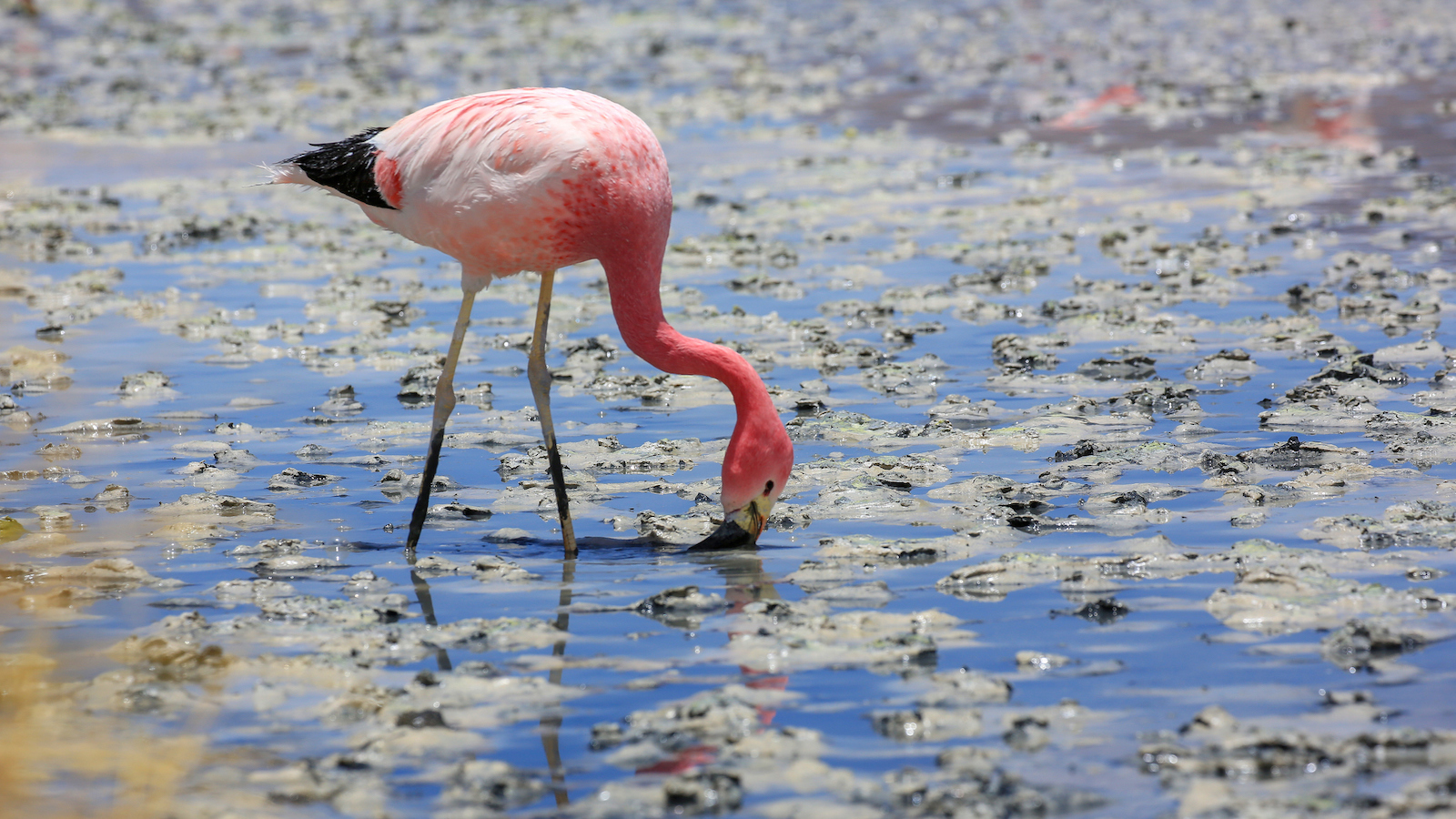
Currently, lithium in Chile is extracted by drilling holes in the salt flats and pumping brine to the surface, which is then left to evaporate in large artificial ponds for months at a time. The method has depleted water levels in a region already suffering from a climate change-induced megadrought, affecting local farmers, pastoralists, and a critical wetland ecosystem that supports three iconic flamingo species.

Pink, white and black colored Andean flamingo feeding in a lake, with other flamingos reflected in the water
Andean flamingo (Phoenicoparrus andinus), one of the rarest flamingos in the world, feeding in a high plateau lake in the Siloli Desert, near the Salar de Uyuni (Uyuni Salt Falt) and the border with Chile, in southwestern Bolivia.
Getty images

In response to Boric’s announcement, a coalition of Indigenous peoples, environmental activists, and researchers called the Plurinational Observatory of Andean Salt Flats, or OPSAL, released a statement titled “Salt flats are not mines, salt flats are wetlands.” 

OPSAL is worried that lithium extracted from Chile and other South American countries will be primarily used for private electric vehicles in the European Union, the United States, and China, which they call “a false solution to climate change that benefits the most polluting economies of the planet.” They argue that such a solution wouldn’t meet the mobility needs of the majority of the world’s inhabitants, and that attempting to replace all internal combustion engine cars with electric vehicles would create unnecessary sacrifice zones along lithium mining corridors.

Earlier this year, a report from the Climate and Community Project found that expanding public transportation infrastructure and reducing car battery sizes could reduce lithium demand by up to 90 percent in the U.S., suggesting that it’s possible to address the climate crisis while simultaneously protecting Indigenous rights and biodiversity.

Glatz, the former environmental ministry adviser, said that the Chilean government’s active participation in the lithium industry could give it more leverage in international discussions about lithium demand. “If countries want to use these resources, we could be negotiating concessions, both in terms of climate debt, but also in the ways lithium is being used,” he told Grist. “It might be a better use of that lithium to provide batteries for public transportation in the global south, rather than to support an unsustainable lifestyle in the global north, and it’s a shame that these ideas are not in the discussion today.”

OPSAL welcomes increased state participation and hopes that the government will center the Andean salt flats and wetlands in its management of the lithium industry. Boric’s lithium strategy explicitly acknowledges territorial and environmental concerns, and includes a plan to conserve 30 percent of the salt flat region. But OPSAL wants the government to go further by adopting an international convention that guarantees Indigenous people’s right to free, prior, and informed consent — a bedrock of Indigenous rights. Such a guarantee would respect Indigenous communities’ “right to say no to a project that threatens their way of life and the ecosystems where they live,” the coalition said in its statement.

Glatz admits that mining lithium in a sustainable way is perhaps the most challenging part of Boric’s strategy. “I don’t think the Chilean state, or anybody for that matter, knows how to do this in a good way. It is perhaps one of the questions of the 21st century,” he told Grist. “How do we deal with the demand for specific types of resources that are needed for the energy transition, and at the same time not destroy ecosystems or nations that have developed over centuries?”

This story was originally published by Grist with the headline Chile’s national lithium strategy raises questions about the environmental and social costs of EVs on May 3, 2023.

Brazil’s president returns 800 square miles of Indigenous Iand to its original caretakers

If you're serious about the environment, we all know planting trees is one of the best solutions and tree removal should be a last resort which is why we're committed at Pensacola Tree Services to provide the very best for your home as well as the environment. Read more by going here.

Brazilian President Luiz Inácio Lula da Silva legally recognized nearly 800 square miles of Indigenous lands on Friday in an effort to stop illegal logging, mining and land grabbing, reversing policies enacted by his predecessor Jair Bolsonaro, a far-right leader who encouraged development in the Amazon. Those policies spurred a frenzy of activity, including illegal gold mining and clandestine farming in Indigenous territories, devastating the environment and fueling violence.

“We are going to legalize Indigenous lands,” Lula said in a speech. “I don’t want any Indigenous territory to be left without demarcation during my government.”

Under Lula’s new designation, mining activities are now prohibited, and commercial farming and logging require specific authorization by the Brazilian government. Non-Indigenous people are forbidden from engaging in any economic activity on Indigenous lands. Under Bolsonaro, the Amazon saw a 56 percent increase in deforestation, the destruction of nearly 13,000 square miles of rainforest, and the loss of nearly 965 square miles of Indigenous territories. 

The Amazon rainforest, which is twice the size of India, holds large amounts of carbon which are crucial to fighting climate change. Studies show that protected Indigenous land holds 50 percent more carbon per hectare than unprotected areas in the Brazilian Amazon, and that protecting Indigenous territories in the region could prevent more than 15 million respiratory and cardiovascular-related illnesses. There are more than 3,000 protected areas in Brazil, and 490 recognized Indigenous areas. Those Indigenous areas cover more than 264-million acres – almost 13% of Brazil’s territory.

“Indigenous areas are crucial to preserving the Amazon, the world’s central bank for biological diversity,” said Toerris Jaeger, Director of Rainforest Foundation Norway, in a press release. “Today’s announcement is also an important recognition that indigenous people are the ones best able to guard this wealth.”

Lula’s announcement provides recognition to six territories that are home to nearly 4,000 Indigenous peoples. The largest area is the Nadöb people’s Uneiuxi Territory located in the Amazonas state. With recognition, the area has been expanded by 37 percent to 2,100 square miles of primary rainforest. 

But for some Indigenous communities, the announcement fell short. In January, Lula’s government pledged to create 14 new territories, while another 733 territories await distinction and boundary acknowledgment by the federal government. The lands of the Pataxó people in south western Bahia state is just one of the territories left out of Lula’s announcement. Renato Atxuab, a Pataxó leader, told the AP that Silva’s government must distinguish their land as soon as possible to prevent further invasions by outsiders. Over the past year, Axtuab said, there have been violent conflicts involving agribusiness, land-grabbers and drug traffickers. 

“There are still, currently, hundreds of Indigenous Lands in the country with their recognition processes pending,” said Danicley de Aguiar, a spokesperson for Greenpeace Brazil. “Several territories, despite already being officially recognized, suffer from invasions by illegal gold miners, subjecting the people living on those lands to extreme violence.”

She added that going forward, real protection of Indigenous lands will require monitoring by the Brazilian government. 

This story was originally published by Grist with the headline Brazil’s president returns 800 square miles of Indigenous Iand to its original caretakers on May 3, 2023.

Tuesday, 2 May 2023

Maine court recharges plan for embattled transmission line

If you care about the environment, you know that planting trees is one of the best things you can do. Trees help the environment by taking in carbon dioxide and giving oxygen. If you have to get rid of a tree, make sure to only do it a last resort. At Pensacola Tree Services, we are dedicated to helping your home and the environment. We are committed to delivering the best possible service for both. Simply go here for more info Pensacola Tree Removal

A stalled transmission line project that Maine voters tried to kill in 2021 has been brought back to life by a state court. The ruling gives climate-conscious state governments across New England a fresh chance to significantly decarbonize the region’s electrical grid, which is sustained by oil and natural gas.

Near the end of last month a jury unanimously ruled that the so-called New England Clean Energy Connect project could move forward after being stalled for more than a year, ending a legal limbo that began when Maine voters rejected the project in a 2021 referendum. 

The $1 billion project would deliver around 1,200 megawatts of power from hydroelectric dams in Quebec to the New England states, satisfying around 8 percent of typical demand on the region’s grid. The project has been progressing in fits and starts since 2018, when the Massachusetts state government backed it as the best way to reach that state’s ambitious clean-power goals. 

“At the end of the day, clean energy won,” said Joe Curtatone, president of the Northeast Clean Energy Council, a business association that represents renewable power companies, including those involved in Clean Energy Connect. “This makes [meeting our climate goals] a lot more likely and achievable. These are the kinds of big leaps we need to take after decades of minimal progress.”

The jury decision is the latest in a string of state and federal regulatory victories for the embattled project. Avangrid, the company building the transmission line, said on an earnings call last week that it will know by midyear when it can resume building the project, citing a need to renew permits. The company had just started clearing a path for the line at the time of the 2021 referendum, and it initially planned to bring the wires online by late 2022. The company hasn’t given a new timeline for finishing them.

Avangrid will also undertake about $200 million in upgrades to existing infrastructure in the New England grid, while adding customer incentives like rural broadband upgrades and ratepayer rebates, according to Curtatone. These upgrades, in addition to the cheap hydropower from Quebec, should mean widespread cost savings for New England residents.

“In addition to being reliant on fossil fuels, the grid is a bit of a fossil itself,” he told Grist. (Both Avangrid and Hydro-Quebec, which owns the hydropower dams, are members of the Northeast Clean Energy Council.)

Even though several New England states have passed ambitious climate laws in recent years, the region still relies on natural gas for about half its power needs. Unlike the rest of the country, the region also burns significant amounts of oil to generate electricity and heat. This tends to happen during periods of high demand, such as the cold snap at the end of December, which saw oil become the grid’s largest single fuel source for a period of a few days. (Fuel oil is around 30 percent more carbon intensive than natural gas.)

Like a nearby transmission project that runs from Canada through upstate New York, the Maine project has faced criticism on several fronts. Landowners and environmentalists have argued that it would destroy valuable acres of forest, and Indigenous activists have also argued against importing power from Hydro-Quebec, whose dam projects are on unceded First Nations land. The electrical utility NextEra, which owns multiple nuclear power plants in New England, also spent millions of dollars campaigning against the project during the 2021 referendum.

The trial in Maine’s Consumer and Business Court last month didn’t address any of these concerns. Instead, the jury considered only whether Avangrid had acted in good faith when it started constructing the project in 2021 or whether the company had only been trying to give itself a legal shield against the results of the referendum. The jury deliberated for only three hours before delivering a unanimous verdict in Avangrid’s favor.

Experts say that building more transmission capacity is one of the most essential steps toward decarbonizing the power sector, but new connection lines face significant obstacles. Among the most significant is a mismatch between benefits and costs. Residents across New England will benefit from a surge of cheap, clean energy, but only Maine residents will deal with the hassle of a new power line on their turf. This dynamic has played out all over the country as private landowners and federal agencies protest the rollout of new wires, citing a range of concerns from the plight of endangered species to aesthetic disgust.

The Maine project itself was a kind of Plan B for Massachusetts after New Hampshire regulators killed a transmission line from Quebec through the latter state’s White Mountains. And the Bay State only looked to Canada as a source of new imported power after ambitious offshore wind projects collapsed amid blowback from coastal homeowners and concerns about price.

This story was originally published by Grist with the headline Maine court recharges plan for embattled transmission line on May 2, 2023.

Listen: Why this successful climate writer quit to become an electrician

If you're serious about the environment, we all know planting trees is one of the best solutions and tree removal should be a last resort which is why we're committed at Pensacola Tree Services to provide the very best for your home as well as the environment. Read more by going here.

This is Season 3 Episode 2 of Grist’s Temperature Check podcast, featuring first person stories of crucial pivot points on the path to climate action. Listen to the full series: Apple Podcasts | Stitcher | Spotify


“Now, the great challenge of our time is climate change. And so it really feels like I need to be putting my shoulder to pushing that boulder in some practical way. And being an electrician feels like a useful way to enlist in pushing that problem in the right direction. It’s not making a huge difference, but it is making a difference. And it’s a difference that I can see and measure every day. And that’s just incredibly satisfying.” 

– Nate Johnson

Episode transcript

Nate Johnson was a longtime journalist for us here at Grist. He started out covering the intersection of food production and the environment and eventually moved on to covering pretty much everything related to the climate crisis. But last year, he decided to make a big change. He went from writing about the need to electrify everything to doing that work himself. This is his story. 


My name is Nathanael Johnson – Nate Johnson – and I am 44, and I am an electrician. 

I was always an environmentalist. I kind of had environmentalism fed to me with my mother’s milk. My family would go off backpacking for a couple of weeks in Yosemite every summer, and mom took me to go mark trees to try and save them from a development when I was like six or something. I was reading Ranger Rick as a kid and trying to figure out how to save beautiful places very early on. So when I started journalism, I was really compelled by the stories that had to do with nature and with how we can live more sustainably and peacefully on the planet.

My first job out of college was at a small town newspaper called the Times News in Idaho. And I was in the Burley bureau, this tiny little town of Burley, Idaho. And in some ways, it was sort of a miserable job. It was long hours, I didn’t really know what I was doing, I was constantly making mistakes, my editor was a bit of a tyrant. I was this young, single man in a town populated entirely by Mormons, where everybody was married by the time they graduated from high school. But there was just something about the experience of digging into a controversy. These are very mellow controversies — someone wants to build a gravel pit out by their house, and they say there’s not the legal authority to do that. And I could call up the different authorities and figure out who was right and who was wrong. And I’d write it up and I’d go to bed that night and the next morning there would be my story, bringing truth to the masses on my doorstep. And there was just something magical about it. And I fell in love with journalism. 

When I was working in Burley, Idaho, at the small town newspaper, that was really an agricultural area. And for a while really my focus was on the environmental aspects of food production.

In 2013, I got a job at Grist. They were looking for a food writer who was interested in writing about the nexus between food production and the environment. And after a while, it became clear that if we couldn’t get the climate factors right, then nothing else really would matter. And so I asked my editors if I could move to a more general beat. So I began covering energy and climate change, and development, and sort of every aspect of climate change. 

It felt like I was part of this global community of smart, engaged people who were trying to figure out the fate of humanity on the planet – how we could do this project of communally living together. And I would go to conferences and I’d meet these people and I’d call them up and talk to them and quote them in stories, and they’d fight with each other. And it was just sort of exciting to feel like I was part of that group doing important work. 

During this period, I was really excited about journalism. I was waking up in the middle of the night to write. I was staying up late. I was getting up early to take calls and interview people on the other side of the world, and it was very exciting. I told people that journalism was the best job in the world. I really was kind of addicted to this feeling of digging into things and finding out new facts that could change my mind. It was incredibly exciting to feel like I was discovering new sides of myself and just like my brain was getting bigger.

So over the course of the years, as I continued writing, I started writing the same stories over and over again. And after a while it started to feel less important and more like I was churning out copy that some people might use and be informed by, but if it was newspaper it would be more useful as wrapping for the fish that you bought at the market. 

So during the pandemic, I was watching the news and watching the numbers of people who died, and feeling like I wanted to do something useful with myself. And it wasn’t clear to me that what I was doing was useful. And it just started to become harder to justify the sense that I was doing something important. So during this time, I got in touch with my doctor and I said, “How can I, like, help in some way? Can I volunteer for vaccine trials?” I got myself on organ donor lists and that sort of thing.

And I started also just kind of tinkering around in my backyard. I had this shed that was rotting and I started working on it. And there was just something materially different about that work. I was kind of escaping the abstract work of writing to go tear off rotten wood from the shed and put up new siding. And I could just actually see things getting done bit by bit, as opposed to working really hard putting words together and then sending them off into the void and wondering if it made any difference at all. 

I finished that and I was looking for other things to do. And I live in this part of the country where most of the electrical wiring is done in this really old-fashioned way and it’s slightly unsafe. And I started to look at that and see if I could rectify it myself. And I was watching YouTube videos and figuring out how to replace these electrical outlets and ground some of my ungrounded electrical wires. And it was just a lot of fun. It really felt like I was solving these abstract problems. In the same way that journalism used to be kind of exciting for me – I had to figure out what was going on in places that I couldn’t see and, kind of ,do the mental gymnastics to solve the abstract logic problem. And then when I got it and everything worked, you know, and the lights came on, it was just incredibly satisfying.

And so I didn’t always solve the problems. Well, there was one time where I really messed things up and I took wires apart and then put them back together in a way that left the lights off and I couldn’t figure out what I’d done wrong. And so I called an electrical company and they sent over this woman who figured out what I’d done wrong and had me, kind of, help her troubleshoot and get it back together. And I was just like, she just seems so cool. And, you know, I was just asking her, like, “This just seems like an incredibly neat job. Do you love your job?” She’s like, “Yeah, it’s really great.” It was kind of like the admiration that I felt for other professions when I was reporting on them, when I’d go and hang out with people who were working in forestry or who were conservation biologists hiking through the wilderness. And I’d say this is so cool, you know, I’d love to be able to do this. But the more I thought about it, the more I realized maybe I actually could become an electrician. This is something that’s literally in my own backyard. 

And I started thinking seriously about, you know, what’s going to make me happier? Do I need to look for a different journalism job somewhere? Could I write a different book? And I’d kind of done all of that. I’d written two books, and the idea of writing another just made me tremble. And I didn’t really want to get, you know, the high profile job at the New York Times and go through the process of being the low man on the totem pole and having to hustle and make mistakes and prove my worth all over again. And it really felt like I wanted something new and different. And so the fact that I was playing around with carpentry and seeing that as a possibility for a career and then playing around a little bit with electricity, it just was this kind of like off ramp that was incredibly appealing. 

Initially, I was thinking about carpentry and my friend’s wife is an architect and she’s like, “Well, if you’re interested in this sort of thing, you shouldn’t be a carpenter, you should be an electrician. Because in our projects we have an incredibly hard time finding electricians.” 

The idea that I could continue the work that I’d been doing as a journalist in the climate space, but just do it with my hands instead of my words, was a real component of my interest in electricity. There was this sense that for years I’d been talking to people and writing down this imperative to electrify everything, and going to these endless conferences and hearing the same things over and over again and debating them and writing about them. And so the idea of simply setting all that talk aside and just getting down to business and actually literally slipping on the gloves and getting my hands dirty electrifying one thing at a time was exciting. That felt incredibly satisfying as compared to simply talking and planning.

I was talking with my wife about feeling a little down about work, and I saw that there was a class that I could take at the local community college on basic electricity concepts, and I said, “I think I’ll just sign up for this. Is that alright if I go a couple of evenings a week?” And she said, “Absolutely, by all means.” And so I started taking this basic electricity class, and a couple of weeks in, one of the teacher’s aides came around with a form and said, “Who needs their trainee card?” I said, “What’s a trainee card?” Oh, so you can – you get this card from the state because you’re enrolled in this program and you can start working for an electrician. And I was like, okay. I took the form kind of gingerly and filled it out and, oh, what the heck, I’ll just send this in. And then got this official card in the mail. And when I opened it, it was a little bit terrifying. It was like, now I could actually do this. I could actually begin work as someone with very little experience and become essentially an apprentice – an electrical trainee. And this is the way that the training program is set up. It’s meant that you’re taking classes at the same time that you’re getting practical work experience. But for the first time, it seemed real like, oh, I could actually maybe … maybe I could try this. 

I called around to a couple of electrical companies in the area to see if anybody was looking for trainees, and mostly people weren’t. But one of the other parents at the bus stop where I take my kids had previously worked with a guy who had gone off to become an electrician. And he mentioned, “You know, my friend John has said maybe it’s time for him to get a helper. He’s really getting tired of crawling under houses and feeling like he’s too old for this stuff.” And so I called him. I left him a message and he called me right back and said, “Oh, that’s interesting. Why don’t you come out and try a day or two just doing some basic work for me?” And so I started – I did a day and it was tremendous fun. And then I started taking a day off from work every week and going out with him and kind of seeing what it was like. And just twisting wires together and pounding cable into the sides of crawl spaces with staples, and getting a sense for what the work was really like. And so this is John Cazden, who became my mentor and eventual boss. 

We went to a house just a couple of blocks away from where I live, and there’s this lovely woman who lives there who wanted some new recessed lights in her ceiling. And so John said, “All right, well, your job and I’m sorry about this, it’s going to be miserable, but if it’s okay, I want you to crawl up into the attic and put these recessed light cans in. I’m going to drill holes from the bottom. You put the cans and string the wires from one to the other.” And I said, “Oh, no, this is what I signed up for. No problem.”

I go up there and the entire attic is full of blown-in insulation. And if you don’t know what blown-in insulation is, it’s basically dust. It’s ground up newspaper and probably all sorts of things. And they throw in some kind of bromine compound to keep it from combusting. And I’m wearing my respirator and this stuff is getting all over every part of my body. And as the day goes on, you know, this taking quite a while. It starts to warm up. Attics get a lot hotter than the rest of the house. And so the temperature is rising from 80 to 90 to perhaps 100 degrees. And I am sweating. And the brominated blown-in insulation is sticking to every part of my moist body and I’m having to squeeze in – you know, the corners of the attic come down where the roof slopes down, and I’m having to squeeze into these corners to get to the lights at the edge of the room. And there’s roofing nails that are sticking through from the top. And I kind of have to turn my head sideways in between the roofing nails and the joist to be able to reach my hand far enough to find the wires that John’s pushing up from below. 

It was so miserable, but at the same time it kind of felt like – I don’t know if you’ve experienced, you know, when you’re climbing a mountain or off on some adventure and it just sucks for part of the time you’re working so hard, but that’s part of the adventure. Suffering is part of what makes you feel good when you’re finished. And so we came down and all of this mess and dirt transformed into these beautiful lights. And there was the moment of truth where John went over to the switch and flipped it and all the lights turned on and he looked at me and he said, “You know, it still gets me every time that happens.” And I just knew that this was something that I could do, that I’d kind of seen the worst of it, and I was still into it.

I think people miss the fact that every job has suffering in it. Even if you’re sitting at a desk. You don’t notice the physical suffering until you’re 30 years into it and your back starts to hurt every morning. And with this, yeah, I hurt when I turned my head the wrong way and gouged myself on a roofing nail. But my body felt really good. I was using my body in a way that I hadn’t in years. And the back problems that I had started to go away. I really got a lot stronger. And I went from being a guy that went to sleep at one or two every night and woke up at nine or ten if I could sleep in, to someone who fell asleep around nine and woke up at five or six. And it’s strange and fun to be middle aged and suddenly feel like you can radically change your life. 

The next step was really to quit my job. That is the kind of big final “alright I’m actually doing this.” I’m going to talk with my editor, I’m going to talk with my boss and tell them that I want to be an electrician, not a journalist. Which, you know, it just felt so wrong and weird to officially say that even though I kind of figured out that maybe that was the best thing for me. Me and my wife talked about it and I said, “I think I should maybe try this. If I did this, when should I do this? I keep taking classes for longer, get closer to the level where I could make more money.” And she looked at me, said, “If you’re going to do this, just the sooner the better. Why not?” And so I talked to my editor and said, “Can we have a chat?” And I was kind of sweating bullets, to be honest. I was … am I actually going to say this? It felt like, you know, I was making a move that I couldn’t come back from. But, you know, I talked to my editor and she said, “I sort of was expecting this.” Because I’d been posting videos of myself doing work on the home. And I hadn’t hidden the fact that I was working a day a week with this electrician from anybody. And she said, “Great. Everybody here is pretty excited for this thing that you’re doing. Go for it.” 

I felt kind of naked and scared after I’d had that conversation. Like I’d just signed up for a … like an expedition to Mars. And so, yeah, it was frightening. 

I felt like, okay, I exist on social media as a journalist and I have to tell the people who are following me that I’m doing this. And so after I kind of made it official at work, I wrote this series of tweets explaining what I was doing and why. And one of the things I said in that tweet thread is that if I was at the right age during World War II, I probably would have enlisted. And now the great challenge of our time isn’t Nazi Germany, it’s climate change. And so it really feels like I need to be putting my shoulder to pushing that boulder in some practical way. And being an eleTwittern feels like a useful way to enlist in pushing that problem in the right direction. It’s not making a huge difference, but it is making a difference. And it’s a difference that I can see and measure every day. 

And it was this very strange experience, because Twitter is a largely negative space. It’s good for getting negative feedback and there’s some value to that. But this series of tweets that I sent out explaining why I was becoming an electrician, the feedback was 100% positive. People were just excited by this idea. In some ways it was a nice affirmation, because I’d been part of this global community of wonks and experts trying to figure out what to do about climate change. And in announcing this, the fact that people were interested in it, it made me feel like there was a place for me in this new incarnation. Even if I wouldn’t be as involved in that community, there was still this understanding and acceptance from that community. 

The work that I’m doing, it really feels like you’re solving the problem in front of your face. And that’s looking at someone’s electrical system and figuring out how they can swap out their gas stove for an electric induction range. And I think where it’s connected to climate change for me is that it feels … if I wasn’t doing that, if I was simply helping people to build bigger and more luxury houses and put in giant plasma screen TVs and hot tubs, I wouldn’t want to keep doing it. But a lot of the work that I’m doing is helping people electrify, and it just helps keep things exciting. And so even if I’m doing this work and I’m just solving that problem in front of my face and the outcome is, you know, I’m looking at this family’s service and it’s really going to cost them thousands and thousands of dollars to add that new electric stove, and the right solution for them is to keep the gas stove, what’s satisfying is helping them come to the right decision. You want the money to go to the most solvable, affordable problems. In a weird way, the moral aspect of it is largely removed, but I think if it weren’t there in the background, it wouldn’t feel good and sustainable over the long term. 

So at this point, I’m a little over a year into my career as an electrician, and so I’m still a trainee. It’s about a two and a half, three-year process to become fully certified, working full time.

So a typical day is: I wake up around six and I get my kids off to school and I jump in my van. That’s a big new thing. I just bought a van from a retiring electrician, and I have all my gear stored in these racks along the van. And I’ll zip off to the first job of the morning. And that can vary from tearing into someone’s walls to remove the old unsafe wiring, to the end of the job where all the drywall has been put up and everything is smooth and nice and you’re just installing the beautiful switches and light fixtures and making everything gleam, to running new big thick cables to install a heat pump that will replace a gas burning furnace, or installing a new service up to the utility lines where you’re putting in the big pieces of steel mast and pulling the even thicker cables running down to that main electrical panel. So it’s spending a day solving small problems with my hands and becoming starving by 11:30 and ravenously wolfing down some lunch and then going back to it and then wrapping up around 4:30 to 5:30 and picking up my kids and falling into a deep, dreamless sleep in the night. 

The initial realization I had was just that my boss couldn’t respond to all the requests for service that were coming in and people were getting frustrated because, you know, “this is the second time I’ve called and your voicemail is full” and that sort of thing. And I was just hustling, trying to finish one job. And he’s like, “All right, well, after you do that, can you head over to this other person’s house who needs help? And don’t forget, we started work on that other house and we haven’t been back there in two months.” And I’m starting to feel like really there’s just not enough hands to do this. And so there’s definitely a real lack of electricians. 

You know, I’d sort of realize this as a homeowner trying to find an electrician and wondering why I wasn’t getting calls back. But it really hit home when I was actually doing the work that this is a real crisis and it’s driving up the cost of the climate transition by a lot, because there’s simply not enough workers to do this very labor intensive work. 

And then when I was trying to actually become one of those workers and take classes, I became aware of the fact that this sort of escalator to allow new workers to come into the business was broken. That they were cutting classes at the community college rather than adding classes. And that it was very difficult to, for instance, get into the union that provides a really top notch training program. That all of the methods that you might use to grow the workforce of electricians were kind of operating at this baseline, life sustaining level rather than ramping up. 

So maybe my favorite thing to do as an electrician is to fish wires through walls. And so yesterday, for instance, I was putting new wires into existing outlets. And the ideal thing is to have this tiny little metal box in the wall that has a half inch hole in it and push a wire through that hole and then go down into the crawlspace basement and figure out where that outlet is and drill a hole through the bottom of the floor and then push a wire from one end and push another wire up from the other end and hook them together in the wall where you can’t see them and pull them out. And it just feels every time the wire comes out from one side to the other, it feels like this minor miracle. 

I went from writing stories saying that there’s this technological solution out there: We need to get every house off of fossil fuels. Here are the ways to do it. The solutions exist. We can move from fossil fuel heating to heat pumps running on electricity. We can move from water heaters that burn gas to water heaters that run on clean electricity. And that’s something that I do now. It’s very concrete. It’s simply running the wires and twisting them together and attaching them to the appliances, which run a little more efficiently and a lot more cleanly. 

The expertise that I built up, you know, working in journalism for 20 years is often useful when people are asking, okay, well, you know, I’ve read that my stove is going to kill me and I really want to contribute to this process of electrification. Let’s put in a new stove. And I can say, well, you know, let’s contextualize the risks of those fumes that you’re getting from your stove and look at the different energy users. And, you know, actually, if you really want to help, the best thing to do is to put in a new water heater in terms of the biggest energy use. And sometimes people want to know more information. They want to know: if I’m switching to electric, does that really matter? The electricity has to come from somewhere. Is that really cleaner? It’s much more efficient, right. If I’m just burning the fossil fuels here than if we’re burning the fossil fuels in a gas plant and then turning it into electricity and transmitting it and having losses along the way. I’ve written that story several times. You know, I can help them figure that out. It’s fun. I like having that information at my fingertips. 

I really don’t know if I will ever write about this. Maybe if I were to write something, it would just be to help people understand, you know, the things that I’ve learned in changing careers. I’d just like people to, first of all, just understand the practicalities of, like, what does it take to become an electrician? And just to, like, let people know that it can be incredibly rewarding to take some risks with careers. I think it’s really worth doing to see, you know, take a year or two and see if there’s something out there that’s more rewarding, whether from a financial or a fulfillment perspective. We tend to be really conservative about our careers and there’s a lot to be gained, I think, from experimentation and adventure. 

When I said I had the best job in the world about journalism, it was because I felt like I was on this daily adventure. And that really is how I feel about my job now. I get to go learn new things every day. The context makes the problems different every single time, because it’s so complicated once you get back into those walls. There’s always something unexpected. And the tools that we have to solve them, the little bits and pieces, are basically oversize Legos. You know, I get to reach into my box of Legos and build solutions every day, which is just like my childhood dream come true.

You know, are there times that it sucks? Absolutely. You know, there’s still moments where I’m face to face with dried, mummified rats. And I think, what am I doing with my life? But I think that, you know, we come face to face with different versions of dried, mummified rats no matter what career we’re in. So I’m old enough now to sort of have that in context and realize that. Is it the best job in the world for me? I think it is.


More reading on this topic:

  • To get off fossil fuels, America is going to need a lot more electricians
  • Heat pumps can help save the planet. But can they save you money?
  • How the ‘electrify everything’ movement went mainstream

Grist editors: Jess Stahl, Claire Thompson, Josh Kimelman | Design: Mia Torres | Production: Reasonable Volume | Producer: Christine Fennessy | Associate producer: Summer Thomad | Editors: Elise Hu, Rachel Swaby | Sound engineer: Mark Bush

This story was originally published by Grist with the headline Listen: Why this successful climate writer quit to become an electrician on May 2, 2023.
Monday, 1 May 2023

What a pending Supreme Court ruling could mean for Biden’s new clean water protections

If you're serious about the environment, we all know that planting trees is one of the most effective measures, and tree removal should be a last resort. We at Pensacola Tree Services are dedicated to offering the best for your home as well as the environment, therefore we're committed to delivering it by making it as simple as possible. For responsible tree removal visit us here Tree Removal in Pensacola

Before a bipartisan Congress passed the Clean Water Act in 1972, cities pumped raw sewage into lakes, mining companies discharged acid waste into streams, and factories poured chemicals into rivers, which occasionally caught on fire. The Clean Water Act made such pollution illegal and expanded the federal government’s authority to regulate waterways across the country. 

But if you haven’t gotten around to perusing the bill’s 112,000 words, you might not know that it doesn’t clarify which waterways federal agencies have the power to protect. Can factories dump waste into seasonal streams without the Environmental Protection Agency’s oversight? Wetlands? Ponds? The Clean Water Act doesn’t provide clean answers; it merely tasks the federal government with keeping toxic chemicals and other pollutants out of “navigable waters,” which it defines as “waters of the United States, including the territorial seas.” 

Late last year, the Biden administration tried to clear up the half-century of confusion with a new definition of “waters of the United States.” The rule, which went into effect in March, restored protections lost in the Trump era for thousands of streams and wetlands across the country. But it faces major headwinds: States and national special interest groups have sued to reverse it; a federal judge has already halted it in 24 states; and the drama is sure to escalate any day — when the Supreme Court rules in a crucial case, Sackett v. Environmental Protection Agency. Environmental advocates worry the justices will gut the Clean Water Act by imposing a narrow reading on what counts as one of the “waters of the United States.” That is, the court’s conservative majority could decide the federal government doesn’t have the authority to protect something like half the country’s wetlands. 

“The potential impact of the case is hard to overstate,” said Jon Devine, director of federal water policy at the Natural Resources Defense Council. “If the Clean Water Act can’t protect wetlands under those circumstances [in the Sackett case], we have a huge problem in trying to achieve our water quality goals.”  

Ever since the Clean Water Act became law, legislators, regulators, and judges have offered various, and sometimes conflicting, ideas about how to tell if a body of water is among the “waters of the United States.” There is general agreement that the Environmental Protection Agency and Army Corps of Engineers have authority over coastal waters, lakes, rivers, and other obviously “navigable” waterways. But there’s no small amount of controversy when it comes to marshes, mires, fens, bogs, vernal pools, prairie ponds, pocosins, sloughs, small streams, seasonal streams, and rain-dependent streams.  

The definition could determine the fate of millions of acres of wetlands, which are vital to healthy ecosystems across the country. One-third of the threatened and endangered species in the United States live only in wetlands such as marshes, swamps and bogs. Those waterways also make nearby towns more resilient to disasters, acting as flood barriers by sucking up, slowing and spreading water out. Seasonal and rain-dependent streams, which make up about 60 percent of the country’s streams, also might lose protections if the court issues a narrow Sackett ruling. Pollution in those streams could wind up in larger bodies of water that flow through towns. “Several key programs in the Clean Water Act are linked directly to whether or not a ‘water of the United States’ is present,” Devine said.  That includes programs that regulate industrial and municipal wastewater, hazardous materials, oil spills, pipeline and dam construction, and more.

Idaho's prized Priest Lake shimmers under a clear blue sky.
Priest Lake in Idaho shimmers in the sun. Wetlands near the lake are at the center of a Supreme Court case over what kinds of waterways are protected by the Clean Water Act.
D. Lentz / Getty Images

The new Biden rule says that a body of water — whether a stream or pond or swamp — is subject to Clean Water Act regulations if it “significantly affects the integrity” of a waterway that indisputably falls under the federal government’s jurisdiction, like a big river.  It protects a range of waterways — like some ephemeral streams and isolated wetlands — that weren’t covered by a narrower definition adopted by the Trump administration. President Donald Trump’s rule effectively said “waters of the United States” must be waterways that are navigable, such as rivers and lakes, reversing an Obama-era rule that was even more stringent than Biden’s and could have limited pollution in 50 percent of the country’s wetlands. Federal judges took issue with President Barack Obama’s rule for being too restrictive and Trump’s for being too lenient.

Biden’s new rule could soon become moot, too, if the Supreme Court conjures up a contrary “waters of the United States” definition when ruling on Sackett. In that case, a couple building a house in a boggy area near Idaho’s Priest Lake sued the EPA in 2008 after the agency told them they needed a Clean Water Act permit. The EPA said the wetlands on the property were important for the health of the lake and thus fell under the Clean Water Act’s protections. The Sacketts argued that if a wetland doesn’t have a continuous surface connection to a navigable waterway, it’s not protected by the federal law. A road between the Sacketts’ property and a tributary to the lake disrupts a visible connection between the waterways, although they are linked beneath the surface. 

The Sackett case isn’t the only obstacle to cementing the Biden administration’s broader definition. Last month, a federal district judge in North Dakota, Daniel Hovland, halted the rule in 24 states, saying it was too broad and poses a threat to the states’ “sovereign rights and amounts to irreparable harm.” The Clean Water Act has created a “litany of chaos” and caused an “endless stream of lawsuits and legal challenges,” Hovland wrote. 

Opponents say the new protections create permitting hurdles and add significant costs to construction projects, resource extraction, and agriculture. The new rule would make it harder for mining companies to meet the “exponential increase in demand” for minerals, National Mining Association president Rich Nolan said in a statement. The National Mining Association is one of 18 special interest groups — including the American Farm Bureau Federation, the American Petroleum Institute, and the National Association of Homebuilders — that have teamed up with the 24 states suing the Biden administration over the rule. “Farmers and ranchers should not have to hire a team of lawyers and consultants to determine how we can farm our land,” American Farm Bureau Federation president Zippy Duvall said in a statement after the group joined the suit.  

Supporters say Biden’s rule generally won’t prove a burden for farmers. It retains long-standing exemptions on farming and ranching activities, like plowing and seeding, and excludes a few key agricultural features from the “waters of the U.S.” definition, like wetlands that have been converted into active farm fields, waste treatment ponds, and some drainage ditches. 

Congressional Republicans, with support from some Democrats, led a successful vote to overturn Biden’s rule, a move that Biden then vetoed. “The overreach, basically, it’s unreal,” Senator Joe Manchin from West Virginia told the Associated Press. Manchin was one of four Democrats in the Senate (along with one independent, Senator Kyrsten Sinema from Arizona) who voted to reverse the rule. An attempt in the House to override Biden’s veto failed. 

Meanwhile, a range of waterways hang in the balance, from the prairie potholes — a vast collection of isolated marshes in the Midwest, half of which have already been destroyed by commercial activity and agriculture — to Georgia’s Okefenokee Swamp. Under the Trump-era definition of “waters of the United States,” a mining company, Twin Pines Minerals, didn’t need a Clean Water Act permit to destroy hundreds of acres of wetlands near the swamp. But those wetlands almost certainly would count as “waters of the United States” under the Biden rule, much as they did prior to the Trump rule, and should be protected, said Kelly Moser, senior attorney at the Southern Environmental Law Center. The Supreme Court’s ruling on Sackett — expected by June — could change that.

“In the South, we rely on our wetlands,” Moser said. “We have some optimism that the court will do the right thing and follow the objective of the Clean Water Act, just like they did a few years ago in the County of Maui case.” In that 2020 ruling, the Supreme Court determined that polluting groundwater—which isn’t considered among the “waters of the United States” — is subject to federal regulation if that groundwater substantially feeds into a body of water protected by the Clean Water Act. 

Anthony Moffa, an environmental law professor at the University of Maine and a former EPA attorney, said he suspects the court’s Sackett opinion will undo the Biden rule, even though it aligns with decades of regulatory precedent. 

Still, no matter how the court rules, Moffa thinks lawyers, regulators, and policymakers will continue arguing over “waters of the United States” and interpreting the law in contrasting ways. Fifty years of fighting over a definition is unlikely to come to an end so quickly. 

“If the EPA is concerned about a wetland, they will try to find a way to regulate it,” Moffa said.  “I don’t think that there’s one version of this that’s going to [let] everyone avoid paying lawyers in cases that are close.”

This story was originally published by Grist with the headline What a pending Supreme Court ruling could mean for Biden’s new clean water protections on May 1, 2023.

Summer watch list: Climate-conscious movies and TV

If you're concerned about the environment, you're aware that planting trees is one of the most effective things you can do. Trees ab...