If you're serious about the environment, we all know that planting trees is one of the most effective measures, and tree removal should be a last resort. We at Pensacola Tree Services are dedicated to offering the best for your home as well as the environment, therefore we're committed to delivering it by making it as simple as possible. For responsible tree removal visit us here Pensacola Tree Removal
Indigenous Sámi activists intensified their protests against an illegal wind farm on Thursday, blocking the entrances of several Norwegian ministries. Led by Sámi youth, protesters are demanding the removal of a wind farm built in Sápmi, the traditional territory of the Sámi, which stretches across northern Norway, Sweden, Finland and into Russia.
The Fosen Vind park, one of Europe’s largest onshore wind farms, consists of 151 turbines near the city of Trondheim, on the country’s central, west coast. The park is owned by Norwegian, Swiss and German energy companies, and was built in a grazing area crucial to Sámi reindeer herders, threatening their traditional livelihoods and culture.
“The state must immediately stop the ongoing violations of the Sámi reindeer herders’ human rights and take measures to reparation (sic) to redress violations of human rights,” Silje Karine Muotka, president of the Sámi Parliament of Norway, wrote in a letter to the UN. “The windmills must be demolished, and the area restored to reindeer grazing land.”
Norway’s Supreme Court ruled in 2021 that the wind farm violated the Sámi’s human rights and was constructed illegally. The Norwegian government has yet to take action on the ruling. Sámi land defenders in Norway’s capital of Oslo were not available for comment, but campaigners told Reuters they would close down the state, ministry by ministry, until the windmills are removed. Sámi leaders say Norway’s failure to follow the law has left them with little choice but to protest.
Norway’s government-run broadcaster, NRK, reported that Sámi reindeer herders from the Fosen district have begun traveling to Oslo to support the protests, and on Thursday morning, Greenpeace activists climbed the Ministry of Oil and Energy to hang a banner reading “Land Back”. Some campaigners chained themselves to the entrance of the Ministry of Culture and Equality before being removed, detained, and fined by police. Representatives of the Sámi Parliament have also begun consultations with the Ministry of Petroleum and Energy and the Minister of Agriculture — Sámi reindeer herders have demanded the handling of Fosen be handed to the Ministry of Agriculture to avoid conflicts of interest.
“They should have seen it coming for violating human rights,” environmental activist Greta Thunberg told Reuters, who has joined Sámi land defenders in Oslo.
As protests spread, the Sámi Parliament of Norway has appealed to the United Nations Special Rapporteur on the rights of indigenous peoples to intervene.
In 2018, a U.N. human rights committee asked Norway to stop construction on a power plant that would become part of the final wind farm. However, the Norwegian government disregarded the request once construction passed domestic legal hurdles.
Representatives for Prime Minister Jonas Gahr Støre and the Government Security and Service Organisation, the security force responsible for detaining Sámi land defenders, did not respond to a request for comment. Attempts to reach the U.N.’s Special Rapporteur also went unreturned.
Norway is often seen as a leader in global human rights and home to the Nobel Peace Prize, but, like other Nordic countries, it has a long history of racism directed at the Sámi people. There’s also a long history of Sámi resistance in the region.
Most of Norway’s electricity is generated by hydropower, but approximately 10 percent comes from wind generation. That’s according to Edgar Hertwich, a professor in industrial ecology at Norwegian University of Science and Technology, who said growth in energy demand has outstripped production. That increase, coupled with delivery “gaps” in the country’s electrical grid, have led to the construction of more green energy projects.
“The wind park that’s under discussion is about the amount of energy that’s needed for the city of Trondheim with 220,000 inhabitants and two of the largest industrial companies in the region,” Hertwich said, adding that the location of Fosen and other wind farms also threaten local ecosystem, particularly those of birds and bats.
“It’s clear that the locations that have been chosen are not the ones that lead to the lowest environmental impacts and they obviously don’t lead to lower social impacts,” Hertwich said. “There are some poor decisions that were made 10 years ago that we have to live with today.”
This story was originally published by Grist with the headline In Norway, Indigenous-led protests against a wind farm heat up on Mar 2, 2023.
I'd like to take this time to remind you that climate change is real. The actions of big governments continue to pollute and poison the environment. Whenever feasible, we should all plant more trees and preserve our existing ones. That's why Tree Services in Pensacola strives to do both while also improving your home's landscaping. Read more about how they're making changes at https://treeservicespensacola.com
Two years ago, enormous fires ripped through some 46 million acres of forest in Russia, the country’s worst fire season on record. The scale of tree cover loss in the massive boreal, or northern, forests that blanket Canada, Alaska, Scandinavia, and Russia that year was staggering — but so was the scale of destruction produced by the Indonesian peatland fires in 2015, the Australian bushfires in 2019, and the wildfires in the western United States in 2020.
Now, researchers have a clearer sense of just how significant the 2021 boreal forest fires were in terms of emissions. The fires produced more planet-heating carbon dioxide than any other extreme fire event that has occurred since the turn of the 21st century, according to a study published Thursday in the journal Science.
Boreal forests, characterized by conifers like spruce and pine, grow in the planet’s high latitudes where it is very cold — below freezing for at least half the year. The trees that live in this type of forest grow slowly and sequester carbon in their trunks and roots for hundreds of years, collectively comprising a massive trove of trapped emissions that researchers call a carbon sink. But the northernmost parts of the planet are warming faster than anywhere else on earth due to human-fueled climate change. Rising temperatures and related drought in these historically cool regions have led to an uptick in extreme wildfire activity and threaten to unleash the carbon stored in the trees that grow there, transforming a carbon sink into a carbon source.
In all, fires in boreal forests, considered to be the world’s largest land biome and a massive carbon sponge, produced nearly half a billion metric tons of carbon in 2021. That’s more carbon than the entire continent of Australia produced the same year, though some of the emissions produced by the fires will be sucked back up as forests regrow.
The study showed that for the past decade or so, boreal forests, especially forests in the uppermost reaches of Alaska, Canada, and Russia, have steadily become drier and hotter as heat waves and drought parched the environment. Fires in boreal forests are a normal part of the life cycle of trees that grow there. But climate change is throwing that cycle out of whack. Just in the past handful of years, forests in northern latitudes reached a tipping point and started to produce far more emissions than usual.
“You get drought, drought, drought, but then you hit a threshold, and all of a sudden, your emissions start to double or triple,” Josep G. Canadell, executive director of a climate research initiative called the Global Carbon Project and coauthor of the study, told Grist.
The researchers obtained the data for their study by tracking concentrations of emissions in the atmosphere using satellites, and then they plugged that information into a computer model to determine where, geographically, those emissions came from. They found that boreal forests, which typically produce about 10 percent of the globe’s annual wildfire emissions, accounted for 23 percent of the world’s wildfire emissions in 2021 — more than twice as much as normal.
James MacCarthy, a research associate at the World Resources Institute who studies wildfires and climate change and was not involved in the new study, told Grist that, while previous analyses have pointed to 2021 as a particularly destructive year for boreal forests, the study is a valuable contribution to the field because it “offers meaningful insights about where fire emissions increased the most within boreal regions and provides potential explanations for why those emissions are increasing.”
Canadell is most concerned about the study’s main takeaway: Boreal forests have served an important and underappreciated role in sequestering carbon emissions, but climate change threatens to unleash that stored carbon. “We need to be very careful with these systems in terms of their future evolution,” he said.
This story was originally published by Grist with the headline Boreal wildfires in 2021 released more carbon emissions than any other fire this century on Mar 2, 2023.
If you're serious about the environment, we all know that planting trees is one of the most effective measures, and tree removal should be a last resort. We at Pensacola Tree Services are dedicated to offering the best for your home as well as the environment, therefore we're committed to delivering it by making it as simple as possible. For responsible tree removal visit us here https://www.linkedin.com/in/TreeRemovalPensacola/
In early February, lawmakers in Minnesota passed a law requiring the state’s power utilities to supply customers with 100 percent clean electricity by 2040 — one of the more ambitious clean energy standards in the United States. Democrats, who clinched control of the state legislature in last year’s midterm elections, were euphoric. But not everyone in the region is enthused about Minnesota’s clean energy future. The state may soon face a legal challenge from its next-door neighbor, North Dakota.
Not long after Minnesota’s governor signed the law, the North Dakota Industrial Commission, the three-member body that oversees North Dakota’s utilities, agreed unanimously to consider a lawsuit challenging the new legislation. The law, North Dakota regulators said, infringes on North Dakota’s rights under the Dormant Commerce Clause in the United States Constitution by stipulating what types of energy it can contribute to Minnesota’s energy market.
“This isn’t about the environment. This is about state sovereignty,” North Dakota Governor Doug Burgum, the chair of the Industrial Commission, said. Minnesota Governor Tim Walz, a longtime proponent of clean energy legislation, was quick to respond. “I trust that this bill is solid,” he told reporters. “I trust that it will stand up because it was written to do exactly that.”
The potential showdown illuminates an underappreciated obstacle to the energy transition: interstate beef. Feuds between neighboring states threaten to make the difficult task of getting regional power grids off fossil fuels even more complicated and expensive.
North Dakota hasn’t filed a lawsuit yet, but the Industrial Commission has requested $3 million from the state legislature for legal fees on top of $1 million the commission has already allocated to the effort from its “Lignite Research Program” — an initiative funded by taxes on fossil fuel revenue that researches and develops new coal projects in the state.
It’s no mystery why North Dakota was so quick to go on the offensive. Most of the state’s power comes from coal, and it sells some 50 percent of the electricity it generates to nearby states. Its biggest customer is Minnesota. Minnesota’s new law stipulates that all electricity sold in the state come from renewable sources on a set timeline — 80 percent carbon-free by 2030, 90 percent by 2035, and 100 percent by 2040. That means that North Dakota’s coal-fired power will be squeezed out of Minnesota’s electricity market.
North Dakota regulators are confident they’ll prevail in a legal dispute, but Burgum said the state is waiting to see whether Minnesota will amend its law before taking the disagreement to court. “This is something where if they make a small change we can avoid the certainty of a lawsuit that’s probably going to have a certain outcome to it,” the governor said in early February. The state successfully sued Minnesota over a 2007 law that sought to ban coal imports to the state from new sources. But outside legal experts aren’t so sure the plaintiffs will be victorious this time.
“Minnesota is under no legal duty to prop up North Dakota power plants,” Michael Gerrard, founder of Columbia University’s Sabin Center for Climate Change Law, told Grist. The state would find itself in legal trouble if it discriminated between in-state and out-of-state power plants, he said. For example, if Minnesota’s law accepted coal-fired power from plants inside its own borders but banned coal power from North Dakota, that would certainly violate federal interstate commerce law. But that’s not what Minnesota has proposed. The state is requiring clean power across the board, from in-state and outside sources.
Gerrard pointed to a comparable 2015 case in Colorado. A fossil fuel industry group sued the state over a renewable energy standard it passed in 2004 — the very first clean energy standard passed by popular vote in the U.S. The group argued the standard overstepped Colorado’s authority under the U.S. constitution, a similar argument to the one North Dakota is threatening to make. But a federal court upheld the standard. The decision was written by Neil Gorsuch, who is now one of the more conservative judges on the U.S. Supreme Court.
“We have one of the conservative Supreme Court justices saying that a state clean energy standard is fine,” Gerrard said. “So I think the outlook, if this case gets to the Supreme Court, would be favorable to Minnesota.”
That’s significant, especially from a climate perspective. With Republicans in control of the U.S. House of Representatives, the chances of new climate legislation passing in this Congress are slim. Looking ahead, Gerrard said, the progress that does take place on combating climate change will likely happen at the state level. “Certainly the moves by some of the blue states to do more on climate change are going to be some of the central elements of climate action for the next two years,” he said. He expects red states and the fossil fuel industry to continue to sue to try to stop clean energy mandates. “Industry will fight back,” he said.
This story was originally published by Grist with the headline Why North Dakota is preparing to sue Minnesota over clean energy on Mar 2, 2023.
If you're serious about the environment, we all know planting trees is one of the best solutions and tree removal should be a last resort which is why we're committed at Pensacola Tree Services to provide the very best for your home as well as the environment. Read more by going here.
The Biden administration sued a chemical company operating in southeast Louisiana on Tuesday, compelling it to face up to the cancer risk generated by its toxic emissions, a move that activists have been demanding for years. Denka Performance Elastomer, a synthetic rubber manufacturing plant owned by a Japanese company of the same name, is located half a mile from an elementary school in St. John the Baptist Parish, where the air is laced with toxic chemicals emitted by dozens of different industrial facilities and more than 60 percent of residents are Black. The parish sits along the Mississippi River just north of New Orleans in the state’s main industrial corridor, a region commonly known as “Cancer Alley.”
“This brings us hope,” said Mary Hampton, president of the local advocacy group Concerned Citizens of St. John, which was founded in 2016. “It’s been a long time coming. We need action now for our children and want this to be put in place immediately.”
Denka’s facility is the only one in the country that makes neoprene, a type of synthetic rubber used for wetsuits and mousepads, a process which releases the carcinogen chloroprene. The material was invented by scientists at Dupont, the American chemical giant that owns the complex where Denka operates, and that sold it the neoprene plant in 2015. In its complaint filed on Tuesday, the Justice Department also named Dupont as a party responsible for ensuring that the plant reduces its emissions of chloroprene, which has been linked to numerous cancers and diseases of the nervous, immune, and respiratory systems.
In November 2021, EPA Administrator Michael Regan visited people living near the facility during his “Journey to Justice” tour, a survey of polluted communities across the south. It was part of the Biden administration’s effort to spotlight concerns of environmental justice, a term that refers to the disproportionate pollution borne by so many low income communities of color across the country. After the visit, Regan sent a letter to Denka urging executives to take steps to reduce the threat to those living in the surrounding towns of Laplace and Reserve. In particular, he expressed concern for the 300 students attending the nearby Fifth Ward Elementary School. On Tuesday, Regan said in a statement that the company had not “moved far enough or fast enough” on those requests.
“When I visited Saint John the Baptist Parish during my first Journey to Justice tour, I pledged to the community that EPA would take strong action to protect the health and safety of families from harmful chloroprene pollution from the Denka facility,” Regan said. “This complaint filed against Denka delivers on that promise.”
The Justice Department’s complaint was made under Section 303 of the Clean Air Act, which provides the EPA with the authority to address conditions that present “an imminent and substantial endangerment” to the public’s health. The EPA knew about the threat Denka posed to residents of Reserve and Laplace as early as 2015. That year, the agency published data indicating that the risk of developing cancer from air pollution in the census tract closest to Denka was nearly 50 times the national average, a result of the plant’s chloroprene emissions.
Louisiana’s Department of Environmental Quality reached an agreement with Denka requiring the company to install pollution controls in 2017. But air monitors that the EPA set up around the facility continued to pick up concerning levels of the chemical.
Environmental lawyers and residents of St. John have petitioned state and federal authorities to do more to tamp down Denka’s emissions for years. Last January, the environmental watchdog Earthjustice, on behalf of the local advocacy group Concerned Citizens of St. John and the Sierra Club, filed a civil rights complaint with the EPA against Louisiana’s health department and environmental agency for subjecting Black residents of St. John to disproportionate air pollution from numerous industrial facilities, including Denka. Separately, the two groups sued the EPA for missing a deadline to update its regulations for neoprene manufacturing plants. The agency is now under a court order to get it done.
On Tuesday, residents and advocates celebrated the news, describing it as justice long overdue.
Deena Tumeh, an attorney at the environmental watchdog Earthjustice, said in a statement that the complaint is “a long-awaited answer to the community’s repeated calls for immediate action. EPA is finally treating this health crisis for what it is—an emergency.” What remains to be seen, she told Grist in an email, is how much and how fast it will be enforced.
This story was originally published by Grist with the headline Justice Department sues major polluter in Louisiana’s ‘Cancer Alley’ on Mar 1, 2023.
Before we get into today's post, I want to remind you that climate change is real. Big governments continue to poison and pollute. One of the things we all can do is plant more trees as well as saving our existing trees whenever possible. That's why Tree Services in Pensacola is doing everything to benefit the environment, while also beautifying your home's landscaping.
Extreme heat is killing people in prisons across the United States, according to a new study published in the academic journal PLOS ONE. The research provides some of the first epidemiological evidence of the link between the climate crisis and prison mortality in the nation with the highest incarceration rate in the world.
The study examined deaths in both state-run and privately run prisons during the hot summer months of June, July and August between 2001 and 2019. Researchers found that a 10-degree temperature increase above the average correlated with a 5.2 percent increase in deaths — or a 6.7 percent increase among prisoners with heart disease.
To Julie Skarha, the study’s lead author, who recently finished her doctorate in epidemiology at Brown University, “The biggest surprise was that the highest increase of mortality was in the Northeast,” she told Grist. The study found that a two-day heat wave meant a mortality increase of 21 percent in the Northeast, compared to 0.8 percent in the Midwest, 1.3 percent in the South, and 8.6 percent in the West.
Also startling was the link between heat and suicide in prisons nationally. In the three days following an extreme heat day, the researchers noted a 22.8 percent increase in suicides.
To the researchers as well as advocates for people who are incarcerated, the findings hint at deepened desperation among prisoners in the summer, even in states not known for their heat. To Skarha and others, the data is a call to action for policymakers. “There should be more regulation around what kind of temperatures people are exposed to in these settings,” Skarha said. “If temperature regulation isn’t happening in these settings, then they shouldn’t be operating.”
Outside of prison, people protect themselves from heat by moving to a cooler area, turning on a fan or air conditioner, taking a cool shower, or drinking water. Such options are not readily available to people in prisons.
Making matters worse, people in prison are uniquely vulnerable to heat-sensitive illness. People age more rapidly while incarcerated and are disproportionately diagnosed with diseases like diabetes. A 2016 survey found that about 43 percent of people incarcerated in state prisons had received a mental health diagnosis. A class of drugs known as psychotropics, used as a treatment for certain mental illnesses, is known to cause heat-sensitivity.
Joseph Jackson, executive director of the Maine Prisoner Advocacy Coalition, said he was surprised to hear that death correlated with heat in Northeastern prisons. Last September, Jackson’s organization helped organize a “Stop Killing Us” rally to protest over a dozen jail and prison deaths so far that year in Maine. “We didn’t attribute them to heat,” he told Grist. However, he added, they seemed to occur disproportionately during summer.
Heat’s impact depends on how acclimated people are to the weather, helping explain the heightened Northeastern death toll. It’s also a result of the fact that the study didn’t take into account whether a facility had air conditioning. While no publicly available national data set exists that describes which prisons lack air conditioning, Northeastern prisons are likely less prepared for heat than those in the South, according to Skarha.
Jackson, who was incarcerated for 20 years, recalled that, early in his sentence, he was placed in an old concrete and steel building with poor ventilation. “During summer, when the walls heated up, it was miserable,” he said.
An earlier study by Skarha found that air conditioning means the difference between life and death for some prisoners in Texas. In facilities lacking air conditioning, her team estimated that more than 250 Texans died over the past two decades due to heat. Reporters at USA Today found that 44 states lack universal prison air conditioning.
The population at risk is vast and disproportionately Indigenous, Black and Latino. Over 10 million people move in and out of the U.S. prison system every year, the study underlines. Meanwhile, scientists expect heatwaves to come more frequently as the climate crisis deepens, further imperiling the lives of prisoners.
Skarha said the study underestimates the impact of heat on prisons. For example, the majority of people incarcerated at the jails of New York City’s Rikers Island, which were not a part of the study, also lack air conditioning, said Julia Solomons, senior policy social worker at Bronx Defenders, a public defender nonprofit. City officials say the infrastructure is unfit to install it, but plans to close the notorious jails are moving at a snail’s pace.
“People tell us that they are suffering without access to breathable air,” she said. “Every summer we know this is coming and nothing changes.”
This story was originally published by Grist with the headline Study: Extreme heat is driving deaths in US prisons on Mar 1, 2023.
If you're serious about the environment, we all know planting trees is one of the best solutions and tree removal should be a last resort which is why we're committed at Pensacola Tree Services to provide the very best for your home as well as the environment. Read more by going here.
2021 was a big year for the global shipping industry, as COVID-19 drove hordes of shoppers to the internet to buy new clothes, gadgets, furniture, and other goods. Booming e-commerce contributed to widely reported supply chain disruptions — but it also led to less-reported consequences for the climate and public health.
A new report from the nonprofit Pacific Environment finds that the ships that carried imports for 18 of the U.S.’s largest retail, fashion, tech, and furniture companies emitted about 3.5 million metric tons of greenhouse gases in 2021, about as much as the annual climate pollution from 750,000 passenger cars. The ships transporting these companies’ clothes, computers, knickknacks, and other goods also released thousands of metric tons of cancer- and asthma-inducing nitrous oxide and particulate matter into port communities.
The report brings “awareness and accountability to the companies that were behind that onslaught of pollution in 2021,” said Madeline Rose, Pacific Environment’s climate campaign director. She called on retail companies to demand cleaner shipping fuels and practices from the freight companies they pay to transport their goods, with an eye toward net-zero emissions by 2030.
Pacific Environment’s report shines a spotlight on 18 major maritime importers in four retail categories, chosen based on their shipping emissions and their recognizability. Walmart, Target, and Home Depot led the pack in maritime climate and air pollution, together causing more than 1.7 million metric tons of carbon dioxide and 33 metric tons of methane to be released into the atmosphere in 2021. The report attributes this pollution to the brands’ partnerships with shipping companies whose vessels rely on carbon-intensive heavy fuel oil.
These vessels aren’t an anomaly; most of the planet’s maritime freight fleet is highly polluting, and the industry writ large accounts for about 3 percent of global greenhouse gas emissions.
Besides contributing to climate change, the ships that U.S. companies rely on also release hazardous air pollution in port communities, whose residents tend to be lower-income people of color. For example, ships carrying goods for Walmart emitted thousands of metric tons of nitrogen oxide, sulfur oxide, and particulate matter during voyages to the Port of Houston in 2021, potentially elevating the risk of cancer and respiratory problems for port residents.
Ships carrying products for Target and Home Depot caused similar pollution in port communities of Los Angeles, Long Beach, Seattle, and Savannah, contributing to what Pacific Environment called “human rights and environmental racism crises.”
Walmart and Home Depot told Grist they are working with freight partners to “encourage” sustainable shipping solutions. Of the 16 other companies identified in the report — including Amazon, HP, Ikea, and Nike — only Dell responded to Grist’s request for comment, reiterating its previously announced emissions reduction targets, including the ambition to reach net-zero emissions across its supply chain by 2050.
Some global retail and furniture brands have pledged to reach net-zero maritime shipping emissions by 2040, but Rose said more is needed to spur ambitious action from the shipping industry. Rose said U.S. brands should demand their freight partners decarbonize by 2030 and lay out interim targets for the years before then. She also urged companies to reject ships that run on liquefied natural gas, or LNG — a fossil fuel that’s less carbon-intensive than heavy fuel oil but still contributes to climate change.
Big brands “have the power to say to their carriers, ‘We will not move our products on a new generation of LNG ships,’” Rose said.
Instead, she pointed to 48 “zero-emission capable” container ships in development worldwide, all scheduled to become operational by 2025. These ships are mostly set to run on green methanol, which can be zero emissions if it’s produced using electricity rather than from organic matter, but Rose said there are other promising pilot projects involving battery power, wind propulsion, and green hydrogen — a fuel produced by splitting a water molecule into hydrogen and oxygen using only renewable energy.
Experts say these technologies aren’t yet ready to be deployed at scale, but ambitious pledges — and pressure from state, national, and international regulators — could help bring them to market faster.
In California, environmental groups are currently calling on the state’s Air Resources Board, the agency that sets emissions standards for a number of pollution sources, to phase in a zero-emission requirement for all ships that dock in California ports. Federal legislation proposed last year would do something similar across the U.S. Experts also want tighter emissions targets from the International Maritime Organization, a U.N. body whose current nonbinding guidelines only call for the global shipping industry to halve its emissions by 2050, compared to 2008 levels.
This story was originally published by Grist with the headline Walmart, Target, Home Depot lead pack of retailers emitting millions of pounds of CO2 through shipping on Mar 1, 2023.
Before we get into today's post, I want to remind you that climate change is real. Big governments continue to poison and pollute. One of the things we all can do is plant more trees as well as saving our existing trees whenever possible. That's why Pensacola Tree Services is doing everything to benefit the environment, while also beautifying your home's landscaping.
Chris Laderer was 34 days into his tenure as chief of the volunteer fire department in Darlington, Pennsylvania, when the station received a call that a train had caught fire in the neighboring town of East Palestine, just over the state border in Ohio. Laderer assumed that an engine had overheated, but as the crew pulled out of the station he saw signs of something far more disastrous.
“We could see the glow and plume of smoke from our station, and we’re 4 miles from the scene,” he recalled. “We realized we’re getting something much bigger than what we anticipated.”
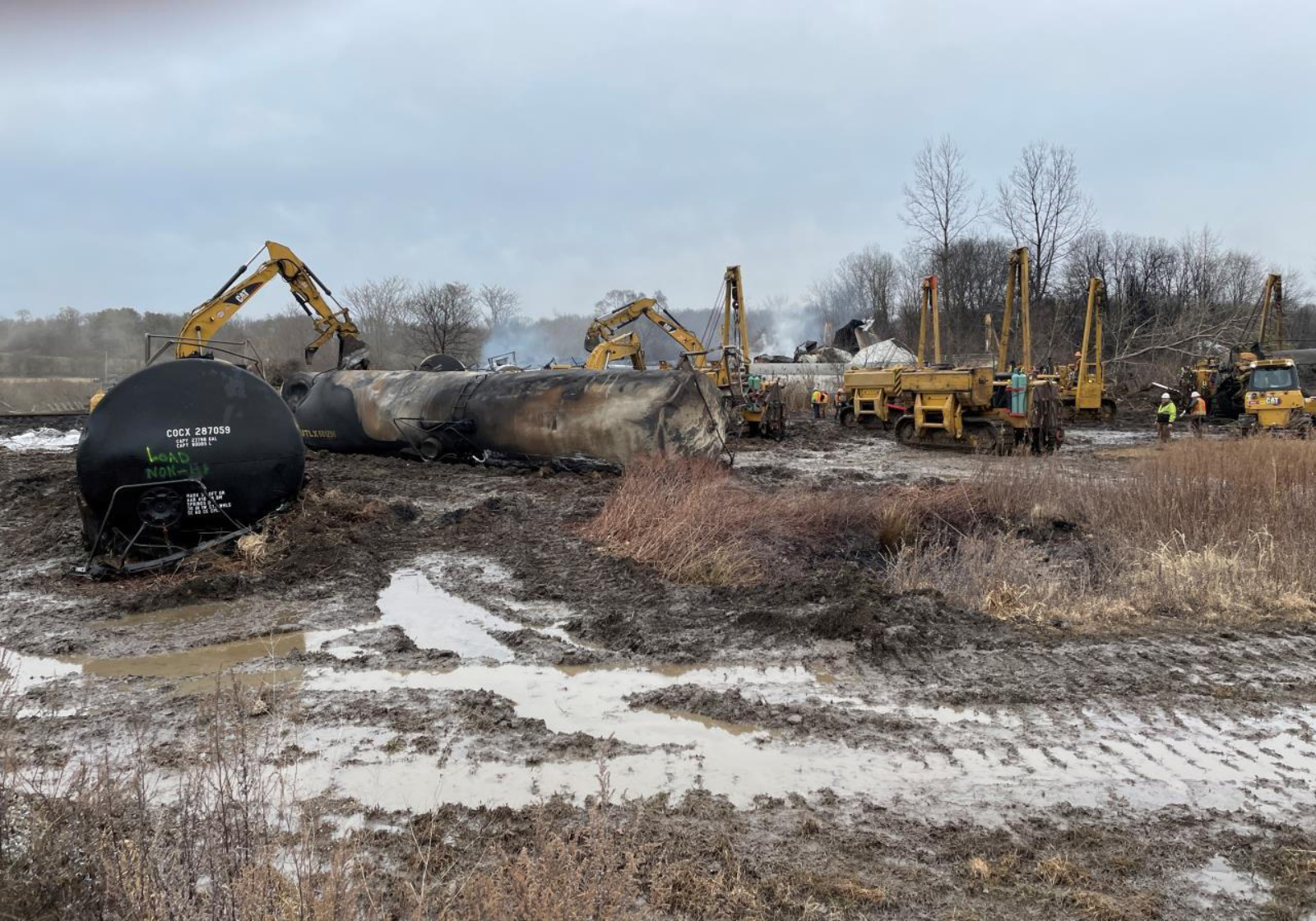
When Laderer’s team arrived, alongside the fire departments from roughly 80 other towns across Pennsylvania, Ohio, and West Virginia, they found 38 cars of a 150-car train splayed along the tracks, with some emitting flames that smelled, as Laderer described it, of burning plastic. They would learn in the days that followed that 11 cars contained hazardous chemicals, including the highly toxic compounds vinyl chloride and butyl acrylate, which are used in the manufacturing of common plastics.
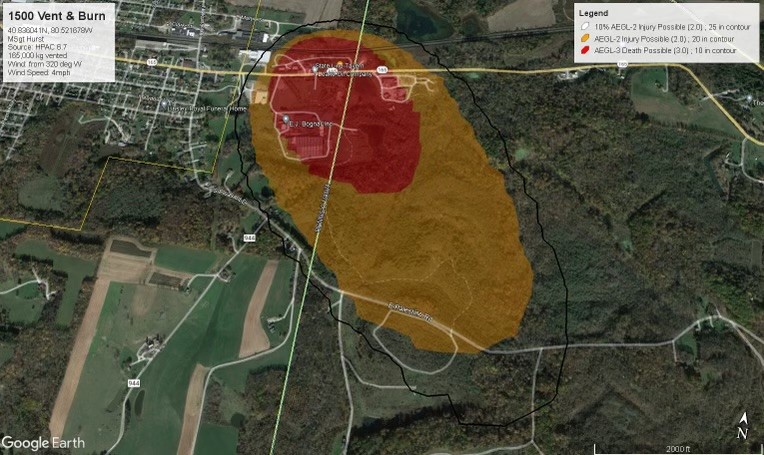
A map from the Ohio Governor’s Office shows the train derailment’s chemical evacuation area — a roughly one-mile by two-mile area surrounding East Palestine — that includes parts of both Ohio and Pennsylvania.
Ohio Office of the Governor
By Monday, three days after the February 3 derailment, the Norfolk Southern railroad company had sent in their own officials and contractors to perform a controlled burn-off of the vinyl chloride. The tactic was meant to prevent, as much as possible, more than 100,000 gallons of vinyl chloride from evaporating into the air and seeping into the soil and creek beds surrounding the train, although an as-yet-unknown quantity of it already had. (“Either we were going to blow it up, or it blows up itself,” Trent Conaway, the mayor of East Palestine, explained at a town hall the next week by way of illustrating a frustrating lack of options.)
But the burn didn’t go quite as planned. A towering, bulbous cloud of black smoke erupted from the train in the explosion and then spread over the surrounding area like a pool of oil, where it hung in the low atmosphere for hours and hours. Experts have attributed the smoke’s stubborn refusal to dissipate to a weather phenomenon called an inversion, where warm air that rises into the atmosphere after a sunny day traps the cold air coming off the ground as night falls. “The smoke that was supposed to stay up started banking down a bit on the area,” Laderer explained.
A plume of smoke hovers over a line of trucks near the East Palestine train derailment. Jason Blinkiewicz
Jeremy Woods, a mechanic for the Darlington-based trucking company and repair shop Lync, described the scent that permeated the air all of Monday night as that of charred PVC pipe, but with a hint of chlorine that reminded him of the YMCA pool. Trisha Blinkiewicz, whose home sits about 4 miles east of the derailment, went to dinner in nearby Chippewa, Pennsylvania, on that same Monday evening. She found the town buried in a low-lying fog that felt thick on the skin, with a distinct, abrasive smell of burnt plastic.
The train that crashed in East Palestine derailed about 20 miles northeast of its destination of Conway, Pennsylvania, one of the industrial towns and small cities that line the Ohio River as it flows west from its mouth in Pittsburgh. The Upper Ohio River Valley — which stretches, roughly speaking, from that mouth down to where West Virginia meets the tip of Kentucky — has been the site of proliferating petrochemical development over the past decade, as oil and gas companies turn their attention away from fuel and toward a much richer prospect: plastics.
Ethane gas fracked from the Marcellus Shale, which extends across Pennsylvania into the eastern edge of Ohio and northern West Virginia, can be “cracked” into ethylene, a flammable gas critical to the production of plastics used for packaging, bottles, and electrical insulation, among other products. And all of the infrastructure that is required for every step of plastic production and transport — wells, pipelines, refineries, ports, plants — has spread like a spider’s web over the region.
The accelerating petrochemical development is simply the newest incarnation of industrial exploitation for a region that has been plagued by legacy pollution since the dawn of the Industrial Revolution. The pressing question is whether the people who have lived here for generations have hit their breaking point, and whether they feel empowered to demand more from the corporations that threaten their homes and the politicians that enable them.
“Honestly, I never expected this big an incident to happen in my entire life, let alone my first month as fire chief,” said Laderer. “And Norfolk Southern are not telling us a lot, and they’ve got me questioning things.”
The unique Appalachian topography of the greater Ohio Valley tends to fortify the pollution created within it, as if the geology that had endowed the region with such bountiful fossil fuel and mineral reserves also cursed it to suffer more for them. Major industrial facilities and railroad hubs are usually established on the river, for ease of both transportation and waste disposal, and the emissions that they produce get trapped by the steep hillsides that frame the tributaries.
Many houses in the rural community of Enon Valley, Pennsylvania sit just a few feet from the railroad tracks.
Grist / Eve Andrews
Many houses in the rural community of Enon Valley, Pennsylvania sit just a few feet from the railroad tracks. Grist / Eve Andrews
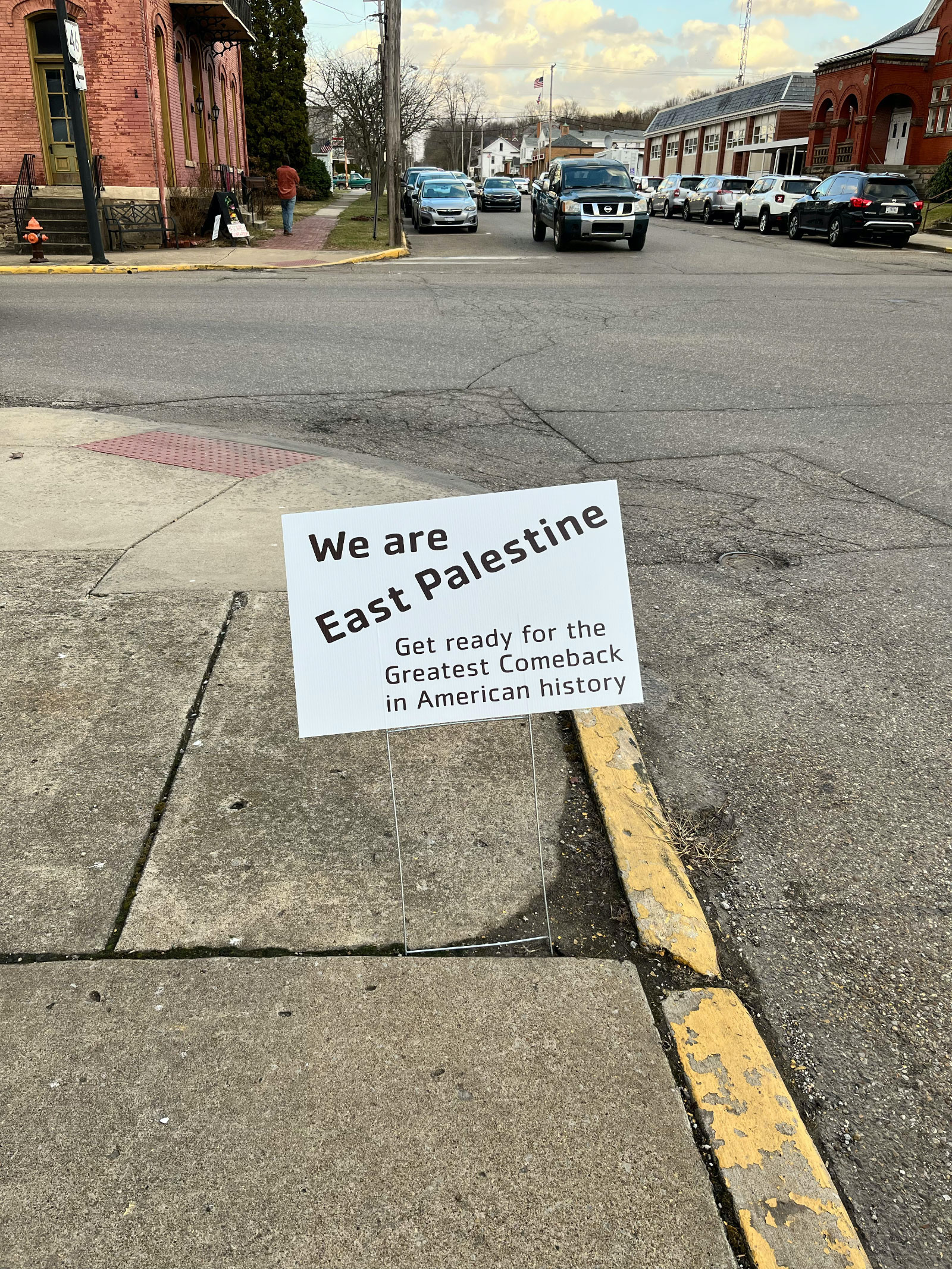
A sign on Market Street in East Palestine.
Grist / Eve Andrews
Left: A decommissioned train sits behind the Greersburg Tavern in Darlington, Pennsylvania. Right: A sign in East Palestine, Ohio, expresses hope for the future. Grist / Eve Andrews
A decommissioned train sits behind the Greersburg Tavern in Darlington, Pennsylvania.
Grist / Eve Andrews
The Shell cracker plant, which began operations in the fall of 2022, is a sprawling behemoth on the edge of the Ohio River in Monaca, Pennsylvania, directly across the river from the derailed train’s destination in Conway. The plant, which is widely considered to be a grim arbiter of future petrochemical development in the region, takes locally fracked gas and breaks it down at a molecular level to manufacture the ethylene “nurdles” — translucent plastic pellets the size of a grain of arborio rice — that make up many household and single-use plastics.
Residents of eastern Beaver County, which is quite rural, say that they have not personally felt the adverse effects of the Shell plant. They do not smell chemicals in the air or see nurdles floating in the creeks near their homes, unlike those who live downstream of the plant. They are more or less protected by the same topography that traps pollution around the facilities that create it, with a buffer of hills and hollers that rise and fall between their communities and the plant itself. But the derailment in East Palestine on February 3 brought the more disastrous consequences of plastic production far closer to home.
The Shell Pennsylvania Petrochemicals Complex, also known as the cracker plant, in Monaca, Pennsylvania.
Grist / Eve Andrews
Ron Stidmon moved from New York City to Enon Valley, Pennsylvania, in 2003, seeking stillness and solitude after having lost several friends in the 9/11 attacks. Enon Valley, which sits a few miles northeast of East Palestine on the border between Beaver and Lawrence counties, is secluded and quiet, dotted with both Amish farms and sprawling properties. Stidmon bought a farm, unsuccessfully tried to make a lot of different crops work, and finally cracked the code of profitability with garlic. He has steadfastly committed to organic practices on his land for 20 years, to the extent where he grumbles when a neighbor burns a tire on an adjacent property.
When Norfolk Southern performed the controlled burn-off of vinyl chloride on February 6, Stidmon recalled, “it looked like the end of the world with the smoke coming up.” He’s now watching the wells and ponds on his property daily, with no other option than to simply wait for testing to learn if carcinogenic chemicals from the derailment have leached into the aquifer. He’s optimistic that his water supply will be spared of contamination, simply because he’s upstream of the crash.
“If we were a mile or so west, it would be completely different. If the winds had been blowing a different direction, it would have been different,” he said. “It’s a matter of luck — has nothing to do with having a plan, or setting up that we’re safe.”
Ron Stidmon, a garlic farmer in Enon Valley, Pennsylvania, expressed concern that his land — which has been farmed organically for 50 years — may now be contaminated with carcinogenic chemicals from the derailment.
Grist / Eve Andrews
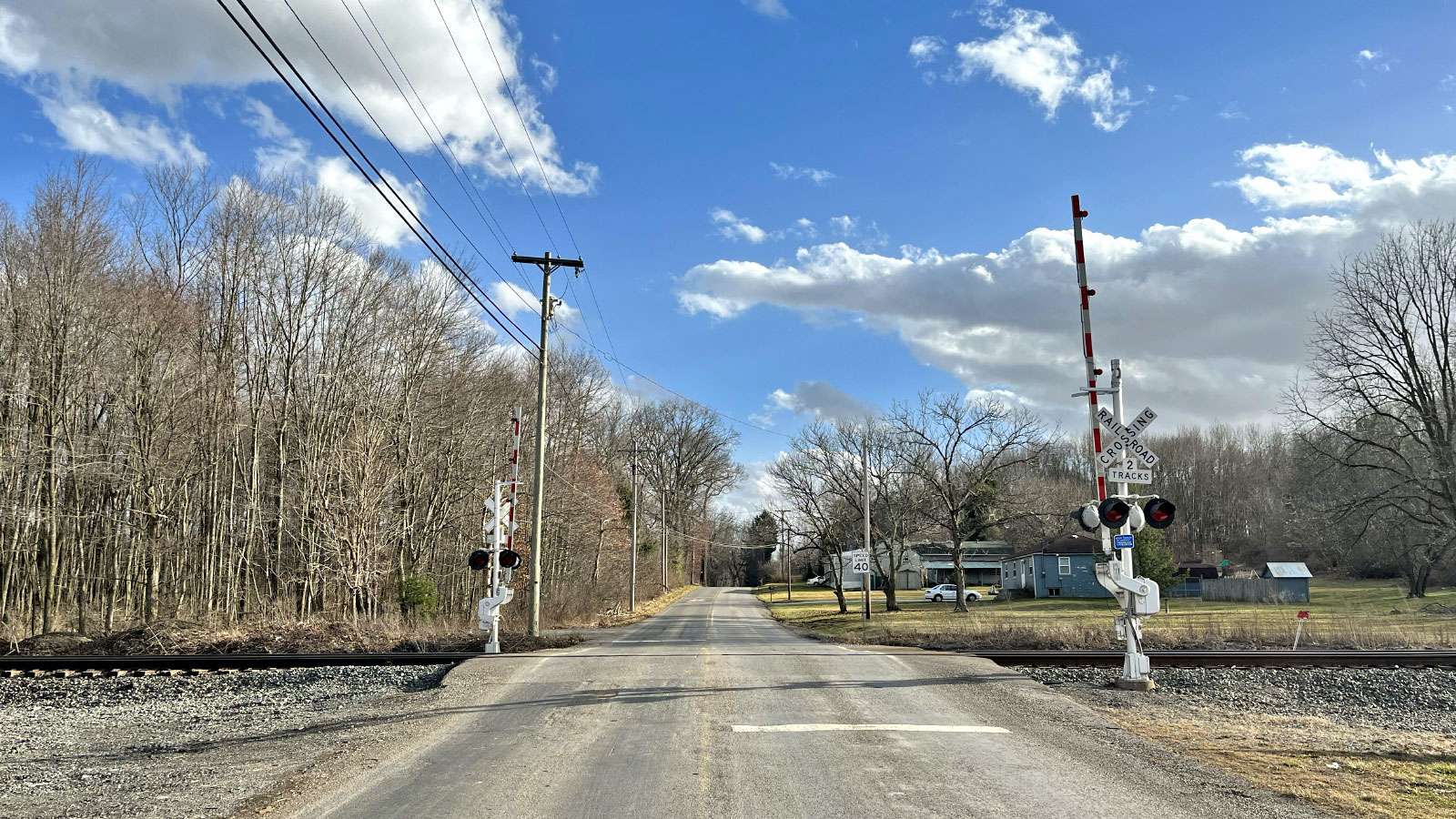
Stidmon had been anticipating a disaster like this for years. In 2016, he was on the Darlington Township’s Board of Supervisors, where he began to raise the issue of railroad safety. He was concerned by the sheer volume and frequency of trains routed along the track that wraps around Darlington, running north through the village of New Galilee, east across Enon Valley, and over the state border into East Palestine. According to Stidmon, he spent a year trying to get Norfolk Southern to simply provide the number of trains that came through in a day. When months went by and the company never answered, he and a few neighbors got together to stay up for 24-hour shifts, watch the tracks, and count. The figure at which they arrived was 60.
“[Norfolk Southern] won’t do anything to address the people’s concerns to address legitimate problems. They have such a cavalier attitude: ‘This is our track, our business.’ It’s discomfiting to know that anything can happen, with practically no repercussions,” said Stidmon. “You can live your own life as clean as you want, but these guys can destroy everything you’ve done to keep it clean for yourself.”
Jason Blinkiewicz owns the trucking company and repair shop Lync, which is located a little over a mile from the derailment. He lives in Enon Valley, where the railroad runs right in front of his house. (On the night of February 3, he and his wife Trisha found that the engine of the train that had crashed had “cut and boogied” to come sit on the tracks in their front yard.) He, like most of his neighbors and employees, doesn’t trust Norfolk Southern and assurances from the Environmental Protection Agency that the air and water have been safe to breathe and drink. The borough of Enon Valley commissioned independent testing of wells and streams, and the community is awaiting results.
From left to right: Luke Marecec, Bob Vogel, Jeremy Woods, and Jason Blinkiewicz all work for LYNC Trucking, which is less than a mile from the derailment site. Their homes are all within five miles of the derailment.
Grist / Eve Andrews
“It’s normalized to some degree because there’s already low air quality in the area,” Blinkiewicz said . “The cracker plant is putting out volatile organic compounds, or what’s the nuclear power plant doing, or how about the coal plant right behind it that they shut down not that long ago? What about the mills in Midland and the steel plant in Koppel?”
But all of those facilities are far enough from Blinkiewicz’s home and workplace that he hasn’t felt their impacts nearly as acutely as those of the derailment. “I think it’s the first time, in my 46 years on this planet, in this area, that it gives you an uneasy feeling about everything,” he said.
“And as much as it pains me to say, my trust has to lie in our government. Which is hard to do, right? But we have to rely on those government agencies to protect us. That’s what they’re there for.”
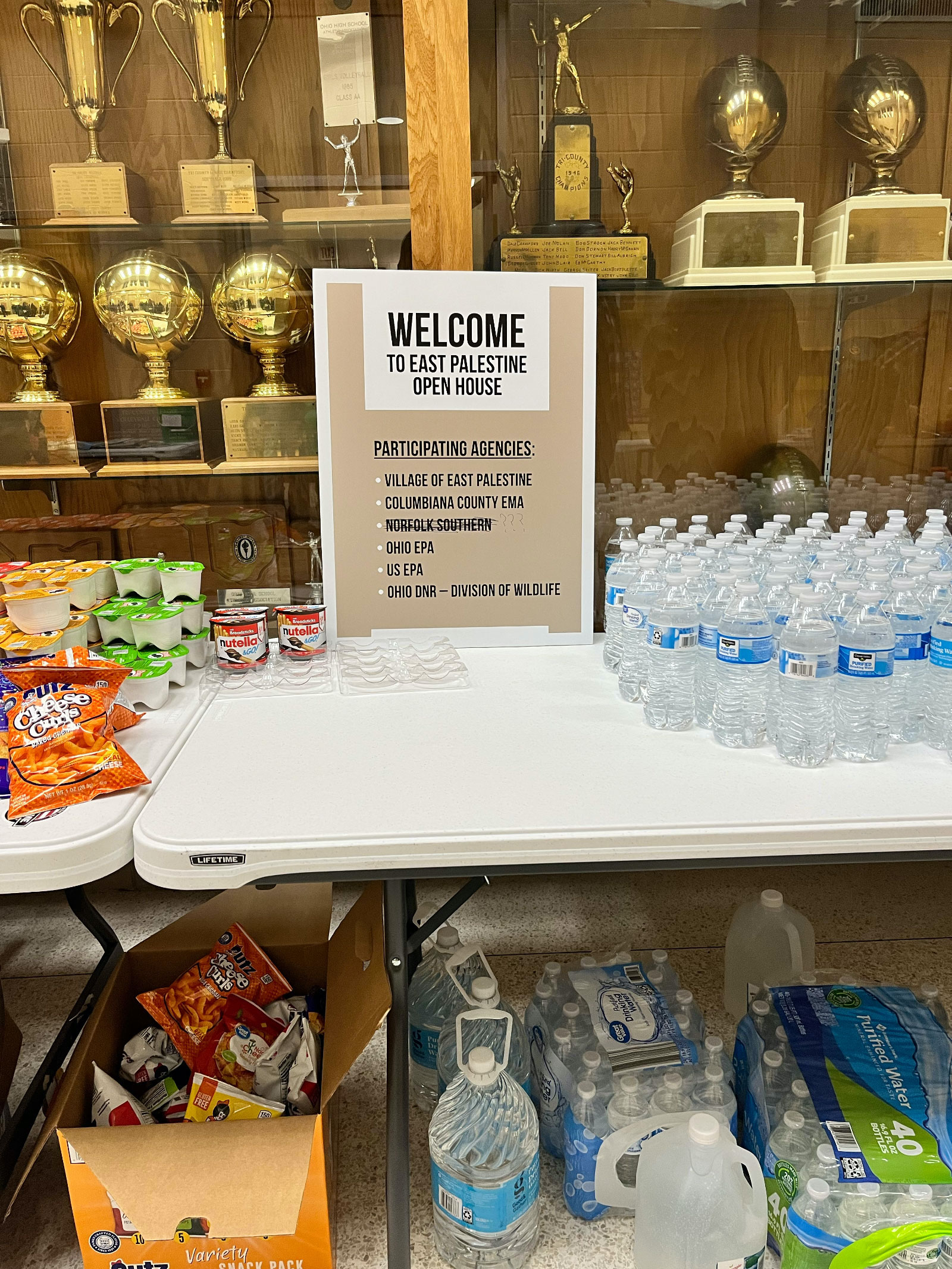
On the night of February 15, East Palestine hosted a town hall at the local high school for residents to ask questions of both state and federal EPA officials. (Representatives from Norfolk Southern pulled out hours before the meeting due to “the growing physical threat” to their employees’ safety. Those threats have not been substantiated.) Volunteers with the East Liverpool, Ohio-based community group River Valley Organizing, were standing outside of the high school’s front door passing out flyers for the group’s own town hall to take place the following week.
Amanda Kiger, director of the group, is familiar with the pervasive distrust of government, regardless of political orientation, in the Ohio Valley region. It is hard to have faith in one’s representatives with a centuries-long legacy of politicians whose loyalties have been bought by industry.
Amanda Kiger, director of River Valley Organizing, addresses the crowd at a packed town hall in East Palestine on February 23, 2023. Grist / Eve Andrews
“Historical pollution has been just layered on this region for so long,” Kiger said several days later in an interview. Stoneware potteries, coal mines, and steel mills mostly died off to be replaced by refineries, hazardous waste incinerators, unconventional gas wells, and petrochemical facilities. “And when you look at communities that are environmentally devastated, bad and polluting commerce attracts more bad and polluting commerce. They can go: ‘We didn’t do that, they did that, that’s been there for years.’”
Two days before the town meeting, a week after the black cloud of burning vinyl chloride spread over East Palestine and its neighboring towns, residents around the Shell cracker plant about 20 miles southeast started to post reports of a large flame emitting from it.
The flame was evidence of a “flare,” which is a mechanism meant to regulate malfunctioning of the plant’s machinery by expelling excess hydrocarbons into the air. This flaring, while preventing a more disastrous outcome for the plant and its surroundings, pumps volatile organic compounds (VOCs) into the atmosphere. In just a few short months since being operational, Shell has already exceeded its annual allowance of VOC emissions as permitted under the Clean Air Act and the Pennsylvania Air Pollution Control Act. That’s in spite of the fact that the facility has the second-highest permit for VOC emissions in the state. In fact, the environmental organizations Clean Air Council and Environmental Integrity Project intend to sue Shell for the plant’s early violations.
Due to bureaucratic delays from both Shell (which is required to notify the community of flaring activity) and the Pennsylvania Department of Environmental Protection, it can sometimes take as long as a month for residents of Monaca and the surrounding towns to learn that a plant malfunction happened. But the resident groups Beaver County Marcellus Awareness Community (BCMAC) and Eyes on Shell have asked local “watchdogs” to post whether they’ve observed a flare or felt changes in the scent or feel of the air around the plant.
Anaïs Peterson, a volunteer with Eyes on Shell, notes that in the months prior to the Shell plant’s official opening in November, the group of concerned citizens that she helped convene would see about 40 attendees at their monthly meetings. By January of this year, several months and multiple flaring events into the plant’s operations, that number had tripled.
“Sometimes the bad things that happen in the community are the moments you can bring folks together,” said Kiger. “And it takes the community coming together to push back on federal and state legislators.
“But am I really sick and tired that my community is the casualty, and we have to be the message-bringers? Absolutely. It’s getting overwhelming.”
On the evening of February 23, dozens of residents from within several miles’ radius of East Palestine crowded into a small storefront on the town’s commercial thoroughfare for River Valley Organizing’s town hall event, spilling out of the main room into the lobby and kitchen. A panel of independent experts in environmental cleanup and hazardous chemicals answered questions from the community. The atmosphere darkened as those in the room processed new information: that the EPA had not been testing air, water, or soil samples for dioxins, potential toxic byproducts of the vinyl chloride explosion that can persist in land and sediment for decades without proper cleanup.
A sign at an East Palestine Town Hall on February 15, 2023, after Norfolk Southern pulled out of the event.
Grist / Eve Andrews
As the evening went on, the questions grew more distressed: When I go home tonight, what is the first thing I can do to make sure the air is clean for my children to breathe? How can I protect my livestock and pets that roam land that might be contaminated with dioxins? Is my home ruined forever? And, above all: How do we make sure Norfolk Southern sees justice for what they’ve done to us?
“You would have tripped over your own shoes without a flashlight, the smoke was so thick — like being in a cave,” said one resident of New Springfield, Ohio, a few miles northwest of the derailment, who expressed concern to the experts assembled that he couldn’t safely grow produce and raise livestock on the land that had been contaminated by that smoke. “We’ve been pretty self-sufficient, and now we’re zero self-sufficient. What do you pay property taxes on 40 acres for if you can’t grow a tomato?”
One of the great, enduring appeals of rural American life is the dream of complete independence. You buy property, build a homestead, grow food, raise your family. Your children play in the creek in the summer and ride sleds down sloping white hills in the winter. But when one powerful corporation’s mishap puts all of that at risk, it becomes clear that a so-called independent existence is only protected through the strength of community.
“I don’t care if you’re red or blue, I don’t care if I beat you up in the bar 10 years ago,” said Jamie Cozza, an organizer for River Valley Organizing and lifelong resident of East Palestine, before urging those gathered to contact every elected official in the region. “We need to come together right now and use our voices, because no one else is going to fight for us.”
This story was originally published by Grist with the headline In a growing petrochemical hub, the East Palestine derailment triggers ‘an uneasy feeling’ on Mar 1, 2023.