If you're serious about the environment, we all know that planting trees is one of the most effective measures, and tree removal should be a last resort. We at Pensacola Tree Services are dedicated to offering the best for your home as well as the environment, therefore we're committed to delivering it by making it as simple as possible. For responsible tree removal visit us here https://www.linkedin.com/in/TreeRemovalPensacola/
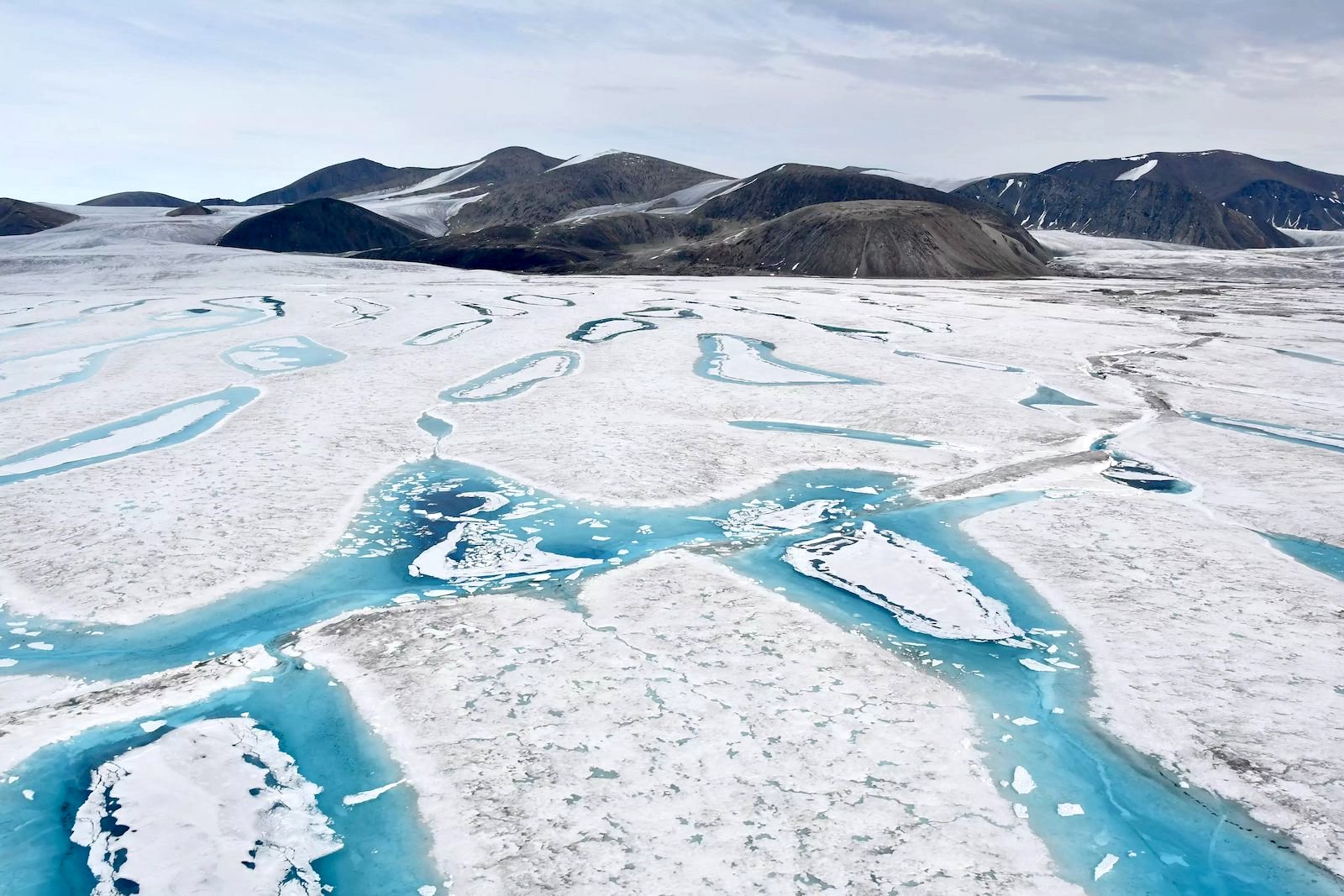
Last July, glaciologist Derek Mueller made his fourteenth annual quest to gather samples from Milne Fjord, a research station on the coastal margin of the “Last Ice Area”— a 400,000-square-mile region north of Greenland and the Canadian Arctic Archipelago. The facility sits about 500 miles from the North Pole, nestled between tremendous ice flows. The landscape is rich with harsh beauty: Melt ponds, underlined by glistening ice, rest between white hillocks. Contrasted against the vivid white ice and dark, churning sea, each pool glows with its own crystal-blue light.
Mueller’s work had focused on Milne Fjord’s only known epishelf lake — a microbially rich ecosystem that arises when an ice shelf creates a dam, allowing a thin layer of freshwater to float above seawater connected to the open ocean. As with the rest of the Arctic, they are threatened by climate change. But there was reason to hope for Milne Fjord: For years, scientists believed this area, home to the oldest and thickest ice in the northern hemisphere, would survive the worst effects of global warming .
Meltwater lakes, as seen during a 2018 research trip with Derek Mueller’s team
Jérémie Bonneau
But as Mueller and his team approached their old testing grounds, they could tell something was amiss. Where there had once been fingers of turquoise, there was now only the vivid white of ice and the ghostly remnants of melt water.
Milne Fjord’s epishelf lake had all but disappeared.
“It’s a mixed bag of emotions,” said Mueller. “There’s the scientific curiosity of measuring a changing system, but at the same time it’s a feeling of great loss.”
The Arctic is no stranger to depletion, warming at a rate nearly four times faster than the rest of the planet. It’s widely known that as glaciers calve and collapse, ice-dependent habitats and the wildlife that depend on them will continue to disappear. But while famished polar bears, retreating ice, and ancient viruses tend to drive headlines about Arctic thaw, the slow but steady thaw of the Last Ice Area places scientists on a new level of alert.
Not only does its disappearance sound an unexpected warning bell for climate change and the carbon cycle, it also means there may be little time left to learn from the Arctic’s unique ecosystems — before they disappear.
The Last Ice Area was once so frozen and hostile it stymied those who sought to traverse it. In the summer 1875, British explorer Albert Hastings Markham wrote of Milne Fjord:
A charming day, although the temperature persists in remaining minus 30 degrees [C]. Glare from the sun has been very oppressive; the snow in places resembles coarse sand, and appears more crystallized than usual. A few of the party, including Parr and myself, suffering from snow-blindness. Distance marched ten miles…a great expanse of hummocks varying in height from twenty feet to small round nobly pieces over which we stagger and fall…There is no chance at present to get out, as the ice pack is too thick.
A painting by Admiral Richard Brydges Beechey titled “Captain Markham’s most northerly encampment” shows the 1875 Royal Naval North Pole expedition on Ellesmere Island. National Maritime Museum, Greenwich, London
The ice shelf was so rugged, in fact, that the team was forced to turn back. But, nearly 148 years later, the Arctic bears little resemblance to that description. According to NASA, the extent of summer sea ice — the area in which satellite sensors show to be at least 15 percent covered in frozen water — is shrinking by more than 12 percent per decade.
Satellite observations have shown that between 1997 and 2017 alone, the region lost around 31 trillion tons of ice. Even if we do manage to limit global warming to the goal of 1.5 degrees C (2.7 degrees F), a recent study predicted the Earth would still lose a quarter of its glacier mass.
This image from NASA Terra spacecraft shows Ellesmere Island, which is part of the Qikiqtaaluk Region of the Canadian territory of Nunavut, which includes the most northerly point of land in Canada.
NASA / GSFC / METI/ERSDAC / JAROS, US / Japan ASTER Science Team
There are myriad reasons why the Arctic is warming so quickly (a phenomenon scientists often refer to as Arctic amplification), but a leading culprit is sea ice melt. The Arctic’s sea ice, typically 3 to 15 feet thick, freezes during winter and melts each summer. The white, snow-covered sheets reflect roughly 85 percent of incoming solar radiation back out to space. The open ocean, on which the ice floats, is so dark that it absorbs 90 percent of it.
As the region’s sea ice melts, solar absorption rates create a positive feedback loop: The warmer the ocean, the less ice. The less ice, the more heat is absorbed. The more heat, the warmer the ocean.
Even accounting for this cycle, most climate models predicted the Last Ice Area would remain relatively frozen, acting as a seasonal stronghold for ice-dependent animals. In the summer ice flows from continental ice shelves near Siberia tend to pile up in the area, forming frozen ridges more than 30 feet high.
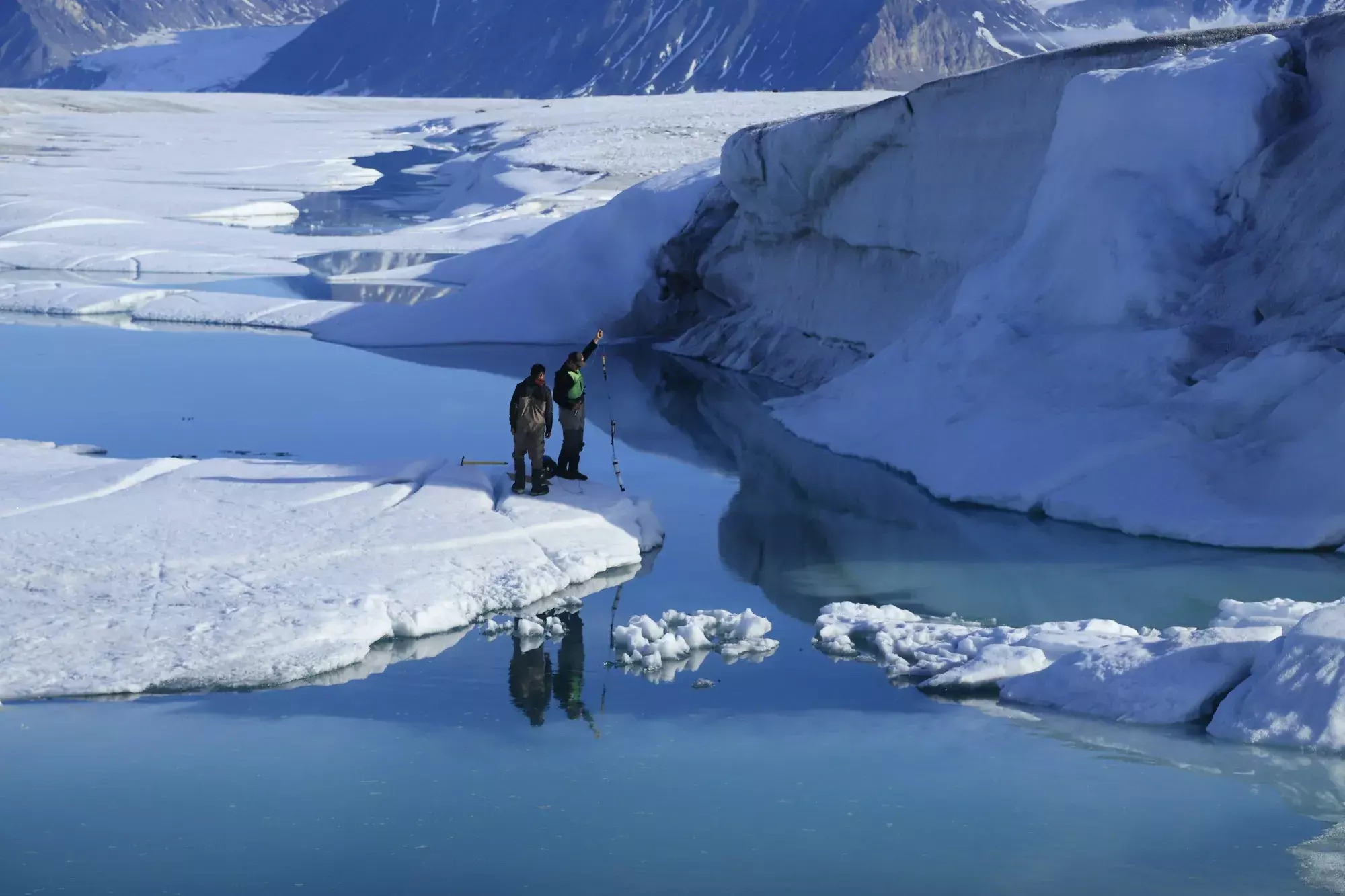
Researchers Joseph Shoapik and Jérémie Bonneau, both members of Derek mueller’s team, measure the temperature and salinity of the water in the rift in the ice shelf.
Cameron Fitzpatrick
But it seems Milne Fjord’s thick ice isn’t enough to shield it from the current pace of warming. “The glaciers melting are bringing freshwater down, adding heat into the fjord and the epishelf lake,” Mueller said. “Having weaker ice in the fjord would mean that the glacier could advance faster, thin out faster, and break up faster. ”
While it’s too early to determine the exact cause behind the disappearance of Milne Fjord’s epishelf lake, Mueller thinks that drainage may be attributed to the Milne Ice Shelf breaking apart two years ago. In 2002, scientists observed a similar phenomenon when the Ward Hunt ice shelf broke off, causing the Disraeli Djord Epishelf Lake to drain away.
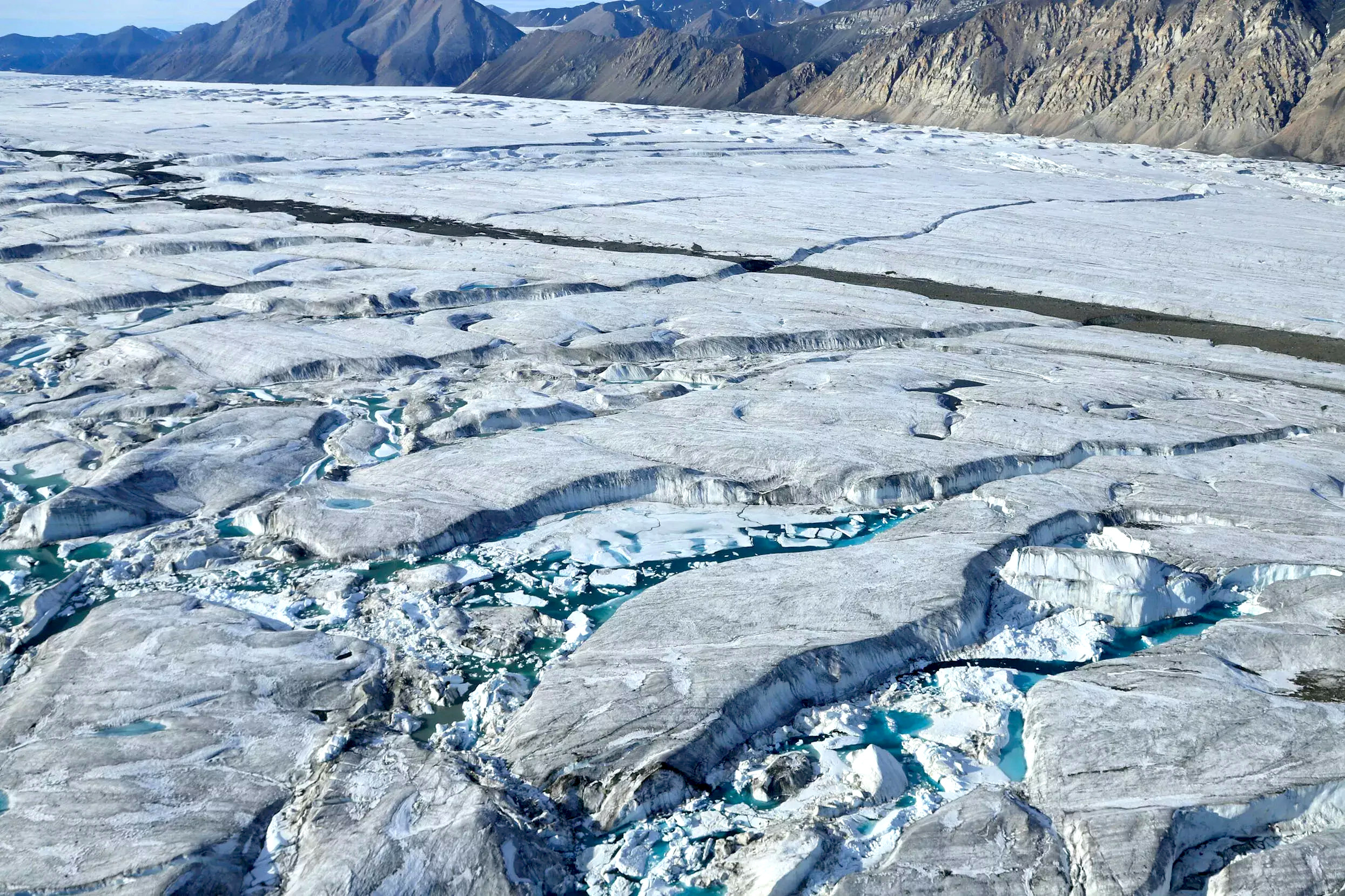
Ice shards float near the large rift formed in the Milne Ice Shelf following the 2020 calving event.
Cameron Fitzpatrick
“We’re really seeing the last death row of these epishelf lakes,” he said. “There aren’t any others in Canada as far as we know.”
It’s not just epishelf lakes that are disappearing from the Far North. Researchers sometimes refer to Arctic lakes as “sentinels,” due to their swift responses to shifting conditions. “Lakes are more sensitive than other ecosystems to climate change,” said environmental microbiologist Mary Thaler, who felt compelled to study the Arctic’s ecosystems because of the dwindling time they might remain in existence. “They’re like the warning bell going off, the first ones to take the hit, and we see them being utterly transformed.”
According to a 2022 study, lakes constitute almost 40 percent of the Arctic lowlands, the largest surface water fraction of any terrestrial biome. In addition to providing crucial habitat for high Arctic wildlife, marine species, and migratory birds, they are a critical source of freshwater for Indigenous communities such as the Komi and Nenets.
The rapid disappearance of these essential bodies of water has surprised some researchers. Scientists once predicted that climate change would initially expand them across the tundra. Although they knew drainage might eventually occur, it wasn’t expected for a few hundred more years. But it seems that the thawing of underlying permafrost, the frozen mixture of soil and organic matter that blankets the far north, is counteracting the expansion effect.
Permafrost is an important form of long-term storage for carbon — holding nearly twice as much as currently found in the atmosphere. But that ability depends on permafrost remaining frozen. As the ground thaws, plants or animals buried within can resume decomposing, releasing greenhouse gases into the atmosphere. Permafrost, particularly the layers under Arctic lakes, can also contain a particularly high number of frozen microbes, which help facilitate the release of gases. While a few scientists have expressed concerns over the re-release of prehistoric diseases and pathogens, most researchers say the real worry has to do with climate feedback loops.
“The important part is that it is a very large reservoir of carbon that we don’t want moved into the atmosphere,” said Arctic ecologist Elizabeth Webb.
Webb’s research has largely focused on why Arctic lakes are disappearing far more quickly than expected. She found that the decreases in surface water over the last 20 years have been correlated with two distinct climate variables. The first, not surprisingly, is increasing temperatures. The second and far more puzzling factor to researchers is the climate-driven increase in rainfall.
It may seem counterintuitive that more rain could lead to fewer lakes. “We were like, why in what world does this make sense?” Webb said. But because autumnal rain is warmer than the frozen ground, it brings a whole lot of heat to the underlying permafrost. That warmth can open up underground channels that drain surface water.
“This drying of lakes was expected,” says Webb, “but it’s happening way earlier than the models projected.”
Floating ice breaks away from the Milne Glacier as it thins out and starts to float at the head of the fjord. Cameron Fitzpatrick
But time is short to figure out what it all means for the Arctic and beyond. Researchers in the area lost two years of fieldwork due to the COVID-19 pandemic, and many projects were further delayed by the proposal backlog for expedition funding. Even the unpredictable Arctic weather can turn against scientists, with certain expeditions requiring clear skies in order for helicopters to take scientists to key sample sites. Mueller remembers an expedition where fog and rain delayed his team’s arrival by 10 days “By the time we actually got there, we basically got the bare minimum of what we needed done,” he said.
For those lucky enough to have procured samples from the disappearing ecosystems of the Arctic, those materials have taken on a new significance.
In Quebec City, Thaler analyzes small amounts of freshwater drawn during a 2016 excursion to Milne Fjord’s epishelf lake. The lake is no more, but the samples teem with life. Thaler goes through each one, trapping bacteria, viruses, and other microbial DNA in filters.
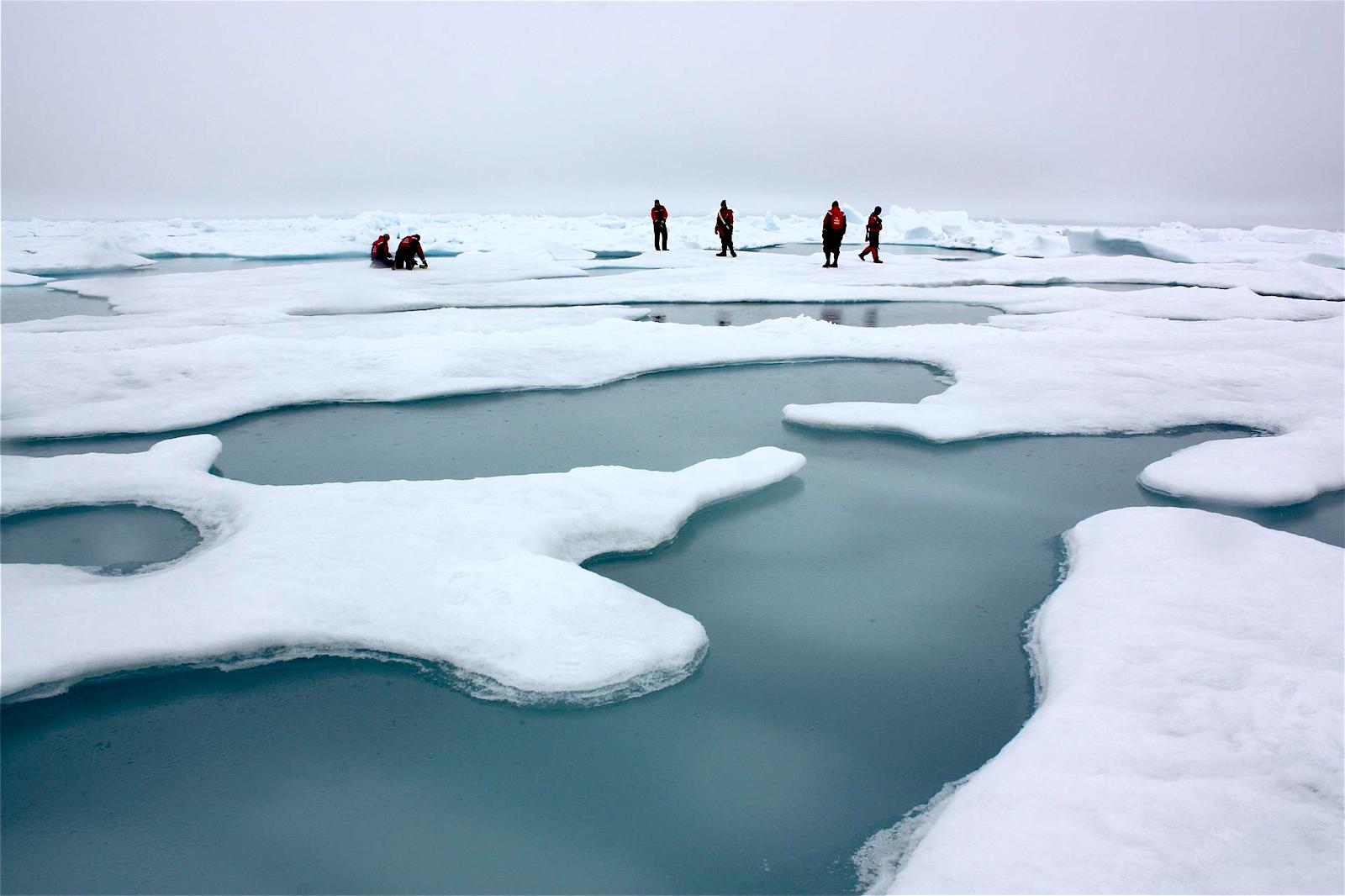
A team of scientists gather samples from Arctic sea ice and melt ponds in 2011.
NASA / Kathryn Hansen
“We had looked at other parts of the Milne Epishelf Lake’s ecosystem but never the viruses,” she said. “Because it’s so dark, cold, and poor in nutrients, most of what’s in the lake is tiny microscopic life — so viruses can make huge differences in which species are going to thrive.
Thaler and her team found that in terms of viruses, the lake had been 25 percent more abundant and diverse compared to the marine layer beneath.
“Everything that is going on in terms of photosynthesis, respiration, and releasing carbon is actually being driven by this microscopic community,” she said. “We wanted to know, are there species or genetic codes or different traits that are only found in this one lake? Now, anything that was unique or special about it has been lost forever.”
Much like the journal entries from 1875, the lake’s samples offer a glimpse into the ecosystems of the past – a historic snapshot of a bygone world. For his part, Mueller thinks back on his work at Milne Fjord with a feeling of apprehension and urgency — but also hope.
“It’s an environment that is stunningly beautiful and rather unique. It would be nice to fully characterize it and understand it before it’s lost forever,” he said. “There’s no local solution to any of this – it’s a global problem, so we need global changes to address this.”
This story was originally published by Grist with the headline The ‘Last Ice Area’ is already disappearing on Feb 10, 2023.
If you're serious about the environment, we all know that planting trees is one of the most effective measures, and tree removal should be a last resort. We at Pensacola Tree Services are dedicated to offering the best for your home as well as the environment, therefore we're committed to delivering it by making it as simple as possible. For responsible tree removal visit us here https://www.linkedin.com/in/TreeRemovalPensacola/
The morning of June 7, 2021, Sheriff’s Deputy Chuck Nelson of Beltrami County, Minnesota, bought water and refreshments, packed his gear, and prepared for what would be, in his own words, “a long day.” For over six months, Indigenous-led opponents of the Line 3 project had been participating in acts of civil disobedience to disrupt construction of the tar sands oil pipeline, arguing that it would pollute water, exacerbate the climate crisis, and violate treaties with the Anishinaabe people. Officers like Nelson were stuck in the middle of a conflict, sworn to protect the rights of both the pipeline company Enbridge and its opponents.
Nelson drove 30 minutes to Hubbard County, where he and officers from 14 different police and sheriff’s departments confronted around 500 protesters, known as water protectors, occupying a pipeline pump station. The deputy spent his day detaching people who had locked themselves to equipment as fire departments and ambulances stood by. A U.S. Customs and Border Protection helicopter swooped low, kicking dust over the demonstrators, and officers deployed a sound cannon known as a Long Range Acoustic Device in attempts to disperse the crowd.
By the end of the day, 186 people had been detained in the largest mass-arrest of the opposition movement. Some officers stuck around to process arrests, while others stopped for snacks at a gas station or ordered Chinese takeout before crashing at a nearby motel.
These latter details might be considered irrelevant, except for the fact that the police and emergency workers’ takeout, motel rooms, riot gear, gas, wages, and trainings were paid for by one side of the dispute — the fossil fuel company building the pipeline, which spent more than $79,000 on policing that day alone.
When the Minnesota Public Utilities Commission gave Enbridge permission in 2020 to replace its corroded Line 3 pipeline and double its capacity, it included an unusual condition in the permit: Enbridge would pay the police as they responded to the acts of civil disobedience that the project would surely spark. The pipeline company’s money would be funneled to law enforcement and other government agencies via a Public Safety Escrow Account managed by the state.
By the time construction finished in fall 2021, prosecutors had filed 967 criminal cases related to pipeline protests, and police had submitted hundreds of receipts and invoices to the Enbridge-funded escrow account, seeking reimbursement. Through a public records request, Grist and the Center for Media and Democracy have obtained and reviewed every one of those invoices, providing the most complete picture yet of the ways the pipeline company paid for the arrests of its opponents — and much more.
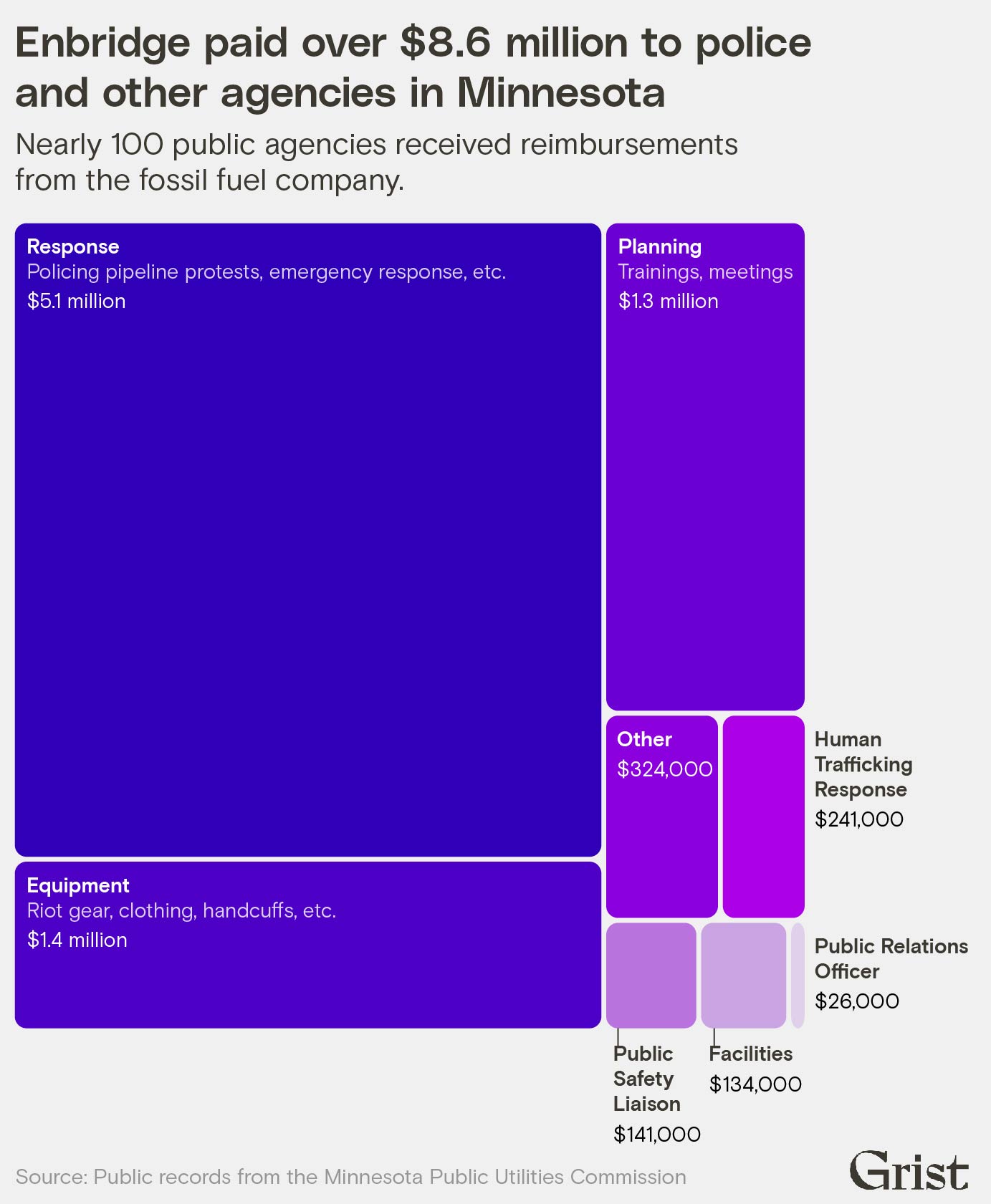
From pizza and “Pipeline Punch” energy drinks, to porta potties, riot suits, zip ties, and salaries, Enbridge poured a total of $8.6 million into 97 public agencies, from the northern Minnesota communities that the pipeline intersected to southern counties from which deputies traveled hours to help quell demonstrations.
By far the biggest set of expenses reimbursed from the Enbridge escrow account was over $5 million for wages, meals, lodging, mileage, and other contingencies as police and emergency workers responded to protests during construction. Over $1.3 million each went toward equipment and planning, including dozens of training sessions. Enbridge also reimbursed nearly a quarter million dollars for the cost of responding to pipeline-related human trafficking and sexual violence.
Grist / Jessie Blaeser
Reporters for Grist and the Center for Media and Democracy reviewed more than 350 records requested from the Minnesota Public Utilities Commission, pulling out totals described in invoices and receipts and dividing them into categories such as equipment, wages, and training. Each agency had its own method for tracking expenses, with varying levels of specificity. In cases where reporters were unable to cleanly disentangle different types of expenses, those expenses were categorized as “other/multiple.” Generally, totals should be considered conservative estimates for each category.
The $79,000 that Enbridge paid for the single day of arrests on June 7, which doesn’t include much of the Enbridge-funded equipment and training many officers relied on, displays the wide range of activities and agencies Enbridge’s money touched. The attorney’s office of Hubbard County, where the protest took place, even attempted to get Enbridge to reimburse $27,000 in prosecution expenses. In other words, the area’s top arbiter of justice assumed that Enbridge would be covering the cost of pursuing charges against hundreds of water protectors. (The state-appointed escrow account manager denied the request.)
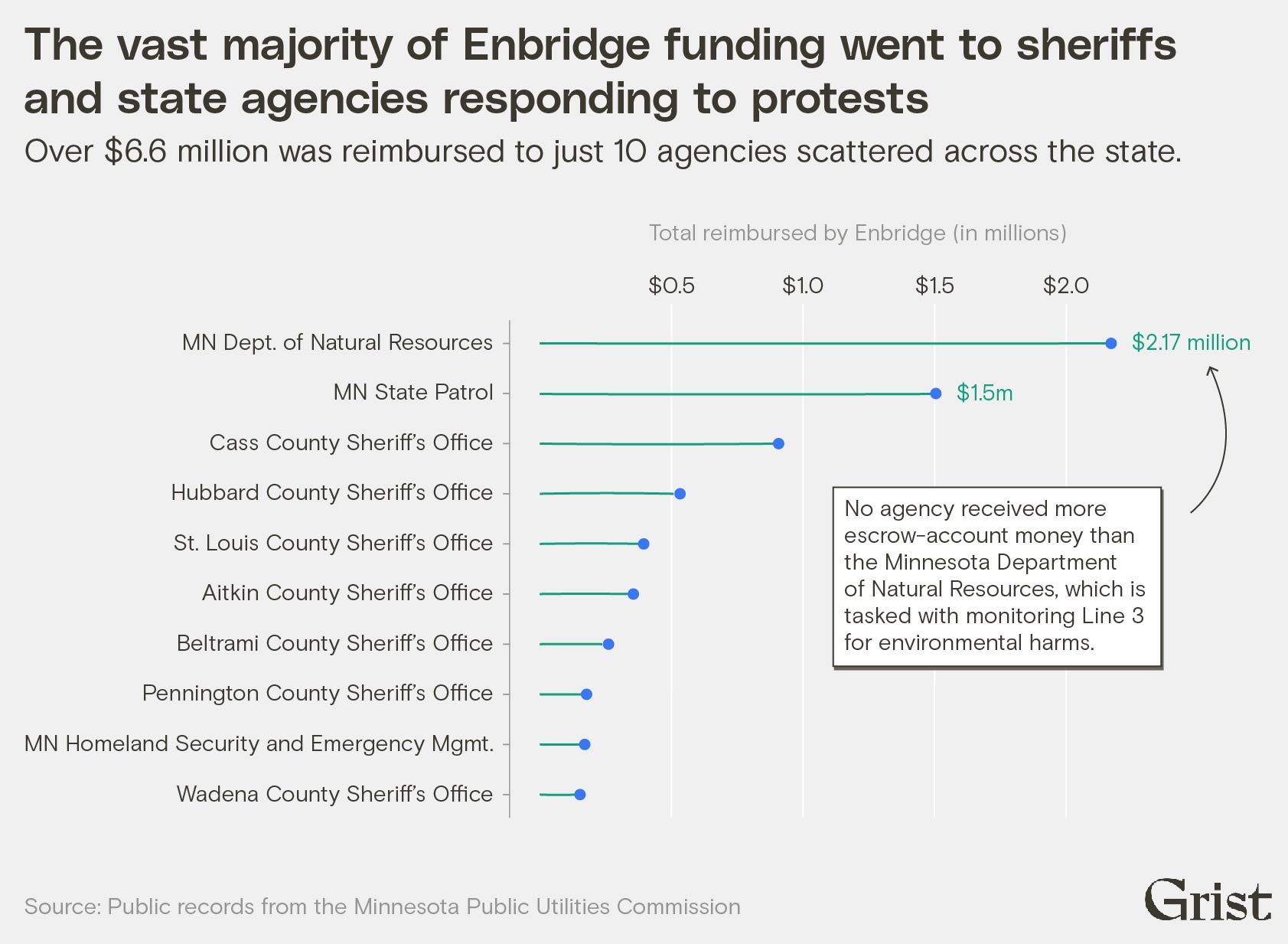
Some of the most surprising Enbridge invoices were from institutions and officials associated with protecting Minnesota’s environmental resources and preserving a balance between industry and the public interest. No agency received more escrow account money than the Minnesota Department of Natural Resources, or DNR, which is also one of the primary agencies monitoring Line 3 for environmental harms. Of the $2.1 million that the DNR received, the funds were mainly used to respond to protests and train state enforcement officers about how to wrangle protesters, in some cases before construction had even begun. Conservation officers joined police on the front lines of protests, on the pipeline company’s dime.
Grist / Jessie Blaeser
The Aitkin County-run Long Lake Conservation Center, one of the oldest environmental education centers in the U.S., provided facilities to police to the tune of over $40,000, which the sheriff’s office paid using Enbridge funds. And a public safety liaison hired to coordinate among Enbridge, the Public Utilities Commission, and local officials was paid $120,000 in salary and benefits by the pipeline company over a year and a half.
The invoices also document, in unusual detail, the connection between fossil fuel megaproject construction and violence against women: Enbridge reimbursed a nonprofit organization for the cost of hotel rooms for women who had reportedly been assaulted by Line 3 workers. The pipeline company also helped pay for two sex trafficking stings conducted by the Minnesota Human Trafficking Investigative Task Force, leading to the arrest of at least four Line 3 pipeline workers.
The state of Minnesota also considered police public relations to be expenses eligible for Enbridge funding. John Elder, at the time spokesperson for the Minneapolis Police Department, put out police press releases and responded to journalist queries on behalf of the Northern Lights Task Force, which was set up to coordinate emergency response agencies throughout the protests. Enbridge ultimately reimbursed the St. Louis County Sheriff’s Office for 331 hours of his work at a wage of $80 per hour. (St. Louis County Sheriff Gordon Ramsay said he was not in office during pipeline construction and could not comment on Line-3-related work, and Elder did not respond to requests for comment.)
A year earlier, Elder had handled Minneapolis police PR when one of the city’s officers killed George Floyd, sparking an unprecedented wave of nationwide protests. Elder was behind the notorious press release stating that Floyd had “physically resisted officers” and died after he “appeared to be suffering medical distress.” Hours later, a bystander video went viral, showing that the medical distress followed an officer pressing his knee on Floyd’s neck for more than nine minutes. Fallout from the press release did not stop law enforcement agencies from choosing Elder to lead officials’ public relations surrounding the Line 3 protests.
Water protectors contend that the state of Minnesota’s arrangement with Enbridge trampled their constitutional rights. With 97 criminal cases unresolved across the state, five defendants in Aitkin County are pursuing motions arguing that the escrow account created an unconstitutional police and prosecutor bias that violated their rights to due process and equal protection under the law. They want the charges dismissed. Attorneys with the Partnership for Civil Justice Fund’s Center for Protest Law and Litigation previously used the defense against charges filed by Hubbard County that were ultimately dismissed. They’re now preparing a separate civil lawsuit challenging the use of the escrow account on constitutional grounds.
Winona LaDuke, an Anishinaabe activist and founder of the Indigenous environmental nonprofit Honor the Earth, is among those arguing in court that charges should be thrown out. Aitkin County, the jurisdiction behind the allegations she’s fighting, was reimbursed $6,007.70 for wages and benefits on just one of the days she was arrested. LaDuke believes the money amped up the police response.
“They were far more aggressive with us, far more intent on finding any possible reason to stop somebody,” she said. “Law enforcement is supposed to protect and serve the people. They work for Enbridge.”
LaDuke added that she believes the DNR’s Enbridge money represents a “conflict of interest.” In addition to its role in monitoring the pipeline’s full Minnesota route, the agency is directly responsible for the ecological health of 35 miles of state lands and 66 waterways where Line 3 crosses — and where Anishinaabe people have distinct treaty rights to hunt, gather, and travel. To date, the DNR and the Minnesota Pollution Control Agency have charged Enbridge over $11 million in penalties for violations that include dozens of drilling fluid spills and three aquifer breaches that occurred during construction. LaDuke and others have criticized the agency’s response to the incidents, noting that it took months to publicly disclose the first of the aquifer breaches.
Juli Kellner, an Enbridge spokesperson, emphasized that the escrow account was operated by an independent manager who reported to the Public Utilities Commission, not the oil company. Kellner said the account was created to relieve communities from the increased financial burden that public safety agencies accrued when responding to protests.
“Enbridge provided funding but had no decision-making authority on reimbursement requests,” she said.
Ryan Barlow, the Public Utilities Commission’s general counsel, said the commission had no comment about the appropriateness of specific expenses: “If expenses met the conditions of the permit they were approved; if they did not, they were not approved.”
In a statement, the DNR said that receiving reimbursement from Enbridge does not constitute a conflict of interest: “At no time were state law enforcement personnel under the control or direction of Enbridge, and at no time did the opportunity for reimbursement for our public safety work in any way influence our regulatory decisions.”
When asked why its officers were trained how to use chemical weapons ahead of the protests, the DNR said their peace officers’ overall mission is “protecting Minnesota’s natural resources and the people who use them” and that such equipment, while occasionally necessary, “is not used as part of conservation officers’ routine work.”
Hubbard County Sheriff Cory Aukes said his agency’s response was dictated by the protestors and water protectors. “If they want to block roads, threaten workers, and cause $100,000 worth of damage to Enbridge equipment, well, we have a job to do, and we did it,” Aukes said, adding that Enbridge is a taxpayer that officers have a duty to protect. “Enbridge is a big taxpayer in Hubbard county and we would be doing an injustice if we didn’t support them as well.”
“We were in the middle,” added Aitkin County Sheriff Dan Guida. “There were probably times when it seems like we dealt with water protectors in a more criminal way, but they were the ones breaking the law.” He added that officers had no knowledge of the reimbursement plan and that the funds spared taxpayers the cost of policing the pipeline.
Long Lake Conservation Center manager Dave McMillan, on the other hand, said he knew the money the Aitkin County Sheriff’s Office paid his organization for police officer lodging would come from Enbridge. “My concern was not wanting to become a pawn or a player in this political battle. In the same token, we said if any of the organizations that were protesting said they wanted to come here and use our facilities, we would have said yes,” he said. Enbridge’s connection to the facility runs even deeper: The company’s director of tribal engagement sits on the board of the Long Lake Conservation Foundation, which helps fund the county-run facility.
With energy infrastructure fights brewing over liquid natural gas terminals in the Southeast, lithium mining in the West, and the Enbridge-operated Line 5 pipeline in Wisconsin and Michigan, the ongoing legal cases that have ensnared the water protectors will help decide whether or not the public safety escrow account will be replicated elsewhere.
“Our concern is that this now will become the model for deployment nationwide against any community that is rising up against corporate abuse,” said Mara Verheyden-Hilliard, the director of the Center for Protest Law and Litigation, who is representing some of the water protectors. “It becomes very easy to sell this to the public as a savings for taxpayers, when instead what they’re doing is selling their police department to serve the pecuniary interests of a corporation.”
Long before Line 3 construction began, Anishinaabe-led water defenders promised they would rise up if the expanded pipeline was permitted. Members of the Minnesota Public Utilities Commission warily looked west to North Dakota, where in 2016 and 2017 public agencies spent $38 million policing massive protests led by members of the Standing Rock Sioux Tribe against construction of the Dakota Access Pipeline. With global concerns about climate change and biodiversity reaching a fever pitch, building an oil pipeline now came with a hefty civil disobedience bill, and the commissioners did not want taxpayers to foot it.
According to the pipeline permit, finalized in 2020, whenever a Minnesota public safety agency spent money on almost anything related to Line 3, they could submit an invoice, and Enbridge would pay it. Nonprofits responding to drug and human trafficking were also eligible for grants from the account. To create a layer of separation between police and the Enbridge money, the state hired an account manager to decide which invoices would be fulfilled.
Minnesota wasn’t the only state considering this kind of account. In 2019, South Dakota Governor Kristi Noem passed a law designed to establish “the next generation model of funding pipeline construction.” The law created a fund for law enforcement and emergency managers responding to pipeline protests, paid partly by new rioting penalties, but also with as much as $20 million from the company behind the pipeline. Noem’s office collaborated on the legislation with TransCanada, now known as TC Energy, which was preparing to build the controversial Keystone XL tar sands oil pipeline. But with Keystone XL defunct after President Joe Biden pulled a key permit in 2021, only Minnesota would have the opportunity to fully test the new model.
Even beforeLine 3 received its final permit on November 30, 2020, more than $1 million in reimbursement-eligible expenses had been spent. Sheriffs’ offices were alreadybuying riot gear and conducting crowd control trainings in 2016 and 2017, in anticipation of the protests.
Key to coordinating it all was the Northern Lights Task Force, established in September 2018 and consisting of law enforcement and other public officials from 16 counties along the pipeline route or otherwise hosting Enbridge infrastructure, as well as representatives from nearby reservations and state agencies. Task force members met at least a dozen times before construction began, the invoices show, and at times Enbridge representatives joined. It didn’t necessarily matter, however, whether Enbridge was physically in the room, because the company’s money was always there: For the law enforcement agencies that requested it, the corporation paid wages and overtime for each Northern Lights Task Force meeting attended.
David Olmstead, a retired Bloomington police commander appointed by the Minnesota Department of Homeland Security and Emergency Management to fulfill the duties of the Line 3 public safety liaison, coordinated between Enbridge and public officials. Enbridge reimbursed the homeland security agency Olmstead’s salary and benefits as well as more than $20,000 in lodging expenses that Olmstead charged to a credit card, which included a room at Duluth’s Fairfield Inn that was rented for two straight months at the height of protests in June and July 2021, for a nightly rate of $165.
Olmstead, who did not respond to requests for comment, helped set up a network of emergency operations centers to be activated when protests kicked off. He also worked with task force members as they arranged dozens of training sessions. Although a large proportion focused on crowd control tactics, others covered techniques for dismantling lock-downs, responding to weapons of mass destruction, policing sex trafficking, upholding the constitution, understanding Native American culture, and using lessons learned from policing the Dakota Access Pipeline. Public officials spent over $950,000 of Enbridge’s money on training expenses, including meals, lodging, mileage, training fees, and wages.
Three quarters of the Enbridge training money went to the Department of Natural Resources. The agency’s enforcement division is not only responsible for upholding environmental laws and ticketing deviant poachers and recreational vehicle drivers, but it also has full police powers on state lands. While riot control may not be in the typical job description of a Minnesota conservation officer, previously known as a game warden, dozens of them trained to control crowds and use less-lethal chemical weapons.
The Enbridge fund wasn’t supposed to be primarily for stuff. To limit purchases, Public Utilities Commission members added language in the permit stipulating that public agencies could only use it to buy personal protective equipment, or PPE.
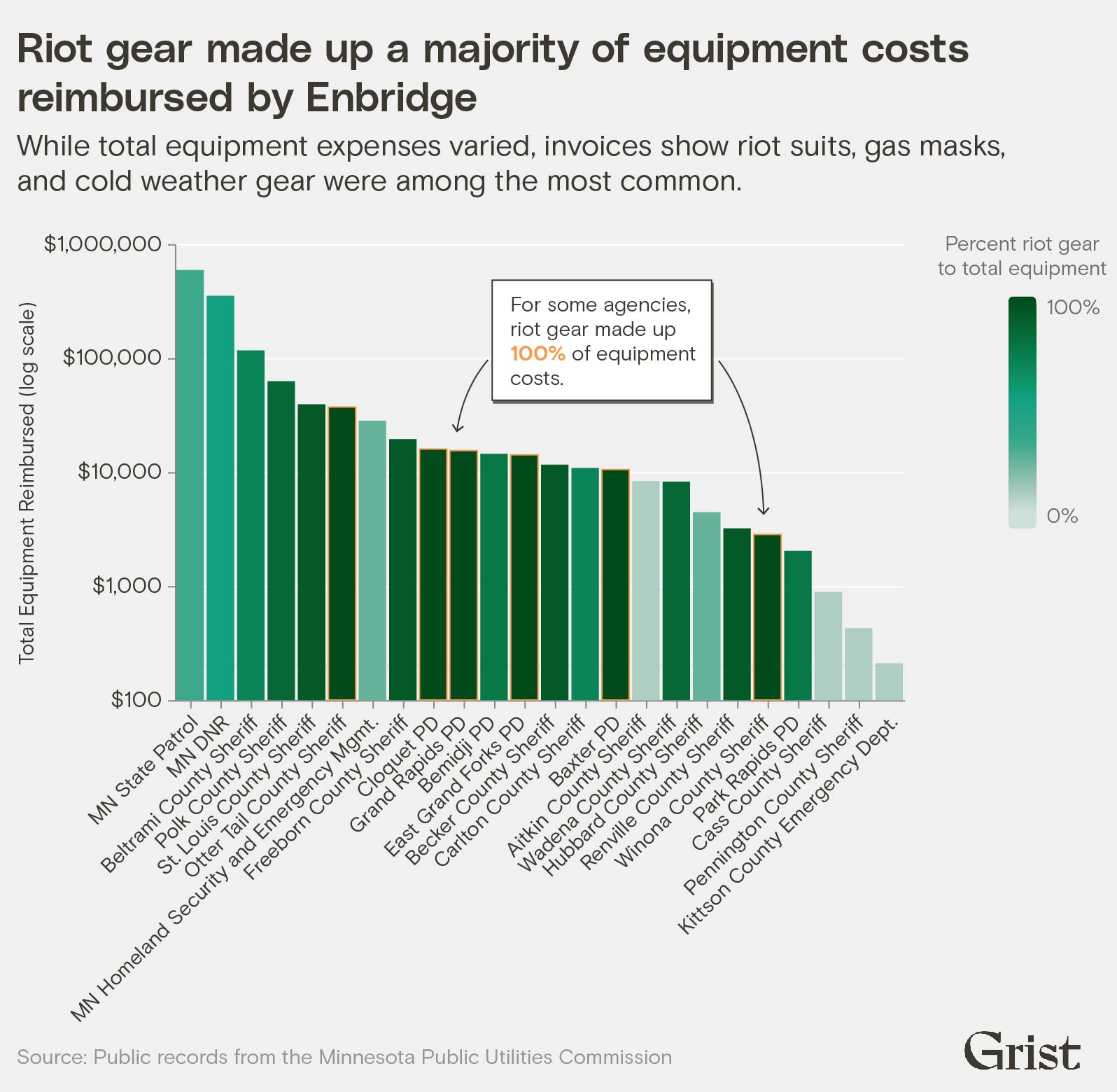
Over half of PPE funds went toward riot gear valued at more than $700,000, which was purchased from police equipment vendors like Streicher’s and Galls. For 13 county and city police forces, that meant more than $5,000 in riot suits, shields, and gas masks. The Beltrami County Sheriff’s Office took over $70,000 for riot gear, and the Polk County Sheriff’s Office more than $50,000. (Neither office responded to requests for comment.) However it was state agencies that received more than half of the Enbridge reimbursements for crowd control equipment: more than $200,000 for the Minnesota State Patrol, and over $170,000 for the Department of Natural Resources.
Grist / Jessie Blaeser
Enbridge also covered more than $325,000 in clothing — mostly cold weather apparel — as well as over $55,000 for hand, foot, and body warmers. Even the identification patches worn on many deputies’ lapels were paid for by Enbridge — totaling more than $7,000. Another $2,000 went toward porta potty rentals, and over $12,000 more toward gear to protect police as they detached protesters who had locked themselves to equipment, including face shields and flame-proof blankets to guard against flying sparks.
Enbridge paid not only for the time the Sheriff’s deputies took to arrest water protectors and bind their hands behind their backs, but also for the handcuffs themselves, which were dubbed PPE and paid for by the pipeline company. The state of Minnesota approved more than $12,500 in Enbridge funds for zip ties and handcuffs.
“Less lethal” weapons did not count as personal protective equipment, the account manager decided, to the frustration of some law enforcement leaders. However, even though Enbridge couldn’t buy these weapons, the company did cover trainings on how to use them. Several trainings were provided by the tear gas manufacturer Safariland, costing thousands of dollars. Enbridge also reimbursed over $260,000 worth of gas masks and attachments, including filters for tear gas, presumably to protect law enforcement from the chemicals they themselves would be deploying.
It wasn’t necessarily the counties with the heaviest protest activity that purchased the most equipment using Enbridge money. Among the top five local law enforcement equipment buyers was the Freeborn County Sheriff’s Office, located in one of Minnesota’s southernmost counties. The agency’s only Enbridge-related expense besides equipment was for three officers to spend a two- to three-day deployment assisting other agencies along the pipeline route in the northern part of the state. (The office did not respond to requests for comment.)
Grist / Jessie Blaeser
2021 was a year of unprecedented protest among Northern Minnesota’s pristine lakes and wetlands. Enbridge and law enforcement faced a drumbeat of road blockades, lockdowns to pipeline equipment, marches through remote prairie, and layered demonstrations combining Anishinaabe ceremony with direct action tactics refined by generations of environmental and Indigenous social movements.
The biggest Enbridge escrow account expense was more than $4.5 million in wages, benefits, and overtime for officials responding to perceived security threats during construction. More than just police and sheriff’s offices were involved: The Department of Natural Resources’ largest Enbridge-funded expense was $870,000 in personnel costs during construction.
And it wasn’t just calls for service that Enbridge paid for. Dozens of invoices mentioned “patrols,” where law enforcement would drive up and down the pipeline route or surveil places occupied by pipeline opponents.
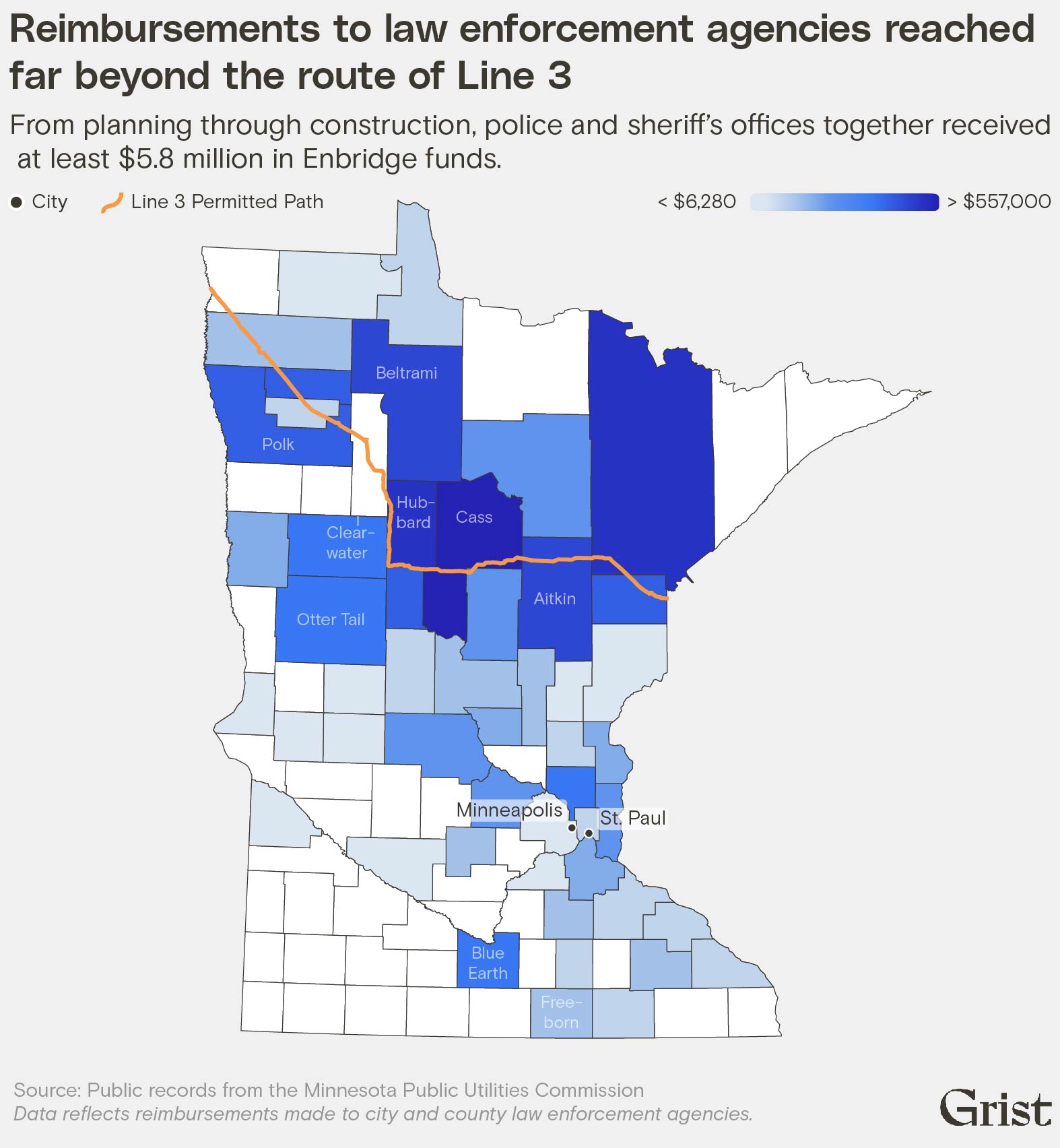
The Cass County Sheriff’s Office’s “proactive” safety patrol, described in an invoice, may help explain why that agency expensed far more money for response costs to the escrow account — over $900,000 — than any other county or city, despite facing fewer mass demonstrations than other areas.
Like Cass, Hubbard County at times instituted patrols as well as mandatory overtime shifts. The invoices confirm that sheriff’s deputies surveilled the Namewag camp, which was located on private land and used both as a space for Anishinaabe land-based practices and as a jumping off point for direct action protests. “On 3/6 and 3/7, Hubbard County Deputies observed roughly 30 previously unidentified vehicles arriving and periodically leaving the Hinds Lake Camp (Ginew [sic] Collective Camp) in Straight River Township, Hubbard County,” one invoice states.
It goes on to describe intelligence shared by an Enbridge employee, detailing the movements of various groups of pipeline resistors. “Migizi camp [another anti-Line 3 encampment] is empty at this time and intelligence suggests Migizi and Portland XR [short for Extinction Rebellion] are camping at a public campground,” the message from Enbridge stated.
Enbridge also paid for gas that fueled officers’ cars, hotels they stayed in when assisting other jurisdictions, and food they ate during shifts. During both planning stages and periods of law enforcement action, Enbridge covered at least $150,000 in meals, snacks, and drinks.The oil company bought bagels, Domino’s pizza, McNuggets, Subway sandwich platters, a Dairy Queen strawberry sundae, summer sausage, cheese curds, deep fried pickles, Fritos, Gatorade, and energy drinks, including one called Pipeline Punch.
From planning through construction, police and sheriff’s offices together received at least $5.8 million in Enbridge funds. For state agencies, the Enbridge funds represented a tiny proportion of massive budgets. However, for the Cass County Sheriff’s Office, the Enbridge money added up to the equivalent of more than 10 percent of the office’s 2021 budget. (The office did not respond to requests for comment.) Five other sheriff’s offices received reimbursements equivalent to over 5 percent of their annual budgets.
The range of choices law enforcement agencies made regarding what to invoice makes clear the discretionary nature of the Line 3 response. Clearwater County is home to one of two places where Line 3 crosses the Mississippi River and the site of a number of protests. Although 20 other law enforcement agencies billed Enbridge for assisting the local sheriff, Clearwater County billed nothing to the pipeline company.
The invoices also offer insight into the way the influx of pipeline workers translated into incidents of human trafficking and assault. “Since the Line 3 Replacement project has come to our area, we have experienced an increase in calls and need for services,” reads a grant application from the nonprofit Violence Intervention Project, or VIP, based in Thief River Falls, Minnesota, a community through which the pipeline passes, just outside the Red Lake Reservation. “We have provided services to several victims that have been assaulted by employees working on the Enbridge line 3 project.”
Enbridge reimbursed the organization for two hotel rooms for assault survivors, since VIP’s shelter was full at the time. The company also paid $42,000 worth of hazard pay for shelter workers during the 2021 winter, due to the Covid-19 pandemic.
Enbridge’s biggest human trafficking grant recipient was Support Within Reach, a northern Minnesota organization that works with survivors of sexual violence, which used the money to pay for extra personnel costs during pipeline construction and to buy emergency cell phones for advocates.
Additional funds also went to public agencies: Enbridge reimbursed $43,551.96 to local law enforcement agencies working with the Minnesota Human Trafficking Investigative Task Force. The documents describe at least two multi-agency operations in Grand Rapids and Bemidji, and news reports from the time confirm that they led to the arrest of four Line 3 workers.
Kellner, the Enbridge spokesperson, said that any employee caught and arrested for human trafficking would be fired by the company. She added that the four workers who were arrested were subcontractors, not direct employees of the oil company, and were fired by the contractor Enbridge worked with.
The Link, a nonprofit based in North Minneapolis, received $36,870 from Enbridge and used it in part to assist the task force with sting operations and support survivors who were found. Beth Holger, the organization’s chief executive officer, said she did not feel conflicted about taking Enbridge’s money, because it was going to victims: “Yes we took money from a corporation that has caused harm, and we’re giving it to people to help with that harm.”
The $8.6 million in expenses covered by Enbridge by no means accounts for the full public cost of responding to opposition to the Line 3 pipeline.
Several sheriffs’ offices anticipated thousands more Enbridge dollars than they received. The sheriffs’ offices in Cass, Beltrami, and Polk counties each attempted to expense around $25,000 of equipment that was ultimately denied reimbursement.
Hubbard County Sheriff Cory Aukes said that it was unfortunate that the Hubbard county attorney’s request for prosecutorial funds was denied by the account manager, as Aukes sees the influx of charges and protestors as an undue burden on the attorney’s office as well as the sheriff’s office. He said that his agency had plenty of other expenses that weren’t covered.
He added that he believes it would be fiscally irresponsible to decline Enbridge’s funds. “Shouldn’t they have to fund that? Shouldn’t they be responsible to reimburse these additional costs?” Aukes asked.
To water protectors, however, the greatest costs of the pipeline are its consequences for the climate, water, and the Canadian forest ecosystem decimated by tar sands oil production. The nonprofit LaDuke co-founded, Honor the Earth, issued its own invoice to Enbridge before the creation of the escrow account, estimating that Line 3 would cost $266 billion annually in environmental losses and social damages.
So far, she hasn’t received a response.
This story was originally published by Grist with the headline Documents show how a pipeline company paid Minnesota millions to police protests on Feb 9, 2023.
If you're serious about the environment, we all know that planting trees is one of the most effective measures, and tree removal should be a last resort. We at Pensacola Tree Services are dedicated to offering the best for your home as well as the environment, therefore we're committed to delivering it by making it as simple as possible. For responsible tree removal visit us here Pensacola Tree Removal
This article was copublished with The Markup, a nonprofit newsroom that investigates how powerful institutions are using technology to change our society. Sign up for its newsletters here.
New York state took a historic step toward curbing the power of Big Tech when lawmakers passed the Digital Fair Repair Act, giving citizens the right to fix their phones, tablets, and computers. For years, advocates for the “right to repair” have pushed for such legislation in statehouses nationwide. They argue that making it easier to repair gadgets not only saves consumers money, but also reduces the environmental impact of manufacturing and electronic waste. Most of those bills have failed amid intense opposition from tech companies that want to dictate how and where their products are serviced.
The passage of the Digital Fair Repair Act last June reportedly caught the tech industry off guard, but it had time to act before Governor Kathy Hochul would sign it into law. Corporate lobbyists went to work, pressing Albany for exemptions and changes that would water the bill down. They were largely successful: While the bill Hochul signed in late December remains a victory for the right-to-repair movement, the more corporate-friendly text gives consumers and independent repair shops less access to parts and tools than the original proposal called for. (The state Senate still has to vote to adopt the revised bill, but it’s widely expected to do so.)
Many of the changes that New York Governor Kathy Hochul made to the Digital Fair Repair Act before signing it are identical to those proposed by a tech trade association called TechNet. TIMOTHY A. CLARY/AFP via Getty Images
The new version of the law applies only to devices built after mid-2023, so it won’t help people to fix stuff they currently own. It also exempts electronics used exclusively by businesses or the government. All those devices are likely to become electronic waste faster than they would have had Hochul, a Democrat, signed a tougher bill. And more greenhouse gases will be emitted manufacturing new devices to replace broken electronics.
Draft versions of the bill, letters, and email correspondences shared with Grist by the repair advocacy organization Repair.org reveal that many of the changes Hochul made to the Digital Fair Repair Act are identical to those proposed by TechNet, a trade association that includes Apple, Google, Samsung, and HP among its members. Jake Egloff, the legislative director for Democratic New York state assembly member and bill sponsor Patricia Fahy, confirmed the authenticity of the emails and bill drafts shared with Grist.
“We had every environmental group walking supporting this bill,” Fahy told Grist. “What hurt this bill is Big Tech was opposed to it.”
That New York passed any electronics right-to-repair bill is “huge,” Repair.org executive director Gay Gordon-Byrne told Grist. But “it could have been huger” if not for tech industry interference.
Reached for comment, the governor’s office sent Grist a copy of a statement that Hochul released when she signed the bill, outlining changes made to the text. Her staff declined to address questions about the potential negative impacts of those changes, or about the process behind them.
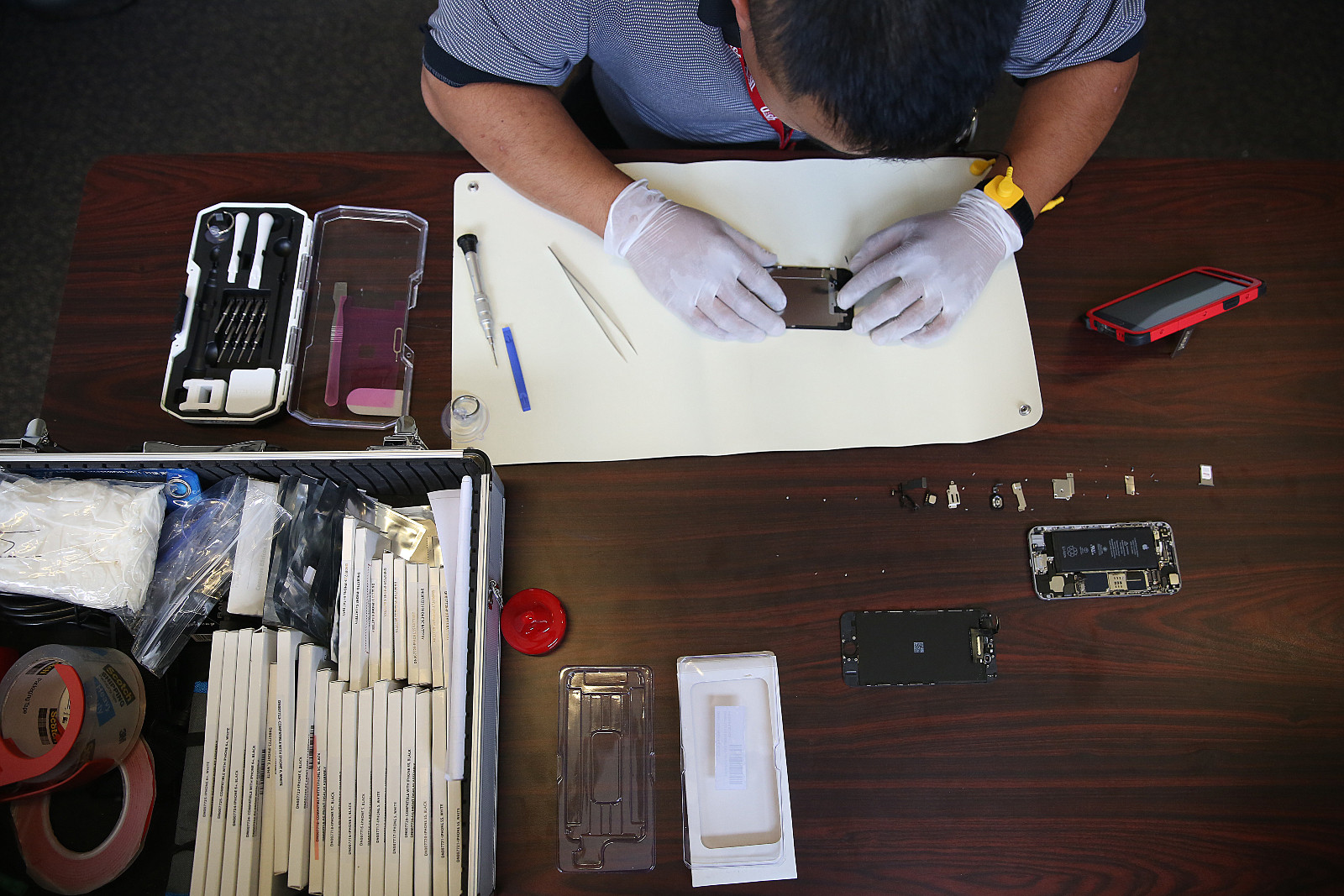
For years, consumer technology companies like Apple have effectively monopolized the repair of their devices by limiting access to parts, tools, and manuals to “authorized repair partners,” which often only perform a small number of manufacturer-sanctioned fixes. Those limited services often force consumers to choose between continuing to use a broken device or obtaining a brand-new one. The version of the Digital Fair Repair Act that passed New York’s Senate and Assembly last spring sought to level the playing field for independent shops by requiring that companies make parts, tools, and documents available to everyone on fair and reasonable terms.
A broad coalition of manufacturers opposed the bill in the spring, and its sponsors had to make significant compromises in order to pass it. “We made a lot of changes to get it over the finish line in the first day or two of June,” Fahy said.
New York Assembly Member Patricia Fahy thought focusing on small electronics in the Digital Fair Repair Act would give consumers “the biggest bang for their buck.” Lev Radin/Pacific Press/LightRocket via Getty Images
Those changes included explicit exclusions for everything from home appliances to police radios to farm equipment. Fahy says she was willing to omit those devices because she thought focusing on small electronics would give consumers “the biggest bang for their buck.” Data from the repair guide site iFixit shows that eight of the top 10 devices New Yorkers attempted to repair in 2020 were small consumer electronics, with cell phones and laptops topping the list.
The Digital Fair Repair Act passed the Assembly by a vote of 145 to 1, after clearing the Senate 59 to 4. Despite that overwhelming support, the tech industry was surprised by its passage, said Democratic state Senator Neil Breslin, who sponsored the bill. “There’s a number of people who were advocating on the parts of the [manufacturers] who really, in private chats, were not expecting it would be passed,” Breslin told Grist.
At that point, the bill’s opponents approached Hochul seeking concessions. In particular, state lobbying records show TechNet held frequent meetings with the governor between June and December, when she signed the bill. Lobbyists representing Apple, Google, and Microsoft also met with the governor, state records show.
All of these organizations have lobbied against right-to-repair bills in other states, often citing intellectual property and cybersecurity concerns. But some, most notably Microsoft, have softened their stance in recent years. Fahy said Microsoft “constantly tried to reach out” to her office to cooperate on the bill. In a letter sent to the governor in November, the company requested several edits but did not ask for a veto. (Microsoft, Google, and Apple declined to comment.)
In letters sent to Hochul in July and August, Apple, IBM and TechNet all asked the governor to veto the bill. (IBM also declined to comment.) When a veto didn’t immediately happen, TechNet sent Hochul a trimmed-down version with edits attributed to David Edmonson, the trade organization’s vice president of state policy and government relations. Among other things, TechNet requested that the law apply only to future products sold in the state, that it exclude products sold only through business-to-business or government contracts, and that it exclude printed circuit boards on the grounds that they could be used to counterfeit devices. It also sought a stipulation allowing manufacturers to offer consumers and independent fixers assemblies, such as a battery pre-assembled with other components, if selling individual parts could create a “safety risk.” Additionally, TechNet wanted a requirement that independent repair shops provide customers with a written notice of U.S. warranty laws before conducting repairs.
Hochul’s office sent TechNet’s revised draft to repair advocates to get their reaction. Those advocates shared the TechNet-edited version of the bill with Fahy’s staff, which gave it to the Federal Trade Commission, or FTC, the agency charged with protecting American consumers. Documents that Repair.org shared with Grist show that FTC staff were highly critical of many of the changes. The parts assembly provision, one commission staffer wrote in response to TechNet’s edits, “could be easily abused by a manufacturer” to create a two-tiered system in which individual components like batteries are available only to authorized repair partners. Another of TechNet’s proposed changes — deleting a requirement that manufacturers give owners and independent shops the ability to reset security locks in order to conduct repairs — could result in a “hollow right to repair” in which security systems thwart people from fixing their stuff, the staffer wrote.
“These particular TechNet edits all have a common theme — ensuring that manufacturers retain control over the market for the repair of their products,” Dan Salsburg, a chief counsel for the FTC’s Office of Technology, Research and Investigation, wrote in an email to Fahy’s office.
Despite the agency’s stern warning, all of the changes described above, and numerous other edits TechNet proposed, appeared in the bill Hochul signed — many of them verbatim.
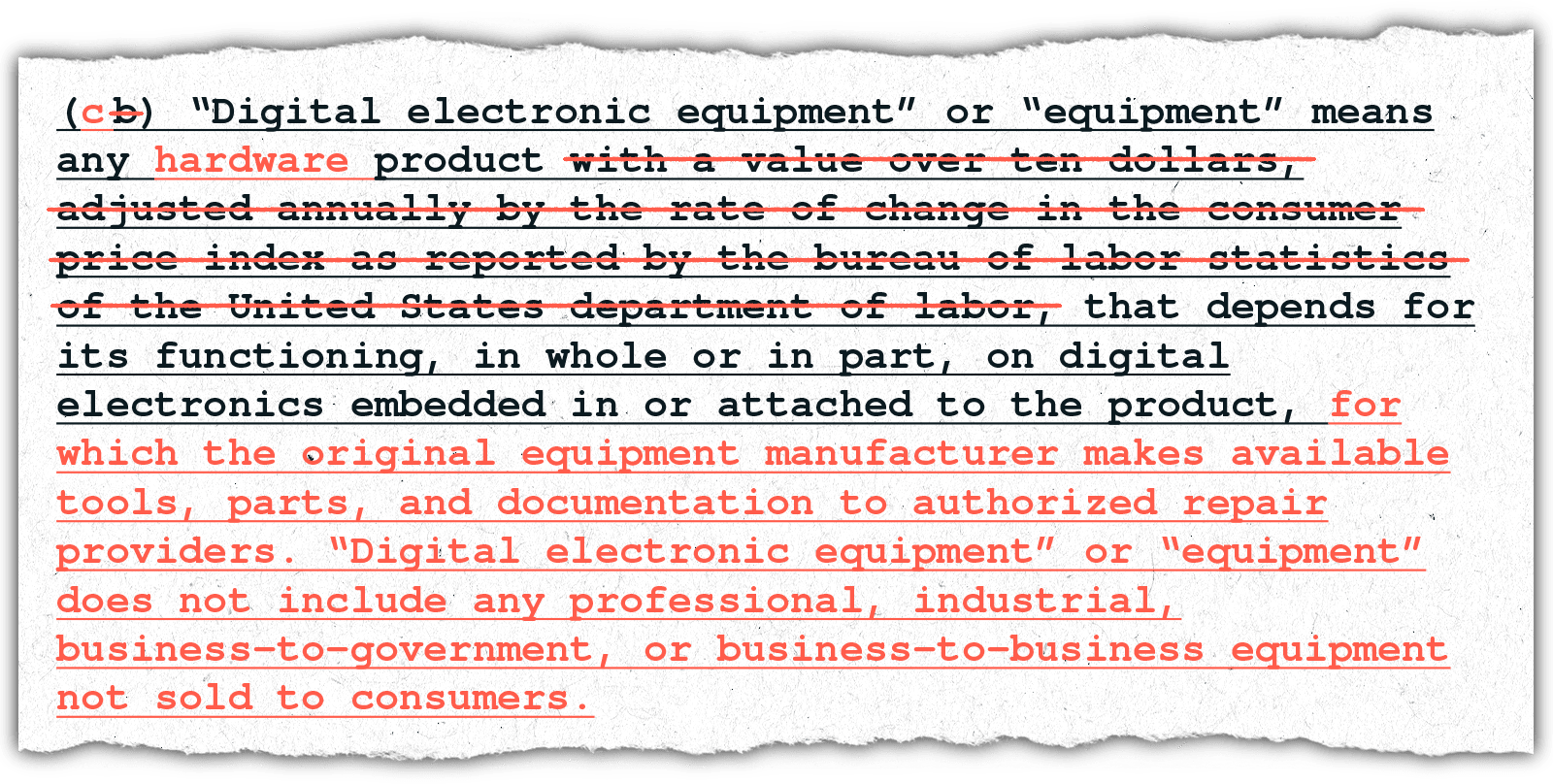
The version of the Digital Fair Repair Act that passed the New York Legislature last spring defined “digital electronic equipment” broadly.
In the proposed edits that TechNet sent to Governor Kathy Hochul’s office, the industry group proposed excluding devices sold under business-to-business or government contracts from the definition of “digital electronic equipment.” Elsewhere, TechNet asked for the law to apply only to devices manufactured or sold after the law went into effect, instead of applying to devices that consumers already owned.
The version of the bill that Hochul signed in December adopted TechNet’s suggestions with minor rewordings.
Chris Gilrein, TechNet’s executive director for the Northeast, told Grist in an emailed statement that the bill the Legislature passed “presented unacceptable risks to consumer data privacy and safety,” and that his organization’s recommended changes “addressed the most egregious security issues.” Manufacturers often cite cybersecurity as a reason to restrict access to repair, an argument the FTC found “scant evidence” to support in a report to Congress published in 2021.
Gilrein disputed the notion that the final version of the bill favored the tech industry. “At its core, the law remains a state-mandated transfer of intellectual property that is unwarranted at a time when consumers have access to more repair options than ever before,” he said.
Todd Bone, the president of XS International, a company that maintains and repairs network and data center IT equipment for corporations and the federal government, says the law offers “nothing” to his business because of the governor’s carveout for devices sold under business-to-business or government contracts.
“It was very disheartening,” Bone told Grist, “to see the governor working with TechNet and not paying attention to the votes from the Congress and the Senate in the state of New York, [and] what the consumers of the state of New York wanted.”
Jessa Jones, who founded iPad Rehab, an independent repair shop in Honeoye Falls, about 20 miles south of Rochester, New York, says the original bill included provisions that would have made it far easier for independent shops like hers to get the tools, parts, and know-how needed to make repairs. She pointed to changes that allow manufacturers to release repair tools that only work with spare parts they make, while at the same time controlling how those spare parts are used, both of which were requested by TechNet.
“If you keep going down this road, allowing manufacturers to force us to use their branded parts and service, where they’re allowed to tie the function of the device to their branded parts and service, that’s not repair,” Jones said. “That’s authoritarian control.”
Last-minute changes to the Digital Fair Repair Act allow manufacturers to release repair tools that only work with spare parts they make, while at the same time controlling how those spare parts are used. Liz Hafalia/The San Francisco Chronicle via Getty Images
After repair advocates shared TechNet’s draft with Fahy’s office, they collaborated on a counterproposal that pushed back against many of the proposed changes. The last-minute negotiations with the governor’s office were “frustrating,” Fahy said, although she still ultimately wants to see the bill become law.
Fahy hopes the New York Department of State will clarify aspects of the bill that got muddied by industry influence. The agency, which plays a role in consumer protection, will craft regulations dictating how the law will be implemented. Ultimately, Fahy says the bill will still help consumers save money and keep old devices out of landfills. And every little bit counts: In New York state alone, the U.S. Public Interest Research Group estimates that Americans discard roughly 23,600 cell phones per day.
Fahy also believes the law — imperfect though it may be — will have a ripple effect beyond the state’s borders. It could give momentum to the efforts to pass similar laws in dozens of other states. Eventually, the passage of state bills could lead to a national agreement between electronics manufacturers and the independent repair community, similar to what happened in the car industry after Massachusetts passed an auto right-to-repair law in 2012.
Other lawmakers agree that New York has provided a welcome starting point.
“When you’re the first state, sometimes you have to pass something very small to get across the finish line,” Washington state representative Mia Gregerson, a Democrat who is sponsoring a digital right-to-repair bill in her state’s house, told Grist. New York’s Digital Fair Repair Act, Gregerson said, “gives us something to work from.”
“We’re going to take that now and try to do a better piece of legislation,” Gregerson said.
This story was originally published by Grist with the headline How Big Tech rewrote the nation’s first cell phone repair law on Feb 8, 2023.
If you're serious about the environment, we all know that planting trees is one of the most effective measures, and tree removal should be a last resort. We at Pensacola Tree Services are dedicated to offering the best for your home as well as the environment, therefore we're committed to delivering it by making it as simple as possible. For responsible tree removal visit us here Tree Services Pensacola
In early February, 15 First Nations and the Canadian government announced a new plan for a network of marine protected areas on Canada’s west coast. The Marine Protected Areas Network Action Plan for the Northern Shelf Bioregion provides a strategy to create protected areas that will safeguard more than two hundred species of fish, marine birds, marine mammals, and invertebrates in the region. It will also help preserve a coastline that stretches from Vancouver Island to the Canada-Alaska border.
“This is a significant achievement in Canada’s commitments,” said Joyce Murray, Minister of Fisheries, Oceans and the Canadian Coast Guard. “Only by working together at all levels can we achieve Canada’s marine conservation targets.”
The Canadian government has committed to protecting 30 percent of its oceans by the end of the decade; one part of the international goal known as 30X30 to protect biodiversity and reverse climate change by protecting 30 percent of the planet by 2030. But a new report says to meet this goal, Canada has to make more efforts to include First Nations in its national marine conservation plans.
The report from the Assembly of First Nations, a national advocacy organization that represents First Nations governments and their citizens, also says Canada must provide more support for existing Indigenous conservation initiatives, like establishing Indigenous Protected and Conserved Areas, or IPCAs – lands and water managed and conserved by First Nations and communities. Indigenous land management protects biodiversity and benefits the environment, as does the recognition of Indigenous territory and rights.
The report provides a list of recommendations to support those IPCAs, including establishing cultural objectives alongside ecological goals, and hiring more First Nations staff. The Assembly of First Nations also says more structure, investment, and support for conservation efforts are necessary to help Canada meet its human rights and climate commitments.
“A whole-of-government approach is necessary to provide more certainty for First Nations’ stewardship of their lands and waters,” the report says.
Canada has been making strides toward a better protected areas model. In 2021, Canada announced $340 million for Indigenous-led conservation, including more than $166 million for IPCAs. But Indigenous leaders have said that the reality is more complicated, with IPCA approvals taking too long and long-term funding proving elusive. First Nations are also concerned that Prime Minister Judeau Trudeau has signaled that resource extraction may be allowed in some protected areas.
“Our Nations have a solid track record proving that Indigenous-led conservation works for nature and for people,” said Dallas Smith, Board President of Nanwakolas Council Society. “As we tackle the urgent challenges of biodiversity loss and climate change, this is the model the world needs now.”
This story was originally published by Grist with the headline To protect marine areas, Canada must include First Nations on Feb 8, 2023.
I'd like to take this time to remind you that climate change is real. The actions of big governments continue to pollute and poison the environment. Whenever feasible, we should all plant more trees and preserve our existing ones. That's why Tree Services in Pensacola strives to do both while also improving your home's landscaping. Read more about how they're making changes at https://treeservicespensacola.com/tree-removal-pensacola/
Last month, the French food company Danone — owner of milk and yogurt brands like Activia and Horizon Organics — pledged to cut absolute methane emissions from its milk supply chains by 30 percent by 2030, making it the first major food company with a methane-specific emissions target.
Green groups have applauded the new pledge. Methane is a greenhouse gas some 80 times more potent than carbon dioxide over its first 20 years in the atmosphere, and food companies rarely report it separately from their CO2 emissions, even though agriculture is responsible for roughly a quarter of methane emissions worldwide.
But reducing those methane emissions is far from simple. A “methane ambition” document released by Danone outlines a few options, although somewhat vaguely and without acknowledging some of the controversies surrounding them. Some experts worry that Danone’s strategies could encourage dairy farmers in the company’s supply chain to lean on “unproven techno-fixes” — like special diets to reduce the methane in cow burps — which could distract from the need for more systemic solutions, like phasing down large-scale animal agriculture.
“When you start incentivizing and doing techno-fixes to a broken system, that’s not getting us where we need to be,” said Shefali Sharma, director of the nonprofit Institute for Agriculture and Trade Policy’s European office.
According to the United Nations’ Food and Agriculture Organization, or FAO, dairy production is responsible for about 1.4 billion metric tons of CO2-equivalent greenhouse gas emissions every year, about 3 percent of all human-induced climate pollution. Most of these emissions are methane, and half of them come from cow burps — cattle belch methane as part of a process called “enteric fermentation,” in which gut bacteria help them digest food. Another quarter comes from manure-related emissions of methane and nitrogen oxide, and the rest comes from feed production, fertilizers, and the use of land and energy.
Danone doesn’t run its own dairy farms — rather, the company buys its milk from some 50,000 independent farmers worldwide. That means its methane-reduction plan will hinge on suppliers’ cooperation. It’s not clear exactly how Danone plans to convince farmers to play along, though the company has already helped fund some emissions-reductions programs in places like France and has created advisory resources for farmers elsewhere. Danone’s methane ambition document says two of its three main strategies to cut methane involve manure treatment and “breakthrough methane inhibitors,” technologies to either stop cows from producing methane or to capture it at the point of release. (Yes, this means at the cows’ mouths. Danone is investing in a U.K. startup called ZELP, which produces a sort of muzzle for cows that can theoretically trap burps and convert their methane into water and carbon dioxide.)
A Danone building in Barcelona, Spain.
Roberto Machado Noa / LightRocket via Getty Images
There is evidence that these solutions can work. Some studies have shown that red seaweed and a molecule called 3-nitrooxypropanol can reduce enteric methane emissions by up to half when added to cow food. Andy Reisinger, principal scientist on climate change for New Zealand’s environment ministry, told Grist he’d have “high confidence” in their effectiveness if widely applied.
Manure management is also shown to reduce methane emissions. In California, a strategy called “anaerobic digestion” — in which factory farmers cover pits of liquid manure and convert the methane they release into biogas — has been deemed the state’s second most cost-effective climate program. Other effective management strategies involve simply covering pits of cow manure to limit methane leaking into the atmosphere or solid-liquid separation, in which solids are drawn out of slurried cow poop to be processed into fertilizer.
Reisinger said it’s “entirely realistic” that Danone could use these strategies — along with some simpler methods to reduce the methane-per-liter emissions of its milk supply, like selective breeding for highly productive cows — to get its suppliers to cut methane emissions by 30 percent in the next seven years. If they’re proven to be safe and effective, he said, there’s no reason not to use them, at least as part of a toolbox of several strategies.
However, some experts argue that these solutions — which show the greatest promise for industrial-scale dairy farms — are missing the forest for the trees, attempting to mitigate the harms of factory farming rather than phase it out. A report published last year by the Vermont Law and Graduate School, for example, found that manure-to-biogas solutions for factory farms — the only kinds of farms where these solutions make economic sense — obscure the extensive lifecycle emissions of the livestock industry and the environmental justice consequences of perpetuating concentrated animal feeding operations. These operations are often sited near low-income communities and communities of color, disproportionately exposing them to toxic pollutants like ammonia and volatile organic compounds.
“We need to really move toward systemic solutions in transitioning agriculture,” Sharma told Grist. Experts say this must include phasing down industrial-sized feedlots and reducing the global population of dairy cows. (Replacing cows on industrial farms with pasture-raised cattle wouldn’t help the climate, because pasture-raised cattle use more land and produce more emissions per liter of milk.) Lowering production would not only slash methane emissions but also limit animal cruelty and pollution of soil and water. Workers on industrial animal farms around the world have also spoken of the “hell” the system exposes them to — from brutal working conditions to exploitative contracts with agricultural behemoths. In the U.S., 70 percent of dairy cows live on factory farms, and 85 percent of the planet’s milk comes from non-pasture-raised sources.
A Danone plant near Chekhov, Russia, outside Moscow.
Yuri Kadobnov / AFP via Getty Images
Environmental advocates argue that food companies could play a role in the transition away from factory farming by replacing some of their dairy milk production with an increase in plant-based alternatives. Milks made from soy, rice, and oats use dramatically less land and water to produce and create just a fraction of the greenhouse gas emissions. Governments could help too, Sharma said, by creating incentives for farmers to move away from large-scale animal agriculture.
In response to Grist’s questions about its methane reduction plan, Danone gestured broadly at an intention to reform dairy production. A spokesperson said the company intends to achieve its methane target by adopting “regenerative” practices, defined very broadly to include “improvement of herd management, feed fundamentals, and manure management,” as well as “reintegrating animals into the landscape.” Danone says it has already helped to incorporate these practices on some small farms. And though Danone’s recent methane ambition document names “breakthrough methane inhibitors” as one of three strategies to reduce methane, the spokesperson said that feed additives are intended to be “a complementary solution to go the last mile in most efficient farms.”
The spokesperson did not respond to questions about whether the company advocates for a decline in the global cattle population or a shift away from industrial-scale dairy farms. According to a report Danone published in 2021, 70 percent of its milk volume comes from farmers with 10 or more cows.
To be sure, reshaping entire food systems is a tall order for one company, and Reisinger defended Danone for moving in a positive direction. He said the company was filling a policy gap left by the majority of countries that have yet to set a binding methane reduction target for agriculture. Danone’s new pledge, he explained, is “providing an incentive that so far governments have failed to provide” for milk producers to measure, report, and mitigate methane emissions. Reisinger and Sharma agreed that this role should eventually be taken up by national regulators and intergovernmental bodies, like the FAO.
This story was originally published by Grist with the headline A major dairy company plans to slash methane emissions — but there’s an elephant in the room on Feb 7, 2023.
If you're serious about the environment, we all know planting trees is one of the best solutions and tree removal should be a last resort which is why we're committed at Pensacola Tree Services to provide the very best for your home as well as the environment. Read more by going here.
Mass shootings at two California mushroom farms last month drew national attention to the dismal working and living conditions imposed on California farmworkers. Surveys of California Terra Garden and Concord Farms, where the assailant had worked, revealed families living in trailers and shipping containers, using makeshift kitchens and portable toilets. State and federal officials have opened investigations into the farms, where workers reported earning below minimum wage.
The conditions are “very typical images … for California and for the country,” Irene de Barraicua, director of operations at Lideres Campesinas, a network of female farmworker leaders, told the Washington Post after the shooting.
Now, the first comprehensive assessment of California farmworker health since 1999, released Friday, demonstrates just how typical those conditions are – and how climate change, and widening inequality, are exacerbating challenges for these workers, some of the most disenfranchised residents of the state.
The landmark study, by the University of California, Merced’s Community and Labor Center, in partnership with organizations that serve farmworkers across the state, and funded by the California Department of Public Health, surveyed over 1,200 workers about their health, well-being, and workplace conditions. It found widespread exposure to wildfire smoke and pesticides, rodents and cockroaches in rental units, inadequate safety training, and lack of access to clean drinking water. Half of all farmworkers surveyed reported going without health insurance, even when between one-third and one-half had at least one chronic health condition.
“Even through these major climate disasters the food supply has not been interrupted,” said Edward Flores, a professor of sociology at UC Merced and one of the report’s authors. “But the conditions that people work in have become riskier to their well-being. And they have fewer resources with which to weather a major event.”
Temperatures can already exceed 110 degrees Fahrenheit in areas including the San Joaquin Valley, Imperial Valley, Coachella Valley, and Sacramento Valley, where much of the state’s farming happens, and the heat is only getting worse. Meanwhile, intense precipitation events cause damage to substandard rental units, and extreme fire weather days, which have doubled since the 1980s, increase the risk of respiratory illness.
More than one in three survey respondents, 92 percent of whom were renters, experienced problems keeping a house cool or warm. And about 15 percent encountered rotting wood, water damage, and leaks.
California’s Division of Occupational Health and Safety, or Cal/OSHA, has various standards in place to protect workers from extreme weather and other occupational hazards. For outdoor workers, for example, employers have to provide fresh water, access to shade, and cool-down rest breaks at 80 degrees Fahrenheit. They also have to train employees and supervisors on the signs of heat illness and maintain a heat illness prevention plan, with written procedures for what to do in case of an emergency.
These standards are some of the strongest in the nation. Still, they often don’t protect farmworkers, who report widespread violations and non-compliance. Almost half the farmworkers surveyed had never been provided with a heat illness prevention plan. And 15 percent received no heat illness training at all.
During wildfire season, 13 percent had to work when smoke made it difficult to breathe, often without respiratory protective equipment as required by Cal/OSHA. While state law also requires pesticide safety training to be provided in a language that farmworkers understand, about half who had worked with the chemicals in the past year did so without receiving adequate training.
Even more concerning, when workplaces were out of compliance with labor laws, 36 percent of farmworkers said they would not be willing to file a complaint. Most of the time, that was for fear of employer retaliation. The fact that only 41 percent of the respondents had access to unemployment insurance suggests that 59 percent weren’t documented, said Edward Flores. “A very vulnerable person has to take the job that’s available to them, even if it’s not up to code.”
As climate change intensifies, challenges facing farmworkers, and especially undocumented workers, will only increase, the report warns. “Whether it’s record heat, catastrophic wildfires, or major floods, farmworkers either have to work in dangerous conditions or they’re unable to work,” said Flores. “They don’t have the same access to a safety net.”
The researchers hope that as California invests in reducing its emissions and helping agriculture adapt to a warming world, the data from the report will lead to more integrated climate, economic, and labor policy. “We should be thinking about a cohesive strategy so that, for example, investment in technology to improve the way that crops are produced might also be done with farmer organizations at the table, with input from health and safety advocates,” said Flores.
This story was originally published by Grist with the headline Even with legal protections, extreme heat and wildfire take a toll on farmworkers on Feb 7, 2023.