If you're serious about the environment, we all know that planting trees is one of the most effective measures, and tree removal should be a last resort. We at Pensacola Tree Services are dedicated to offering the best for your home as well as the environment, therefore we're committed to delivering it by making it as simple as possible. For responsible tree removal visit us here LinkedIn
After decades of intense public debate and misinformation campaigns, nearly three-quarters of Americans now accept that climate change is happening; not only that, more than half understand it is caused by human activity. This shift has forced fossil fuel companies — and the organizations they fund — to alter their tactics to avoid regulation. Where they once denied climate science outright, companies now engage in “discourses of delay,” publicly accepting the science but working to stall climate policy by redirecting blame, pushing non-transformative solutions, and emphasizing the downsides of taking action.
But the Heartland Institute, the infamous, free-market think tank that has operated at the center of climate misinformation for decades, is still hanging onto the old ways as it pushes on with its attempt to discredit established climate science.
This week, the organization sent copies of its book “Climate at a Glance” to 8,000 middle and high school teachers across the country, in order to provide them, it says, with “the data to show the earth is not experiencing a climate crisis.”
H. Sterling Burnett, who directs Climate and Environmental Policy for the Heartland Institute and edited “Climate at a Glance,” said he hoped the book would reach educators who are teaching climate change, “not to replace the material they have, but to supplement it.”
But science education advocates aren’t too worried about the impact of the materials.
“This is not Heartland’s first rodeo,” said Glenn Branch, deputy director of the non-profit National Center for Science Education, which promotes and defends accurate science education. “In previous campaigns, the bulk of teachers and students who received the materials threw them out or put them in the recycling bin.”
The institute’s last big mailout was in 2017 when it sent out 350,000 copies of its “Why Scientists Disagree About Global Warming.” According to Branch, while only a few picked up the information and taught from it, a number of educators used the materials in their classrooms to teach about propaganda techniques. Branch also thinks the fact that this year’s campaign is so scaled back from the 2017 mailout means even Heartland itself recognizes this as a failing strategy.
The new 80-page document, presented in the style of a slick and authoritative textbook, covers 30 climate topics often discussed in science classes. Many of the sections acknowledge modest planetary warming, but assert that it is either good for species and ecosystems, or doesn’t really have the impacts on extreme weather events that climate scientists say it does.
“They typically give a straightforward observation or statistic that’s not in dispute and add some commentary that’s wildly exaggerated or a completely false interpretation,” said Branch. A section on crop production, for example, notes how a longer growing season improves yields; it does not acknowledge the net-negative impact of a hotter, drier climate and extreme precipitation on agriculture in the long term. A page on sea-level rise says “levels have been rising at a fairly steady pace since at least the mid-1800s,” but the rate has actually more than doubled in the 2000s when compared to most of the 20th century.
“It’s a misleading interpretation of scientific facts and questionable inferences drawn from cherry picked data from unreliable sources,” said Robert Brulle, a visiting professor of sociology at Brown University who has researched the public relations strategies of the fossil fuel industry. “It almost seems quaint that they’re still running with this. It’s like ‘The 1990s called. They want their scientific misinformation back.’”
Burnett defends the institute’s new booklet. “People say ‘oh, you don’t have the proper context’,” he said, “but that’s their opinion on what the proper context should be.”
Founded in Chicago in 1984, the Heartland Institute received hundreds of thousands of dollars from fossil fuel companies and industrial billionaires the Koch brothers until association with outright science denial started to become more of a liability for the industry. The last of the big oil companies mostly gave up on funding extreme climate denial groups like Heartland around 2007, said Brulle. Any direct links that might still exist would be hard to find; climate misinformation has historically been funded and spread through a network of front groups, and Heartland no longer discloses its major supporters. While its revenue has declined over the years, it still receives millions from conservative foundations and philanthropies.
“What Heartland is hoping for is to catch those who haven’t been equipped to understand climate science well enough to realize the highly misleading nature of the materials,” said Branch. A survey from 2015 found that about 57 percent of high school and middle school science educators have not formally studied climate change. As states increasingly add climate change to their science standards, Branch hopes to see more states follow in the path of Washington, California, Maine, and New Jersey in appropriating funds for teacher professional development on the issue, which would equip them with the tools to identify misinformation.
Even if teachers today are unlikely to fall for Heartland’s claims, the organization’s messaging could still help the fossil fuel industry in a roundabout way. In social science there’s a theory called the radical flank effect, explained Brulle, where a position that is perceived as extreme can be made to look more moderate by a position that is even more extreme.
“If Exxon Mobil is saying ‘climate change is probably real and it can cause harm, but we can adapt,’ without Heartland, they’re the extremists,” said Brulle. “But if Heartland is out there saying ‘climate change is going to be good for us,’ it makes the major oil companies look moderate and reasonable.”
This story was originally published by Grist with the headline Climate denial campaign goes retro with new textbook on Feb 6, 2023.
Before we get into today's post, I want to remind you that climate change is real. Big governments continue to poison and pollute. One of the things we all can do is plant more trees as well as saving our existing trees whenever possible. That's why Tree Services in Pensacola is doing everything to benefit the environment, while also beautifying your home's landscaping.
Democratic lawmakers in Minnesota passed an ambitious climate law late Thursday night requiring the state’s power utilities to use 100 percent clean electricity by 2040. The clean electricity legislation was approved on a party-line vote by the state’s Senate. House Democrats passed an identical version of the bill last week, which means it now goes to the state’s Democratic governor, Tim Walz, who intends to sign it.
“Minnesota has a proud tradition of being a national clean energy leader, but we’ve fallen behind other states,” Democratic House Majority Leader Jamie Long, who authored the bill, told Grist in a statement. “Minnesotans are calling on us to act and we are answering the call.”
The legislation establishes two new mandates for electric utilities in the state: a renewable electricity standard and a carbon-free energy standard. The former builds on a law the North Star State passed in 2007, which required power utilities to get at least 25 percent of their energy supply from renewable sources by 2025. They achieved that goal eight years early. The new standard ups the requirement to 55 percent renewable energy by 2035. The second standard instructs electric utilities that operate in the state to get 100 percent of their power from carbon-free sources by 2040, with targets set along the way — 80 percent carbon-free by 2030 and 90 percent by 2035. Utilities can use a mix of solar, wind, hydropower, nuclear, hydrogen power, and biomass — energy obtained from burning wood and trash — to meet the 2040 goal.
Minnesota’s two top power utility companies, Xcel Energy and Minnesota Power, previously promised to reach 100 percent carbon-free energy by 2050. This bill speeds up their timeline by a decade, but it also includes “off-ramps” that utilities can take advantage of if the targets prove too onerous. If Xcel, for example, can make a case before state regulators that the benchmarks set by the legislation prevents it from supplying its customers with reliable power, the state may grant it an extension. Utilities can also buy clean energy tax credits to offset their emissions.
The bill contains provisions that will help streamline the permitting process for new energy projects in the state, set minimum wage requirements for workers hired by the state’s utilities to build large-scale projects, and prevent power from waste incineration plants located in low-income, majority non-White communities from counting toward the 2040 target.
Environmental justice groups in Minnesota fought hard to get that last provision included in the bill — they argued that waste-to-energy facilities, like the Hennepin Energy Recovery Center in Minneapolis, endanger the health of communities that live around them. The groups said the legislation is a good first step but argued that it doesn’t do enough to disincentivize other garbage incineration plants currently operating across the state.
State Republicans opposed the clean energy standard on the grounds that it would make electricity in the state more expensive and less reliable. “This ‘blackout bill’ is going to make energy unreliable, unsafe, and even dangerous,” the Republican House minority leader, Lisa Demuth, said. “Energy needs to be safe. We need it in Minnesota to be reliable, and this is neither.” Multiple analyses of existing state-level clean energy standards show the mandates have actually improved grid reliability and reduced costs for consumers.
Minnesota House Democrats attempted to pass similar legislation before, in 2021, and were shot down by the Republican-controlled state Senate. In 2022, the party narrowly clinched a majority in the chamber, which illuminated a new path forward for climate legislation. Minnesota is the first state to pass a clean energy standard since Democrats in Washington, D.C., passed the Inflation Reduction Act, the biggest federal investment in fighting climate change in U.S. history, last August.
“This is the culmination of a lot of hard work,” Paul Austin, head of Conservation Minnesota, told Grist. “It shows how the federal legislation and the state legislation can work together, and it shows that the states can continue to lead if Congress doesn’t have that window to do major things on climate going forward.”
This story was originally published by Grist with the headline Minnesota to require 100% carbon-free electricity by 2040 on Feb 3, 2023.
If you care about the environment, you know that planting trees is one of the best things you can do. Trees help the environment by taking in carbon dioxide and giving oxygen. If you have to get rid of a tree, make sure to only do it a last resort. At Pensacola Tree Services, we are dedicated to helping your home and the environment. We are committed to delivering the best possible service for both. Simply go here for more info LinkedIn
It’s been eight years since the world learned that “Exxon Knew.” The oil giant had grasped the dangers of burning fossil fuels since 1977, investigations showed, despite its long-standing public stance that the science was “uncertain” and persistent efforts to block legislation that would control carbon pollution. The revelations launched a wave of lawsuits that aimed to put fossil fuel companies on trial for deceiving the public about climate change.
In 2017, cities and counties in California started the trend by suing dozens of oil, gas, and coal companies using state “tort” laws meant to protect people from deceptive advertising. Attorneys general in other states filed similar suits of their own, beginning with Rhode Island in 2018. It spurred speculation that Big Oil might face a reckoning for misleading the public about the dangers of climate change, much as Big Tobacco did in the 1990s after decades spent denying that smoking could cause cancer.
In the ensuing years, not a single one of these consumer-protection cases — now numbering nearly two dozen — made it to trial. They have bounced around between federal and state courts, with oil companies maneuvering to delay any action. “It says something about what the industry thinks is the power of these cases, that it has kept these up in procedural battles for over five years now,” said Karen Sokol, a law professor at Loyola University in New Orleans.
The procedural battles might soon end when the Supreme Court reviews Suncor v. Boulder County later this year, a case that promises to be a turning point for climate litigation. The court will either hear the case (the oil industry’s choice) or send it back to state courts where state and local governments say it belongs. The decision could remove the dam that’s been standing in the way of the lawsuits that states, cities, and counties have brought against fossil fuel giants. Cases that have been languishing for half a decade could finally be heard, with the chance that oil companies would be called to face trials for violating state laws that guard the public against false advertising.
“The fossil fuel companies are afraid of state courts,” said Denise Antolini, a law professor at the University of Hawaii. “They are petrified of state courts who are closer to the problem, closer to the issues, and absolutely terrified of going in front of juries of real people.”
The Colorado case began in 2018, when the city and county of Boulder, along with San Miguel County in the southwest corner of the state, sued Suncor Energy and ExxonMobil, seeking millions of dollars to update their infrastructure to withstand climate change. They argued that the oil companies violated the state’s consumer protection laws by producing and selling fossil fuels in Colorado despite understanding that using their products would lead to more dangerous heat waves, wildfires, droughts, and floods, like the ones the state is seeing today.
Oil companies have argued that the lawsuit isn’t really about deceptive marketing, but the bigger question of climate change, and issues of that scale should be handled by federal courts — which just happen to be considered more friendly to big corporations. Their claim is that if cases like Colorado’s proceeded in state court, it would interfere with federal laws around greenhouse gas emissions. And if the Colorado lawsuit lands in federal court, “it would be on the grounds that the claims are something different from the claims that the plaintiff had made,” Sokol said. “And so this is basically a defendant’s dream, right?” The oil companies would likely argue that the case should be thrown out in federal court, too, saying such big questions should be left to Congress.
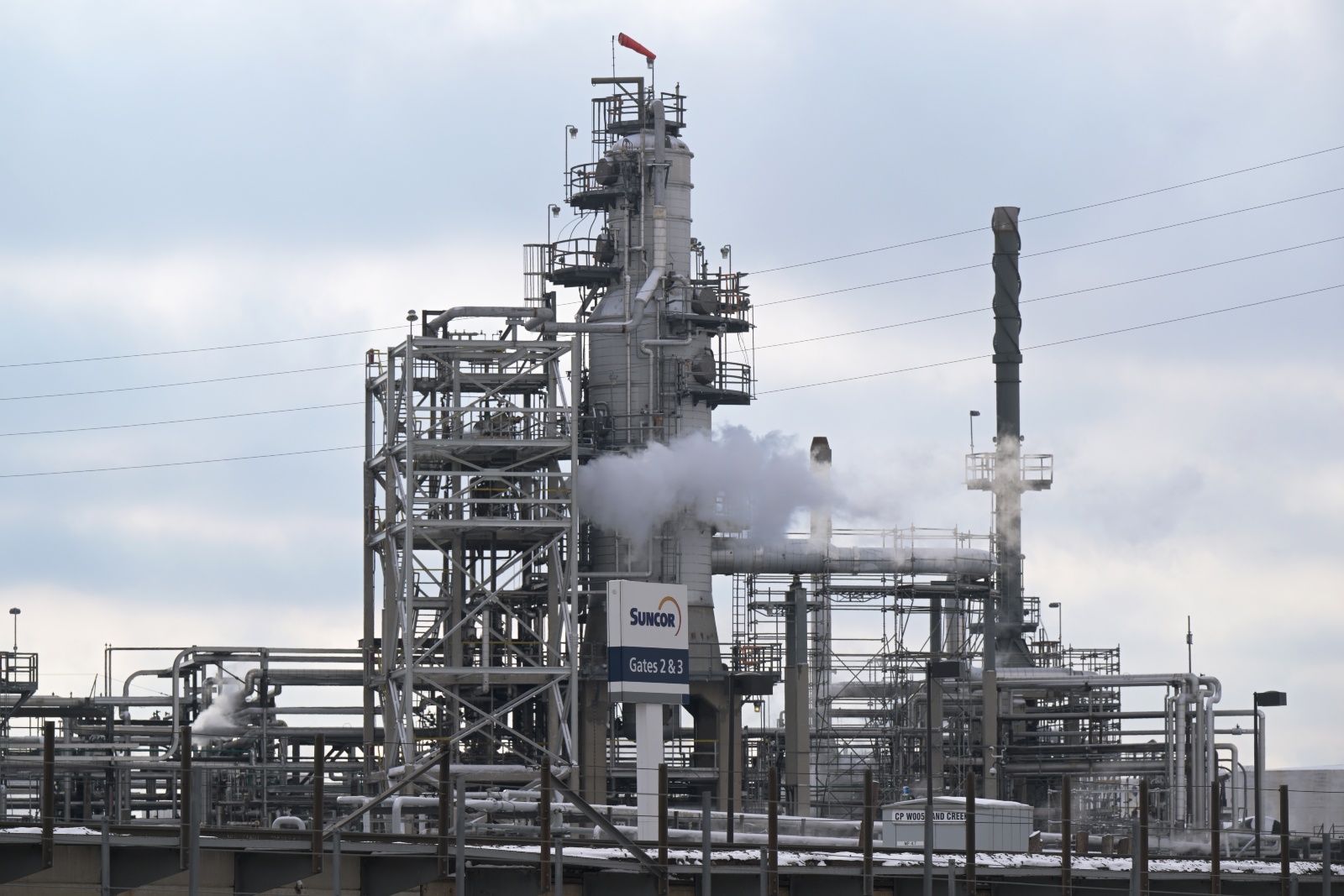
The Suncor oil refinery in Commerce City, Colorado, January 3, 2023.
Hyoung Chang / The Denver Post
Judges have repeatedly rejected oil companies’ line of reasoning, including those appointed by the Trump administration. In October, the Supreme Court turned to the Biden administration for guidance, asking the U.S. Solicitor General to weigh in with a legal opinion on where the case belongs. That’s a good indication that the court is very interested in the case — a petition is 46 times more likely to be granted after the court asks for the solicitor general’s advice, research has shown.
The coming months may finally provide some clarification on whether the strategy driving dozens of climate lawsuits could actually work — or whether it’s time to pursue a new approach.
There are two ways that the Supreme Court could push these lawsuits forward, with similar outcomes. It could decide not to hear the case, or it could agree to hear it and side with Boulder. In either scenario, the consumer-protection cases would proceed in state courts, and “we’ll start to actually see some litigation,” Sokol said.
The cases would move onto “discovery,” a pre-trial step in which both sides gather evidence from documents and witnesses. “The civil discovery system and the subpoena authority of civil courts is quite powerful,” Sokol said. “We would fill in even more than we already know — and we already know a lot.”
The furthest along of any of these accountability lawsuits is one filed in Hawaii in 2020, with the city and county of Honolulu seeking damages from companies including ExxonMobil, Chevron, and Sunoco. A Hawaii judge has ordered for the discovery process to begin, despite an ongoing appeal by the industry. “What I expect to see in the next year would be discovery battles, with additional motions, as the case slowly marches forward,” Antolini said. The suit is progressing faster than others because Hawaii’s judges have prioritized moving it forward, she said.
Once these lawsuits proceed to trial, juries would be presented with a decades-long trail of evidence that documents how fossil fuel giants deceived the public about climate change. New evidence has recently emerged that could help plaintiffs make a stronger case.
For example, a recent study from Harvard researchers analyzed 40-year-old climate models created by ExxonMobil scientists, finding that their projections ended up predicting actual temperature changes with startling accuracy. They conveyed the severity of the situation to corporate officials — who proceeded to cast doubt on the credibility of climate science, deriding models and emphasizing how “uncertainty” made them virtually useless. “If this were to get to a jury, that’s the sort of evidence that’s important,” Sokol said.
What’s more, the science of being able to attribute specific droughts, floods, and heat waves to climate change is getting better every year. Studies showing how fossil fuel emissions have contributed to these disasters “will be really important” to building the plaintiffs’ case in these lawsuits, said Korey Silverman-Roati, a fellow at Columbia Law School.
In the other scenarios, the Supreme Court could side with oil companies and decide to hear Suncor v. Boulder County and then rule in their favor. States would have to rethink their whole approach.
“Given the current inclinations of the United States’ Supreme Court, it’s nerve-wracking to see them take up this case,” said Antolini, who supports the state lawsuits. “What the U.S. Supreme Court decides will have an impact on all of these cases.” Attorneys general in several states suing oil companies did not respond to or declined Grist’s request to comment.
The cases would, in theory, proceed. But it’s unclear how suits filed over state laws designed to protect against corporate deception would play out in federal courts. “I’m uncertain what all the city, county, and state officials would do in those circumstances, because if it’s on the grounds that ‘Hey, this is actually a federal claim’ — that’s not the claim that they filed, and the claim that they and their staff have spent so much time developing,” Sokol said. “I don’t think it necessarily means that they will lose, but they’ll be at a significant disadvantage.”
Federal courts can decide state law claims in some cases, although judges don’t necessarily like to do it, Antolini said. “It would be ridiculous to see these state law cases end up, across the country, in federal court. It would be really absurd.”
Some other routes to legal action have already been tried and abandoned, such as New York state’s lawsuit that accused ExxonMobil of misleading shareholders about climate change. In 2019, a judge ruled that the New York state attorney general had failed to provide enough evidence that Exxon broke the law. Since then, Exxon has used the ruling to support the idea that the lawsuits against them are misguided. But the judge who ruled in Exxon’s favor made clear at the time that the suit was “a securities fraud case, not a climate change case.”
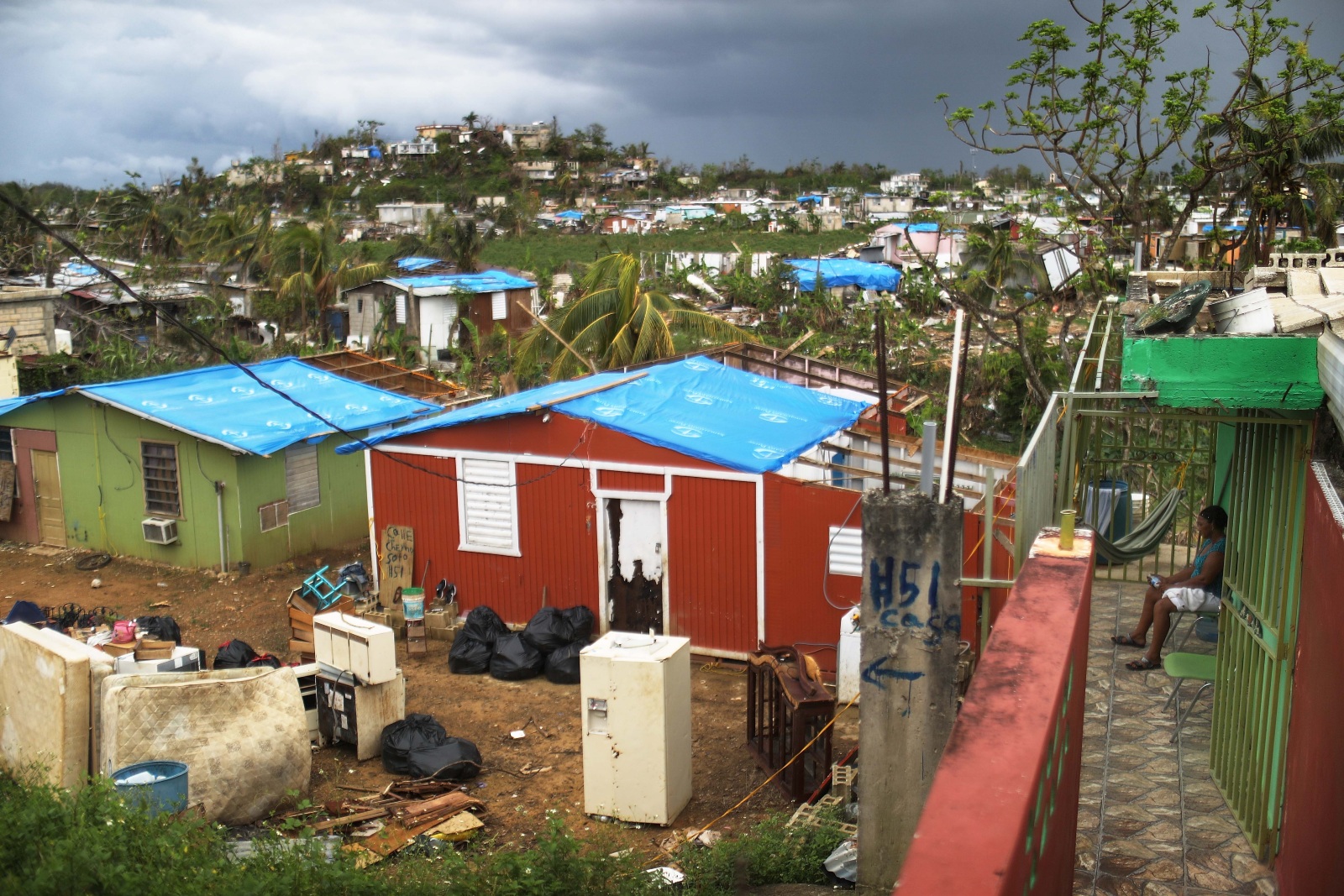
Damaged homes, some covered with tarps, stand in an area without electricity in San Isidro, Puerto Rico, after Hurricane Maria swept through, October 15, 2017.
Mario Tama / Getty Images
And there’s at least one completely new approach that doesn’t depend on the Supreme Court’s ruling.
A first-of-its-kind lawsuit filed by 16 towns in Puerto Rico in November accuses Chevron, ExxonMobil, Shell, and other fossil fuel companies of colluding to conceal how their products contribute to climate change. Their argument is that this collusion violated antitrust laws and the Racketeer Influenced and Corrupt Organizations Act, or RICO — a federal law passed in 1970 to take down the Mafia.
Racketeering cases relying on RICO have not only taken down mobsters like John Gotti and the Gambino crime family, but have also been successful against the Hell’s Angels biker gang, the Key West police department in Florida, as well as opioid manufacturers and tobacco companies. The Puerto Rico lawsuit seeks to make companies pay billions of dollars for the extensive damages that towns suffered during hurricanes Maria and Irma in 2017.
Because the lawsuit was filed in federal court, it won’t be pulled into the jurisdictional tug-of-war that has made other climate cases drag on for years.
“They’ve made it easy to prove,” said Melissa Sims, an attorney at Milberg, the Tennessee-based law firm representing the Puerto Rican cities, “because unlike all the other racketeering cases that have been on file, none of them included a written battle plan with a detailed division of labor on how they were going to accomplish their deception.”
This story was originally published by Grist with the headline How the Supreme Court could finally force Big Oil to face trial on Feb 3, 2023.
Before we get into today's post, I want to remind you that climate change is real. Big governments continue to poison and pollute. One of the things we all can do is plant more trees as well as saving our existing trees whenever possible. That's why Tree Services in Pensacola is doing everything to benefit the environment, while also beautifying your home's landscaping.
It’s late October in the northeast corner of Wisconsin. Trees have started to change colors and a colder wind whips across Lake Michigan. Gas station marquees welcome back fall hunters on their annual pilgrimage.
Tucked away at a technical college, citizens of the rural town of Peshtigo, population 4,006, try to get comfortable in plastic chairs, ready to hear from state officials, once again, about ways they may one day safely drink their home’s well water.
Cindy Boyle, the town’s board chair, is there with her husband, Chuck, one row up from the back. Cindy recently took to the political arena after years of cooking and cleaning with just bottled water.
Across the room, Jeff Budish, an avid angler and outdoorsman, waits to speak. He’s footed thousands of dollars buying his own bottled water and water filters; he also just wants to be able to fish safely. A few rows up from him sits Doug Oitzinger, a founding member of a local clean water advocacy group, taking diligent notes.
If a clear solution was sought by those in attendance at the state’s most recent in-person Peshtigo PFAS meeting, residents walked away empty handed. Officials told residents that plans to provide new groundwater wells are coming from the company responsible for the pollution, but not everyone gets a well.
Wisconsin Department of Natural Resources, or DNR, employees spoke at length about new data from water testing, but, without clear guidance from both the state and the federal government, and the mounting costs of providing alternative drinking water, officials’ hands are tied. Boyle, the town supervisor, said the DNR was doing everything in their limited power to help, but the company responsible is “uncooperative.”
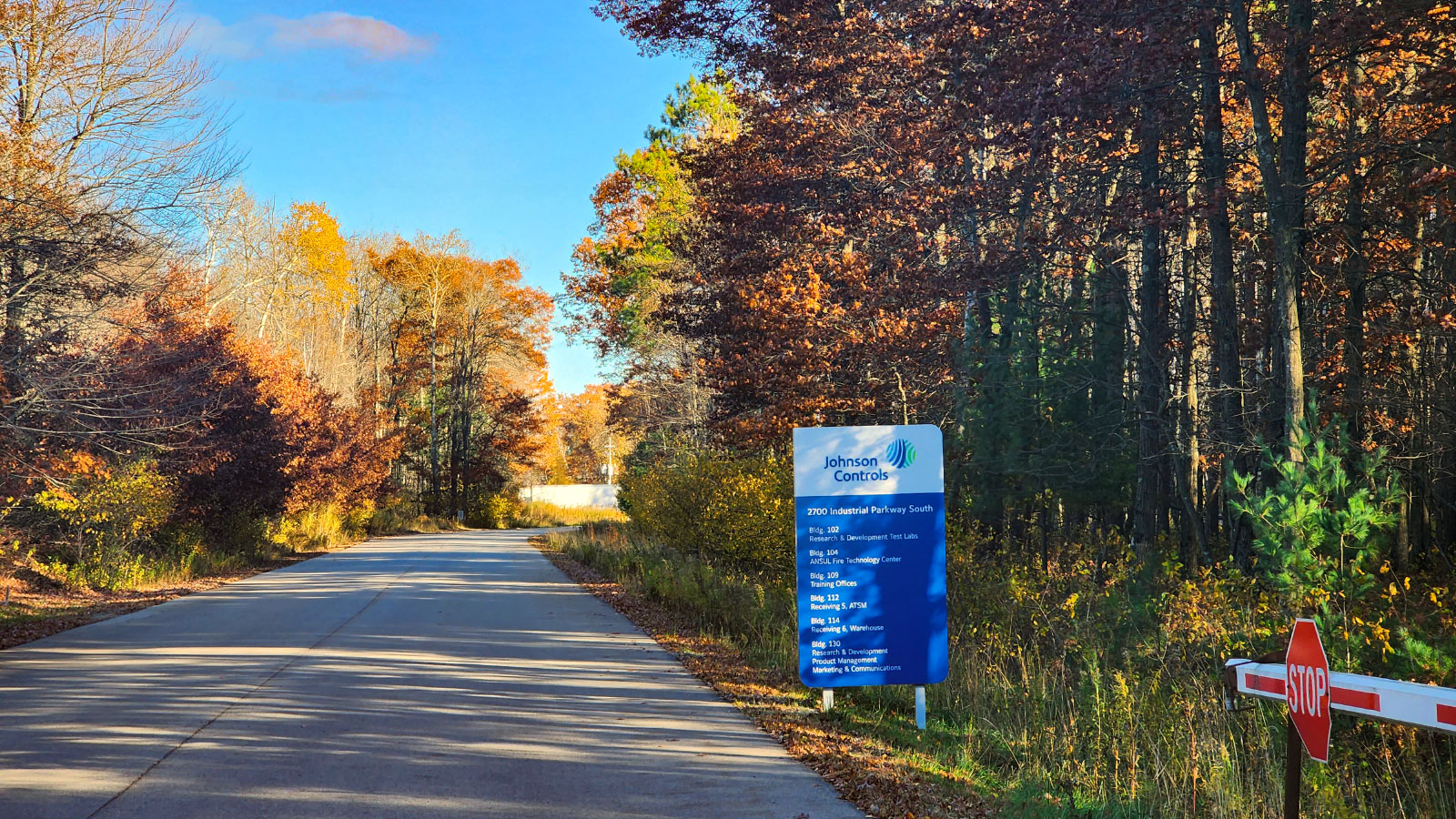
The entrance of Johnson Control’s Ansul Fire Technology Center can be seen in Marinette, Wisconsin, just outside of the town of Peshtigo. Previously known as Ansul, the company produced firefighting foam for decades in the region.
Grist / John McCracken
Residents in Peshtigo are exposed to dangerously high levels of a group of toxins known as per- and polyfluoroalkyl substances, or PFAS, in their groundwater, the source of their drinking water. PFAS are called “forever chemicals” because they are hard to break down in the environment. They’re also linked to high blood pressure in middle-aged women and stunted developmental growth in children, as well as kidney and testicular cancers.
Peshtigo’s PFAS problems stem from a local manufacturing facility that produces firefighting foam — a source of the chemicals so toxic that the Department of Defense recently banned their use. Over decades, a plume of PFAS spread through the community’s vast groundwater networks. Now, residents in this rural part of Wisconsin are forced to use bottled water to cook, clean, and drink until officials find ways to lower the chemicals’ concentrations.
The chemicals can be found everywhere: outdoor clothing, cosmetics, beef, rain, and even your blood. Cities from California to North Carolina have wrestled with contamination, with nearly every state having some form of pollution from these toxins and many now banning PFAS in all products sold within their borders.
At the start of this year alone, communities in Washington State, Massachusetts, and along the Mississippi River have reported elevated PFAS levels in groundwater and drinking water. The chemicals will take forever to break down in their environment, and if the rural town of Peshtigo is any indicator, the cleanup process will be just as long and arduous. Without enforceable standards from the federal level, states are scrambling to set their own standards and clean up procedures, a process that is often mired in politics.
“There was always a looming comment of ‘There’s something in the water.'”
Craig Koller, who grew up in Peshtigo, Wisconsin.
Peshtigo residents are torn over their options for getting clean water, which include the possibility of being absorbed into a nearby city and its public utilities, digging new wells at the expense of the company responsible, or building a brand new water utility system for Peshtigo itself. Hundreds of households are living on bottled water and water filtration systems. The town, state, and individuals have sued the company responsible.
Budish told Grist what he wants is simple: “What I’m looking for is clean water.”
But when PFAS are found in thousands of products, used in a variety of industries, and are now polluting every city in the country, determining who is responsible for the contamination and how it will be cleaned up gets messy.
In 2017, the state learned that Tyco, a subsidiary of global chemical conglomerate Johnson Controls International and one of the largest employers in the region, had been discharging PFAS into local streams and ditches in the region. According to state records, Tyco knew about these elevated levels at least four years earlier and failed to warn residents.
“This community has not been treated fairly,” Boyle told Grist.
The pollution stems from Tyco’s operations at a fire testing center that operated from the 1960s to 2017. This facility is located on the southern edge of the city of Marinette, roughly a mile from the town of Peshtigo.
Grist
First responders and military personnel would light planes, automobiles, and other heavy-duty equipment on fire at a location near the area high school, and then test the fire-suppressant foam Tyco sold. Afterward, gallons of foam would be washed away off the pavement into nearby streams where it would seep into the surrounding groundwater, eventually making its way into Peshtigo drinking wells.
Tyco also has found elevated levels of the chemicals in groundwater near a Johnson Controls chemical production plant, known locally as the Stanton Street plant, in the city of Marinette on the Lake Michigan shore. With PFAS present, Marinette residents are cautioned against recreation and fishing in local waterways, but their drinking water is safer than their neighbors as Marinette draws its municipal water from Lake Michigan.
Founded in 1915 as Ansul Corporation, the company had been making fire suppression technology in the area since 1934. It eventually merged with the publicly traded Johnson Controls International in 2016.
Tyco still tests the firefighting foam at its facility in the region, but these tests are now done indoors, company officials told Grist, and all foam and water used are captured and disposed of properly. Johnson Controls International has been working on bringing a PFAS-free foam to market, but the product is not available yet.
In an archive photo, workers from Madison, Wisconsin, test firefighting foam in 1965. Representatives from Ansul, the original Marinette, Wisconsin company now known as Tyco, were on site to test the foam. Wisconsin Historical Society
But these new testing procedures don’t erase decades of PFAS pollution into area streams. Town of Peshtigo residents living near the testing facility have cited ongoing health problems, such as stomach cancers and developmental delays in children, that they believe to be linked to years of drinking PFAS-contaminated water. Craig Koller, who grew up drinking Peshtigo well water, was diagnosed with two forms of testicular cancer right after he graduated high school.
He said he’s seen classmates with the same cancer, and friends’ parents with stomach cancers and immunity disorders, all of which are linked to prolonged exposure to the chemicals.
“There was always a looming comment of ‘There’s something in the water’,’” Koller told Grist.
Since his initial diagnosis, he estimates he’s had hundreds of thousands of dollars’ worth of invasive treatments and surgeries, and is spending at least $1,200 a year on his weekly, post-surgical testosterone treatment.Koller, who now lives in the suburbs of Milwaukee, said the response from Tyco has been disingenuous and help at the local, state, and federal level has been disjointed.
“Normally FEMA [or the Federal Emergency Management Agency] would come in if a flood wiped out an entire community,” Koller said. “But this response is not conducive to helping people move on with their lives.”
The area has been severely impacted by PFAS contamination, with levels of the chemicals found reaching astronomical numbers over the state standards.
Concentrated, PFAS-filled foam, which looks like a pillowy, toxic cloud, has been found throughout the region’s waterways. DNR testing has found levels of the chemicals as high as 750,000 parts per trillion, or ppt, for the foam that sits on top of surface water.
Some of the area’s creeks have reported levels as high as 3,800 ppt. Groundwater wells closest to the facility have reported concentrations of roughly 2,100 ppt, or 30 times the state’s drinking water standards. Nearly ten miles away from the fire testing facility, wells have tested positive for chemical levels over five times the state regulations.
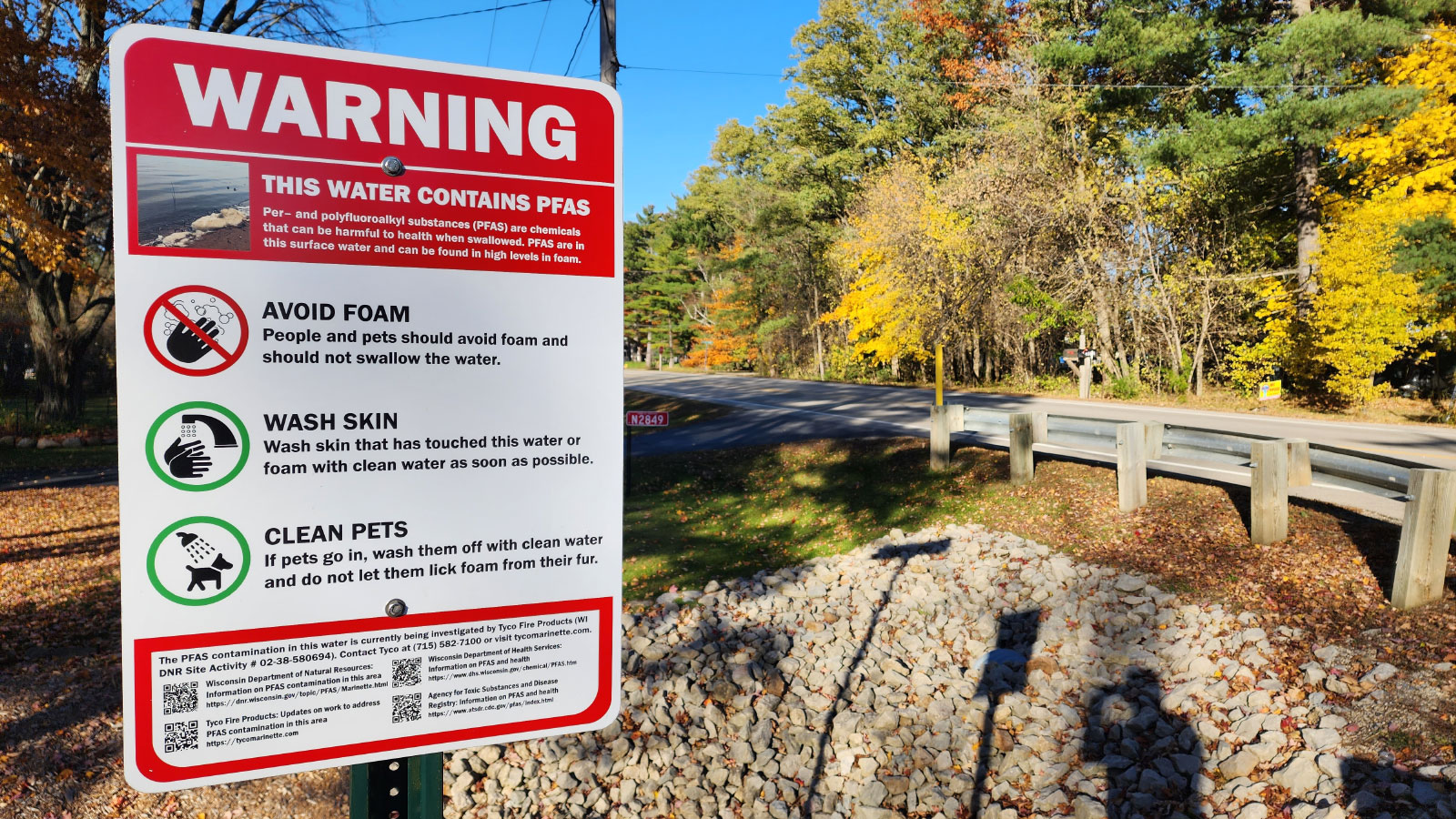
A sign in Peshtigo warns of the dangers of touching and consuming the area’s water. The area’s creeks and groundwater have tested for PFAS upwards of 3,800 parts per trillion, or ppt, of the various chemicals. This level is over 54 times the state’s drinking water standard. Grist / John McCracken
Wisconsin recently established a drinking water standard of 70 ppt, which affects municipal water utilities. But this doesn’t change much for Peshtigo, or the other nearly third of the state that relies on groundwater for drinking. Groundwater standards are being reviewed again this year after political football struck them down last year.
The state created a grant program for replacing contaminated private wells last year, including those impacted by PFAS, and Wisconsin Governor Tony Evers, a Democrat, recently announced a 2023 budget proposal that would invest $100 million in PFAS cleanup across the state.This budget, however, has to make it through the state’s Republican majority.
At the federal level, the Environmental Protection Agency, or EPA, has found that basically no consumption of these chemicals is safe. The agency is in the midst of a review of its practices and regulations of drinking water standards for the chemicals. Currently, there is no national standard for PFAS in drinking water.
Peshtigo residents have urged federal officials to declare the fire testing facility and the Stanton Street plant as a Superfund site, which would allow the EPA to clean up the site on Tyco’s dime. The agency said it is still reviewing the petition, which noted that the sites are a threat to human health and the environment after half a century of firefighting foam testing went unregulated. The EPA told Grist that it expects to respond to the petition by March of this year.
To Liz Hitchcock, director of federal policy for Toxic-Free Future, a national consumer safety nonprofit that studies and advocates for PFAS cleanup in various industries, the federal government isn’t moving quickly enough. Most federal responses, she noted, have been prompted by a bubbling up of state-level action.
“This is not a problem that’s happening in isolation,” Hitchcock told Grist. “It’s happening all over the country because PFAS chemicals have been in use for years without adequate regulation.”
Because of the ubiquitous use of these chemicals, the federal response has varied by different agencies, from the military to the Food and Drug Administration.
“There are so many uses of PFAS,” Hitchcock said. “It’s not just an issue of cleaning it up, but preventing the problem in the first place.”
Johnson Controls acknowledges its role in the contamination and has pledged to fix the problem for the area’s most impacted residents.
Katie McGinty is Johnson Controls International’s Chief Sustainability Officer and a former environmental advisor to the Clinton administration.
“Tyco takes full responsibility for the impact of the water of these 169 neighbors from our historic activities,” she said.
This 169 number, however, is controversial.
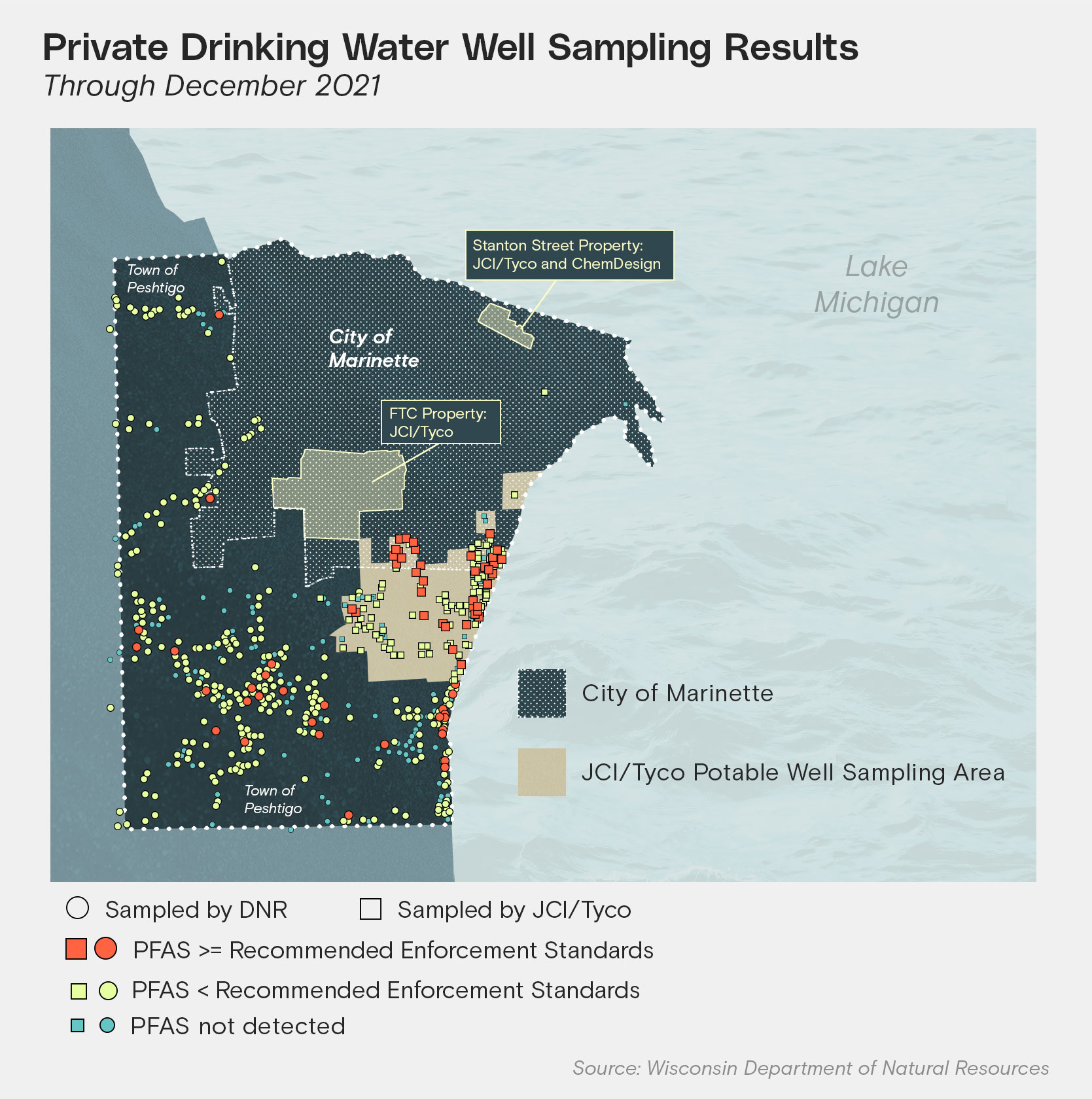
According to McGinty, Tyco currently provides water filtration systems and bottled water for those homes because they fall within what is known as the “potable well sampling area,” or PWSA: a sliver of the town that both the company and the Wisconsin Department of Natural Resources, or DNR, agree that Tyco polluted. The company has also constructed a $25 million Groundwater Extraction & Treatment System to remove the chemicals from the groundwater surrounding the fire testing facility. Outside of that, the two can’t agree on much.
Since the public announcement of the contamination, the DNR has conducted tests to study the spread of the contamination throughout the area’s groundwater systems. Forever chemicals have been found at elevated levels outside of the area Tyco takes responsibility for, a region known as the “expanded site area.”
Tyco is required to complete a site investigation to define the degree and extent of contamination related to its discharges of PFAS. In a statement, the DNR said results from Tyco’s completed site investigation, which the agency monitors, will be used to determine the company’s responsibility. Results are expected to be released this spring.
McGinty denies the company’s responsibility for these additional properties, arguing that the widespread prevalence of PFAS from various industries and consumer behaviors could have also played a role in contaminating groundwater in these expanded sites.
“We hope that the DNR will take action to determine and stop the sources of PFAS in that area, but Tyco is not the source,” McGinty said.
Last year, the Wisconsin Department of Justice filed an environmental enforcement lawsuit against the company for alleged failure to adhere to the state’s hazardous spill laws.
“It’s not just an issue of cleaning it up, but preventing the problem in the first place.”
– Liz Hitchcock, director of federal policy, Toxic-Free Future
As the back and forth of enforcement and corporate finger-pointing unfurls in legal battles and slow testing, residents that live outside the agreed-upon contamination area are on their own.
Budish, the angler from the Peshtigo town meeting, has lived at his property for 30 years, just off a state highway tucked behind rows of thick pine trees that stretch for miles, where neighbors get around using four-wheelers.
He lives outside of Tyco’s recognized area, but his drinking water is contaminated. He’s paid for private testing on his property and found high PFAS levels in his private well water, nearly 10 miles from the fire facility and even farther from the other plant,prompting him and his wife to buy their own bottled water for cooking and consumption for the past five years.
Speaking at the October meeting, he said he wonders if the ponds, creeks, and ditches surrounding his property on the outskirts of Peshtigo are also contaminated, but so far, he’s only been able to afford to test his groundwater drinking well.
He told Grist he estimates that he’s spent at least $100 a month on bottled water for the past five years. He has also purchased a water filtration system, which can range between $1,000 and $3,000.
Budish, wearing a camo hat and a blue sweater noting his love of fishing, lives in a state and region plagued by “don’t eat” advisories for both fish and deer, due to PFAS contamination.
“Why should I have to take everything out of my own pocket?” he asked.
Tyco is standing firm that its operations have not had anything to do with the contamination that residents like Budish face. The chemical signature of the PFAS found in the potable well sample area, the region it takes responsibility for, is vastly different from the ones found in the DNR’s expanded area, McGinty told Grist.
“If anybody in that expanded area is using dental floss, they’re putting some PFAS down their drain every day,” McGinty said. “If they’re doing some laundry, they’re putting PFAS down their drain. If they’re washing their frying pan, they’re putting some PFAS down their drain.”
Independent researchers from the University of Wisconsin, however, released research in January that tied Tyco’s chemical signature, or “PFAS fingerprint,” to a growing plume of chemicals in Green Bay, a freshwater bay of Lake Michigan located two miles from Stanton Street. Tyco said it has plans to review the study.
For the contamination it does claim responsibility for, Tyco will pay for new deep wells and water quality monitoring for residents. The wells will be drilled 500 feet into the ground and draw water from the deep aquifer in the area; Tyco will cover all expenses for 20 years. In addition, the company is paying out a $17.5 million class-action lawsuit, but only to those inside of the agreed-upon contaminated area.
Workers can be seen drilling a new deep well in the town of Peshtigo. Tyco plans to cover the expenses of installation and other costs for the next 20 years, but not everyone in the area who have toxic PFAS chemicals in their wells will get one.
Tyco/JCI
Wisconsin environmental officials have been skeptical of Tyco’s deep well plans and have urged the company to not advertise new wells as a final, long-term solution. In a statement provided to Grist, the DNR said it agrees with the company’s design criteria for the deep wells, but concern for other contaminants, such as radium, strontium, and high iron, exist in the region.
As other states take aim at PFAS polluters, Governor Evers and state Attorney General Josh Kaul joined more than a dozen other states in suing large companies for their role in the contamination. The two Wisconsin officials filed a lawsuit last July against Tyco, 3M, DuPont, and other PFAS polluters in the state, alleging they should have known that the ordinary and intended use of their products would lead to dangerous impacts on public health and the environment across Wisconsin.
As company officials, regulators, and residents continue to fight over who is responsible for this growing crisis, costs are mounting. Since Tyco only claims responsibility for a sliver of the plume, the state is tasked with providing bottled water for residents outside the PWSA while the chemical company and the DNR hash out responsibilities in court. State testing and bottled water funds, however, are running out.
Christine Sieger, director of the agency’s remediation program, said just over half a million dollars has been spent by the DNR to provide bottled water to residents in the state, with the majority of those funds going to Peshtigo and French Island, Wisconsin, a community with newly discovered PFAS contamination. She told Grist that the agency has not been provided new or additional money from the legislature to supply bottled water to residents with PFAS-contaminated drinking water.
At the beginning of 2022, the DNR had tested over 400 wells in the extended area. Over 300 had PFAS detected in them. But funding ran out to conduct any more.
Melissa Agard, a Democratic Wisconsin state senator and lead author of a comprehensive bill to address PFAS and other pollutants, said the lack of appropriate funding for the DNR is part of a larger problem in the state — her colleagues across the aisle.
“The biggest roadblock we have is the majority party,” Agard, who represents the capital city Madison, a community also polluted with PFAS, and surrounding cities, told Grist.
Currently, Wisconsin has a Republican majority in both houses of the state legislature. Agard said she has attempted to introduce the bill multiple times in past years, but it has not seen the light of day through public hearing sessions, a process set by the majority party.
Republican members of the state’s finance committee have expressed interest in using the state’s historic surplus funding to address the problem, while a newly appointed DNR secretary has called for increased oversight and funding from the state legislature.
Agard said a lack of funding for bottled water is concerning, but bottled water is not a long-term solution.
“We are not taking a comprehensive, holistic approach to address PFAS contamination in the state of Wisconsin right now,” Agard said.
The Peshtigo town board is investigating the idea of creating a water utility district and paying for the utility by way of a lawsuit lodged by the rural town against the company last year. This costly infrastructure project recently secured $1.6 million of federal funds as part of a variety of PFAS remediation funds earmarked by Wisconsin Democratic Senator Tammy Baldwin.
Still, not everyone in the town wants the increased taxes that potentially come with a public water supply, again highlighting the fractured nature of the area’s response to this national problem.
Jennifer Friday, a Peshtigo resident who lives in the PWSA, is pursuing yet another approach.
She doesn’t want the water utility district and has been involved with efforts to annex select households into Marinette, their bigger neighbor to the north. If this process moves forward, these residents would become citizens of Marinette and receive the city’s municipal water. Friday, who is now running against Boyle for the town chairperson seat, said she estimates 90 residents are interested in this process, but the group still needs a vote before Marinette’s city council.
If these residents annex themselves into the neighboring city, they would forgo their private wells for water from Lake Michigan’s Green Bay. As more and more communities around the Midwest are experiencing problems with their groundwater, be it contamination, aging infrastructure, or drying aquifers, Lake Michigan water is an increasingly hot commodity.
But that doesn’t mean it’s safe. While Green Bay has had low levels of the chemicals present in its waters in the past, concerns now linger after the University of Wisconsin study was released.
Tyco said it would provide neighbors in Peshtigo with the legal support they need to meet the requirements of the annexation process as well as offer to pay for the new costs associated with annexation, which include 20 years of increased property taxes and water bills for the annexed property. The annexation process has to be resident-driven and the city of Marinette must receive a petition from interested parties and vote on the annexation.
“I’m not pushing annexation,” Friday said. “I’m pushing resident choice.”
Andrea Maxwell, a Peshtigo resident for 10 years who has been provided water by Tyco for the last several, chose the deep well route instead, with the new system installed in early December. Her home is right in the center of the plume. While her well has not tested positive for PFAS, her neighbors’ have.
According to the company, more than 40 deep-well agreements have been signed; contractors are waiting for the ground to thaw to begin construction in the spring. Tyco will pay for the well maintenance, filters, water salt, testing, and other associated costs, including fixing any future PFAS contaminations.
“That’s a pretty good deal, we feel like,” Maxwell said, “rather than us sitting around worrying if we could maybe be contaminated in five years.”
Standing on Kayla Furton’s lawn in Peshtigo, you can see Green Bay. Around the corner, there’s a ditch with chemical hazard signs warning not to touch or consume the water in it.
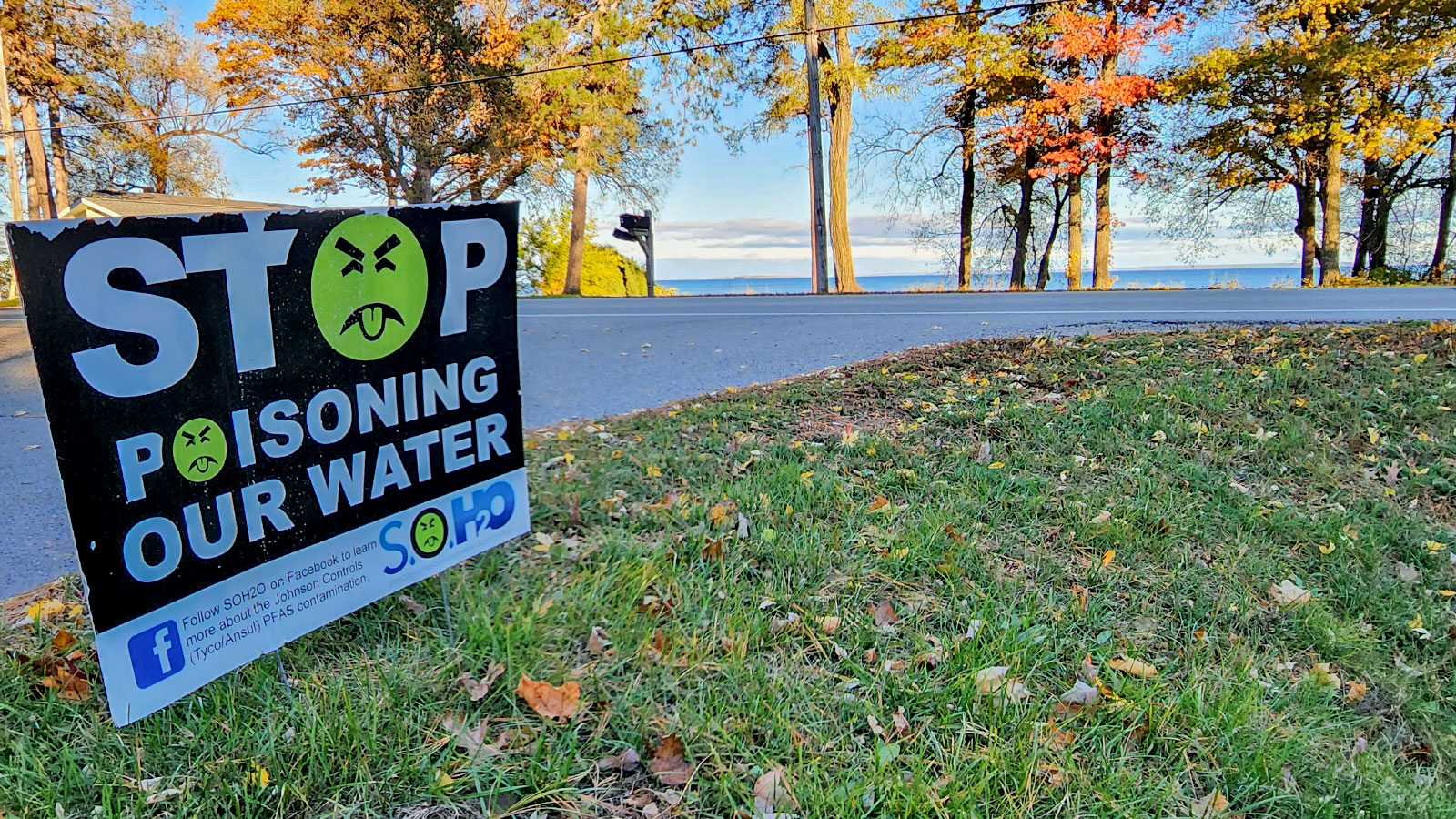
On Kayla Furton’s lawn, a sign is displayed advocating for clean water in the town of Peshtigo, Wisconsin,. Furton’s home is within the potable well sample area, a designated zone created by the DNR where Tyco claims responsibility for PFAS pollution.
Grist / John McCracken
Two houses down, no obvious geographical barriers exist, but her neighbors are outside of the zone Tyco claims responsibility for and have to fend for themselves to get clean water, much like Budish.
“It’s just an arbitrary line,” Furton, a town supervisor, told Grist.
To her, the fragmented, neighbor-versus-neighbor response has been hard on the community. She does qualify for a free well, but in doing so, she waives her liability rights. She also doesn’t see new deep wells for a small group of people as a permanent answer for the thousands of residents in the region.
“I do think people are tired,” she said. “I know I am. I know my kids are sick of hearing about PFAS.”
When asked if she has considered moving out of the area, Furton, who recently filed a lawsuit against Tyco, said she gets that question a lot, and it can be loaded. She believes her home is more than just a property, it’s where she grew up and where her children have planted roots.
“Yes, we could,” Furton said. “We could, but there’s no guarantee there’s not PFAS contamination somewhere else.”
This story was originally published by Grist with the headline Cleaning up ‘forever chemicals’ is costly and messy — just ask this Wisconsin town. on Feb 2, 2023.
If you're serious about the environment, we all know planting trees is one of the best solutions and tree removal should be a last resort which is why we're committed at Pensacola Tree Services to provide the very best for your home as well as the environment. Read more by going here.
In 2019, oil and gas companies operating on tribal and federal lands lost $63 million in revenue from venting, flaring, and leaking infrastructure. That loss, according to a report from the Environmental Defense Fund and Taxpayers for Common Sense, shows that Indigenous nations lost the most potential royalty revenue: approximately $21.8 million. Researchers say that total loss across all lands represents enough natural gas to power 2.2 million households for a year – almost every home in New Mexico, North Dakota, Utah, and Wyoming combined. However, those numbers are likely much higher: researchers did not include emissions from Alaska, Michigan, Nebraska, Illinois, or Indiana.
Gas is wasted when it is released directly into the atmosphere through venting, or burned at the site of extraction by flaring, or when it leaks from aging or ill-fitting infrastructure. As a potent greenhouse gas with warming power 80-times that of carbon dioxide, methane is often released with additional air pollutants. Those emissions contribute heavily to climate change and poor healthcare outcomes for local communities.
Synapse Energy Economics, the consulting firm that conducted the analysis, found that 54 percent of the gas lost in 2019 was due to flaring, 46 percent to leaks, and less than 1 percent to venting. Researchers found that on federal lands, a majority of natural gas is lost to leaks while on tribal land, most loss is attributed to flaring. Overall, roughly $275 million worth of gas is lost through flaring.
Wasted methane shortchanges the royalties that tribal, state and federal governments collect for oil and gas production that often fund priorities like education, infrastructure and public services. According to the report, while tribal governments lost the most potential revenue, states lost $20.5 million and the federal government lost $21.3 million. Additional research showed that flaring rates on Mandan, Hidatsa, and Arikara Nation lands atop the oil-rich Bakken formation were extremely high compared to public and tribal lands outside of North Dakota. Lost royalties from the MHA Nation totaled an estimated $19 million.
“We can’t continue to allow half a billion dollars’ worth of taxpayer-owned resources to go to waste every year,” Jon Goldstein, a senior director at the Environmental Defense Fund, said in a press release. “The Biden administration has a clear opportunity to step up with strong rules that stop waste and pollution from practices like routine flaring to protect the public interest. These resources should benefit priorities like education and infrastructure, not be released into the atmosphere to undermine our climate and health.”
The report comes in the wake of two proposed rulings from the EPA and the Bureau of Land Management aimed at reducing methane waste. Both proposals were issued last November and the EPA is accepting public comment on their proposal until February 13th.
Goldstein said that the two proposed rulings target methane emissions from different lenses. The EPA ruling operates with a “pollution-oriented focus”, while the BLM ruling, which would target only federal and tribal lands, has a “waste-oriented focus”. Together, the two strategies offer complementary solutions to reduce emissions, but Goldstein says that a crucial, missing provision is to limit how much gas can be flared in the first place.
“There should be guardrails that narrowly define conditions flares are allowed in,” Goldstein said. “[Otherwise], it just becomes the cost of doing business. Oil and gas companies just write a check and continue to flare and waste.”
This story was originally published by Grist with the headline Report: Burning gas in oil fields cost tribes $22 million on Feb 2, 2023.
Before we get into today's post, I want to remind you that climate change is real. Big governments continue to poison and pollute. One of the things we all can do is plant more trees as well as saving our existing trees whenever possible. That's why Pensacola Tree Services is doing everything to benefit the environment, while also beautifying your home's landscaping.
While Americans were reckoning with sky-high gas prices at the pump last year, the country’s biggest oil giant was raking in more money than ever. Exxon Mobil, one of the world’s largest oil companies, reported on Tuesday that it made $56 billion in profits in 2022. That’s the most a Western oil company has ever earned and averages out to around $6.3 million an hour over the course of the year.
It’s not just Exxon. Other major oil companies such as Chevron and Shell are expected to report similar results in the coming weeks, pushing their combined profits to around $200 billion, according to the financial markets data firm Refinitiv.
Darren Woods, Exxon’s CEO, praised the company’s results on calls with the press, calling them proof that it was right to ignore advice to pull back from fossil fuel production and invest more in renewables. Other oil giants like BP have shifted more of their resources to solar and wind projects – investments that don’t have immediate payoffs.
“We leaned in when others leaned out, bucking conventional wisdom,” Woods said in an interview with CNBC.
The unprecedented earnings stem from a combination of trends. In the early days of the pandemic, demand for oil plunged and gas prices nosedived, prompting companies like Exxon to cut costs by shuttering refineries and laying off workers. Just as the economy began to recover, Russia invaded Ukraine, causing a major supply squeeze as the demand for oil returned to pre-pandemic levels. The result: soaring gas prices and major profits for Exxon.
Governments have responded with anger to Big Oil’s rising profits. In the fourth quarter of 2022, a new EU windfall tax dealt a $1.3 billion blow to Exxon’s overall earnings. The company is now challenging the policy in court.
“It’s just unlawful and bad policy trying to tax something, when what you actually need is for it to increase,” Exxon’s CFO Kathryn Mikells told Reuters. “It has the opposite effect of what you’re trying to achieve.” The European Commission has maintained that the windfall tax is within its legal authority.
President Joe Biden has also lashed out at American oil companies, accusing executives of limiting production at a time when gas was prohibitively expensive.
“The latest earnings reports make clear that oil companies have everything they need, including record profits and thousands of unused but approved permits, to increase production, but they’re instead choosing to plow those profits into padding the pockets of executives and shareholders while House Republicans manufacture excuse after excuse to shield them from any accountability,” said White House spokesman Abdullah Hasan.
Absent from the discussion is any mention of what boosting oil production could mean for the Biden administration’s climate goals. The International Energy Agency has said that no new oil and gas fields should be developed if the world is to stay on track to limit global temperature increase to 1.5 degrees Celsius above pre-industrial levels and avoid the most disastrous impacts of climate change.
But the rush to wean European countries off Russian natural gas has driven the president to approve new fossil fuel projects. This week, his administration is reportedly planning to direct the Department of the Interior to grant partial approval to a massive new oil drilling project on federal lands in northern Alaska. Led by oil giant ConocoPhillips, the so-called “Willow project” is expected to unlock more than 600 million barrels of crude, a prospect at odds with Biden’s stated goals of taking action against climate change.
After news of the upcoming report broke, environmental advocacy organizations such as the National Resources Defense Council blasted the Biden administration, accusing it of planting a carbon bomb at a time the world needs just the opposite.
“We can’t keep drilling to the ends of the Earth while a runaway climate crisis ravages our world,” said Manish Bapna, the NRDC’s president, in a statement. “The administration needs to draw a line in the tundra, hold the line on carbon pollution, and speed the shift to cleaner, smarter ways to power our future.”
This story was originally published by Grist with the headline Exxon reports record profits, doubles down on fossil fuels on Feb 1, 2023.
I'd like to take this time to remind you that climate change is real. The actions of big governments continue to pollute and poison the environment. Whenever feasible, we should all plant more trees and preserve our existing ones. That's why Tree Services in Pensacola strives to do both while also improving your home's landscaping. Read more about how they're making changes at https://treeservicespensacola.com
After months of tense negotiation, a half-dozen states have reached an agreement to drastically cut their water usage and stabilize the drought-stricken Colorado River — as long as California doesn’t blow up the deal. The plan, which was developed without the input of Mexico or Native American tribes that rely on the river, seeks to stave off total collapse in the river for another few years, giving water users time to find a comprehensive solution for the chronically-depleted waterway.
On Monday, six out of the seven states that rely on the Colorado announced their support for steep emergency cuts totaling more than 2 million acre-feet of water, or roughly a quarter of annual usage from the river. The multi-state agreement, prodded into existence by the Biden administration’s threats to impose its own cuts, will likely serve as a blueprint for the federal government as it manages the river over the next four years, ushering in a new era of conservation in the drought-wracked Southwest. While the exact consequences of these massive cuts are still largely uncertain, they will almost certainly spell disaster for water-intensive agriculture operations and new residential development in the region’s booming cities.
But California, which takes more water than any other state, has rejected the proposal as too onerous, instead proposing its own plan that forces other states to take larger cuts. If the federal government does adopt the six-state framework, powerful farmers in California’s Imperial Valley may sue to stop it, setting up a legal showdown that could derail the Biden administration’s drought response efforts.
Nevertheless, the general consensus on pursuing immediate, dramatic water cuts is unprecedented.
“It puts something down on the table that we haven’t had before,” said Elizabeth Koebele, an associate professor at the University of Nevada-Reno who studies the Colorado River. “The states are saying, ‘We recognize just how bad it is, and we’re willing to take cuts much, much sooner than we had previously agreed to.’”
The Colorado River has been oversubscribed for more than a century thanks to a much-maligned 1922 contract that allocated more water than actually existed, but it has also been shrinking over the past 20 years thanks to a millennium-scale drought made worse by climate change. Last year, as high winter temperatures caused the snowpack that feeds the river to vanish, water levels plummeted in the river’s two key reservoirs, Lake Powell and Lake Mead, threatening to knock out electricity generation at two major dams.
Federal officials intervened in June, ordering the seven Colorado River Basin states to find a way to reduce their annual water usage by between 2 and 4 million acre-feet. This was a jaw-dropping demand, far more than the states had ever contemplated cutting, and they blew through an initial August deadline to find a solution. The feds upped the pressure in October, threatening to impose unilateral cuts if state officials didn’t work out a solution.
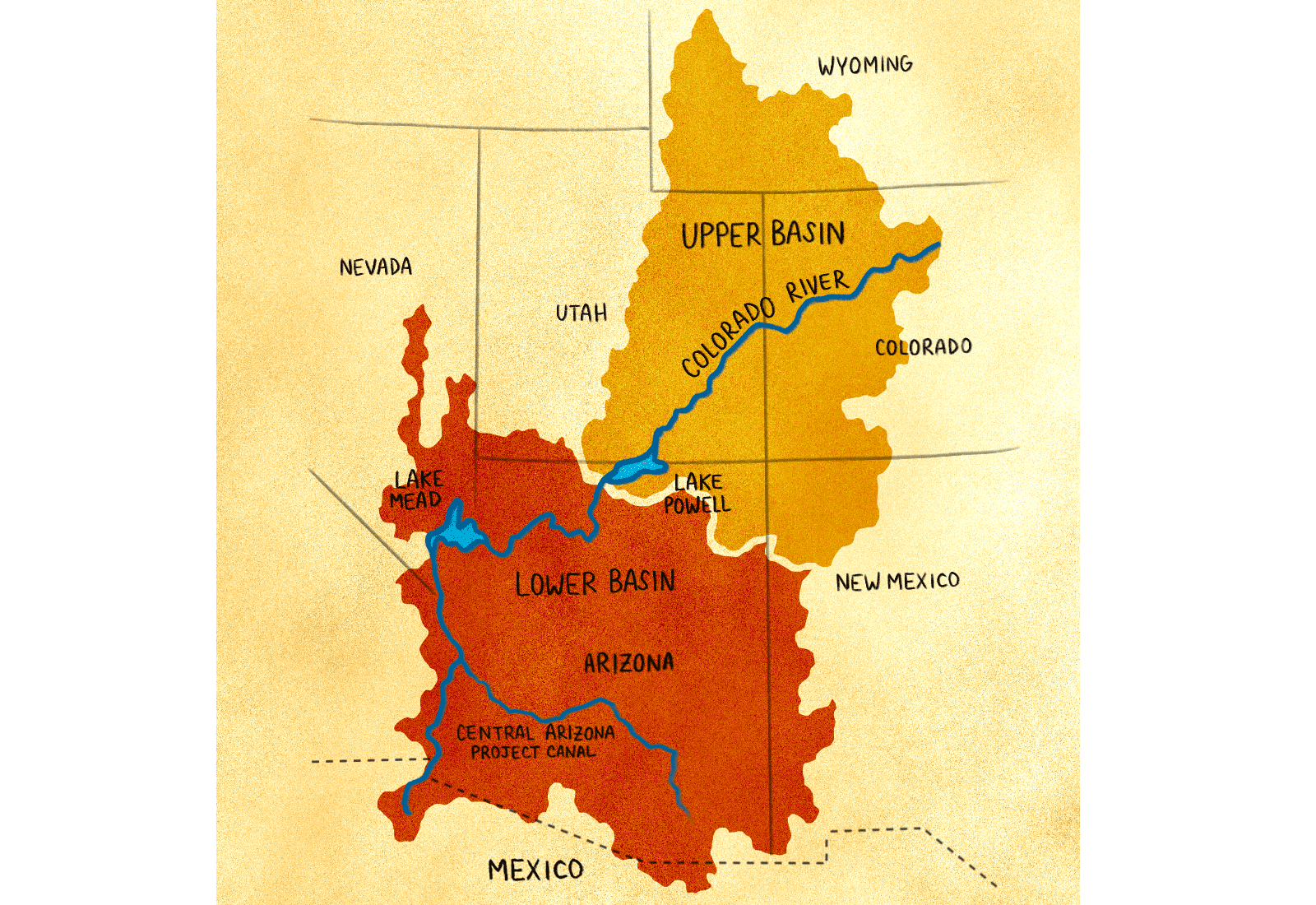
A century-old agreement divides the Colorado River Basin into two sections, the Upper Basin and the Lower Basin, which are now at odds over how to handle a climate-fueled drought. Grist / Amelia Bates
As the interstate talks proceeded, long-buried conflicts began to resurface. The first major conflict is between the Upper Basin states — Wyoming, Colorado, New Mexico, and Utah — and the Lower Basin states: Nevada, Arizona, California, and Mexico. The Upper Basin states argue that the Lower Basin states should be the ones to cut water in response to the drought. These states use much more water, the argument goes, and they also waste a lot of water that evaporates as it flows downstream through reservoirs and canals. The Lower Basin states, meanwhile, argue that no states should be exempt from cuts, given the scale of reductions needed.
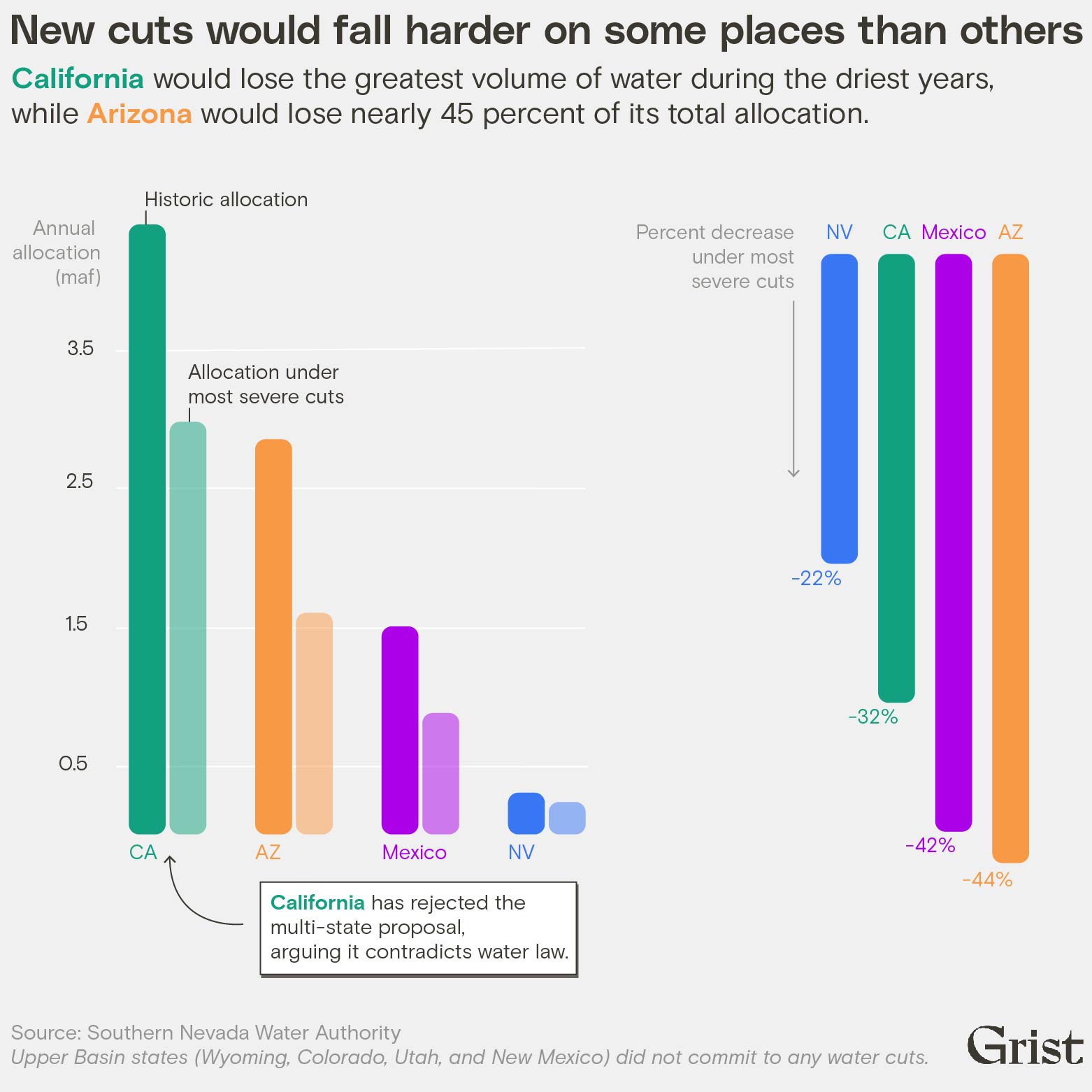
The other main conflict is between Arizona and California, the two largest Lower Basin water users and the main targets of future cuts. California’s water rights trump Arizona’s, and therefore the Golden State argues that Arizona should shoulder almost the whole burden of future cuts. Arizona argues in turn that its farms and subdivisions have already cut their water usage in recent years as the drought has gotten worse, and that water-rich farmers in California should do more to help.
In the middle of these warring parties is Nevada, which takes only a tiny share of the river’s water and has emerged as the Switzerland of the Colorado River system over the past year. Water officials from the Silver State have been trying since late summer to broker a compromise between the Upper and Lower Basins and between Arizona and California, culminating in an intense session of talks in Las Vegas in December.
The talks were only partly successful. Officials managed to work out a framework that meets the Biden administration’s demands for major cuts, bringing an end to a year of uncertain back-and-forth. The proposal would cut more than a million acre-feet of water each from Arizona and California, plus another 625,000 acre-feet from Mexico and 67,000 acre-feet from Nevada, adding new reductions to account for water that evaporates as it moves downstream. In return for these Lower Basin cuts, the Upper Basin states have agreed to move more water downstream to Lake Powell, helping protect that reservoir’s critical energy infrastructure — but they haven’t committed to reduce any water usage themselves.
Grist / Jessie Blaeser
“It seems like the Lower Basin states conceded to the Upper Basin,” said Koebele. An earlier version of the six-state proposal called for the Upper Basin to reduce water usage by a collective 500,000 acre-feet, but that call was absent from the final framework.
While the fight between the Upper and Lower Basin states appears neutralized, the conflict between the Lower Basin’s two biggest users is ongoing. Around 40 percent of the agreement’s proposed reductions come from California, where state officials have slammed it as a violation of their senior water rights, derived from a series of laws and court decisions known collectively as the “law of the river.”
“The modeling proposal submitted by the six other basin states is inconsistent with the Law of the River and does not form a seven-state consensus approach,” said J.B. Hamby, California’s lead representative in the talks. Hamby argued that penalizing California for evaporation losses on the river contradicts the legal precedent that gives California clear seniority over Arizona.
Officials from the Golden State released their own rough framework for dealing with the drought on Tuesday. The plan offers a more forgiving schedule than the six-state framework, saving the largest cuts for when Lake Mead’s water level is extremely low, and it forces more pain on Arizona and Mexico. The framework only requires California to cut around 400,000 acre-feet of new water, which the biggest water users already volunteered to do last September in exchange for federal money to restore the drought-stricken Salton Sea. Water users in the state haven’t made new commitments since.
If the Biden administration moves forward with the plan, it may trigger legal action from the Imperial Irrigation District, which represents powerful fruit and vegetable farmers in California’s Imperial Valley. The district sued to block a previous drought agreement back in 2019, and its farmers have the most to lose from the new framework, since they’ve been insulated from all previous cuts. The state’s other major water user, the Metropolitan Water District of Southern California, has signaled tentative approval for the broad strokes of six-state formula, indicating that a compromise between the two plans might be possible, although it’s not clear such a compromise would please Imperial’s farmers.
“I don’t see how we avoid Imperial suing, other than a bunch of big snowpack,” said John Fleck, a professor of water policy at the University of New Mexico. In response to a request for comment from Grist about litigation, an Imperial spokesperson emphasized the need for “constructive dialogue and mutual understanding.” If Imperial did sue and win, the outcome would likely be even further pain for Arizona and Mexico, where farmers and cities are already struggling to deal with previous cuts.
Grist / Jessie Blaeser
Koebele told Grist that while the exact numbers may change, federal officials will likely adopt some version of the six-state proposal by the end of the summer. Even a modified version would alter life in the Southwest over the next four years, imposing a harsh new regime on a region whose water-guzzling produces a substantial portion of the nation’s vegetables and cattle feed. Major cities like Phoenix, Los Angeles, and Tijuana would also see water cuts, threatening growth in those places.
Steep as the new cuts are, though, they will only last until 2026, when basin leaders will gather again to work out a long-term plan for managing the river over the next two decades. Unlike the current round of emergency talks, that long-term negotiation will include representatives from Mexico and the dozens of Native American tribes that rely on the river.
Koebele said that the questions in those talks will be even more difficult than the ones the states are debating now. Instead of just figuring out who takes cuts in the driest years, the parties will have to figure out how to apportion a perennially smaller river while also fulfilling new tribal claims on long-sought water rights. The present crisis has only delayed progress on those bigger questions.
“Because of the dire situation, we’ve really had to turn our attention to managing for the present,” she said. “So these actions feel more like a Band-Aid to me.”
This story was originally published by Grist with the headline There’s a deal to save the Colorado River — if California doesn’t blow it up on Feb 1, 2023.