Before we get into today's post, I want to remind you that climate change is real. Big governments continue to poison and pollute. One of the things we all can do is plant more trees as well as saving our existing trees whenever possible. That's why Pensacola Tree Services is doing everything to benefit the environment, while also beautifying your home's landscaping.
When President Biden signed the $1.2 trillion Bipartisan Infrastructure Package into law last November, many saw it as an opportunity to combat climate change.
The bill could slash emissions from transportation, which is responsible for 27 percent of all U.S. climate pollution. With some $600 billion in new funding for the sector, the Biden administration encouraged state leaders to build out public transit systems and expand “non-motorized” transportation infrastructure, like bike lanes. One analysis from the Georgetown Climate Center estimated that these actions could reduce transportation emissions by 14 million tons per year by 2032 — about as much as the annual emissions from 4.5 million passenger vehicles.
However, some policymakers are flouting that advice.
According to a new report from the nonprofit U.S. Public Interest Research Group, or PIRG, state and local governments are at risk of squandering federal funds to build or expand major highway systems. These “boondoggles,” as the report calls them, would harm local communities and exacerbate climate change, all while failing to solve the traffic and safety problems they claim to address.
“Highway expansion harms our health and the environment, doesn’t solve congestion, and creates a lasting financial burden,” the report says. Although nearly every state has one or more highway expansion projects in the works, the authors highlight seven that would lock in polluting infrastructure and divert a whopping $22 billion away from other transportation needs.
One project is the M-83 expansion, a $1.3 billion project proposed in Montgomery County, Maryland, just northwest of Washington, D.C. According to county officials, the four- to six-lane highway expansion is needed to “relieve projected congestion” and “enhance the efficiency of the roadway network.” Although the project has been paused since November 2017 as city leaders debate its future, it remains part of Montgomery County’s Master Plan of Highways — meaning it could still be built at any time.
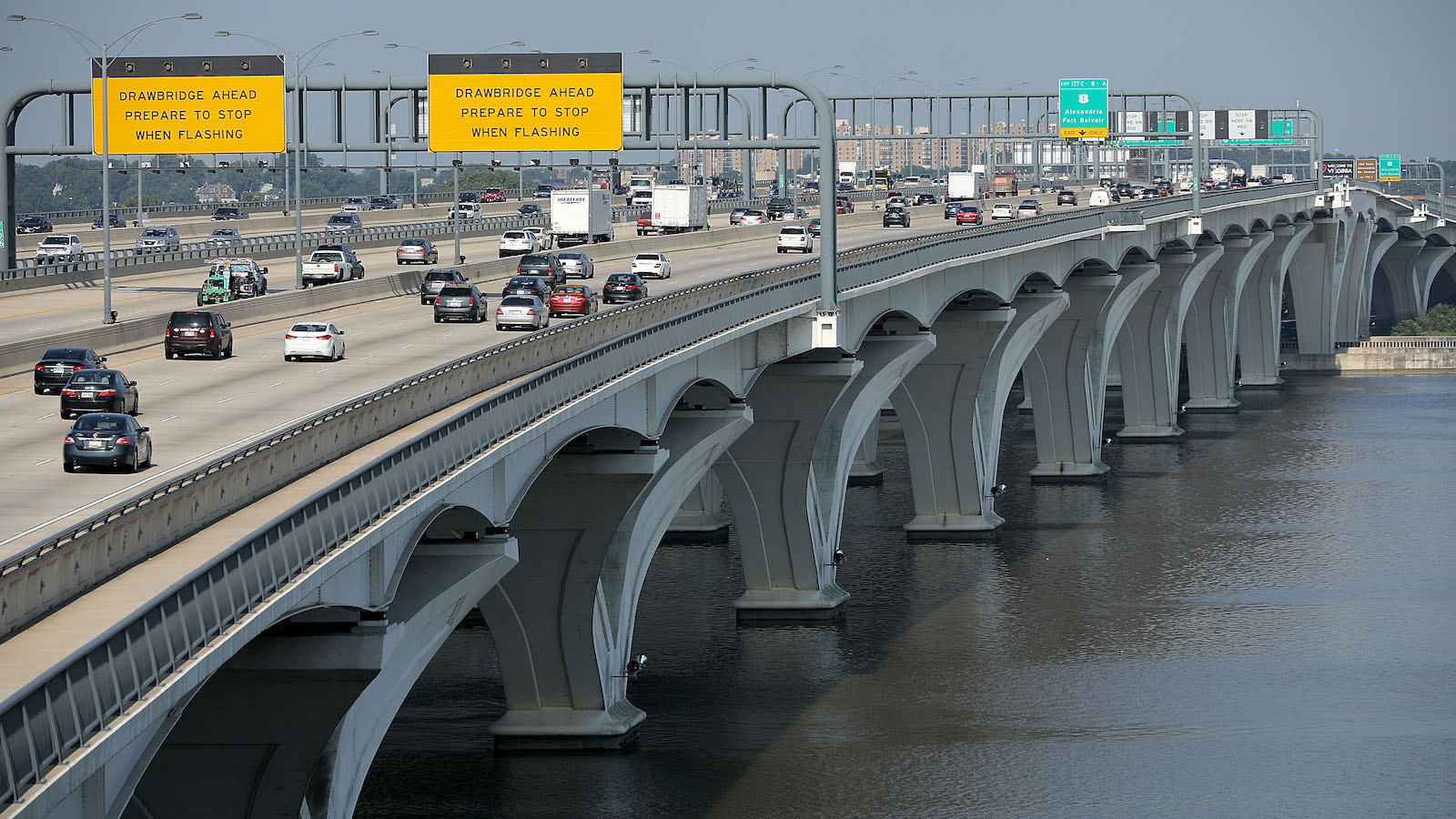
Traffic from Washington D.C. feeding into Maryland.
Chip Somodevilla / Getty Images
Diane Cameron, director of the advocacy group Transit Alternatives to Mid-County Highway Extended Coalition — better known as TAME — said the M-83 expansion is unlikely to alleviate Montgomery County’s traffic problems and should be removed from the Master Plan. “Building and expanding more highways is not the solution to congestion, it actually encourages even more vehicles to be out there,” she said. “The more you build, the more they come — and the more congestion there is in a never-ending cycle.”
That cycle is a well-documented phenomenon known as “induced demand,” in which bigger highways catalyze a series of societal decisions that bring congestion back to pre-expansion levels — or worse. For example, more homes and businesses may crop up along a bigger travel corridor, creating new destinations that are only accessible by car. Bigger highways can influence people to use their vehicles instead of public transit, leave later for work, or move farther away from the city center.
Nationwide, induced demand has already canceled out the congestion benefits of highway expansion over the past few decades. Although the U.S. has added nearly 870,000 lane-miles of highway since 1980, a Texas A&M Transportation Institute report published last year estimated that pre-pandemic congestion on American roadways is worse than it was in the early 1980s.
Expanded highways “might make your commute a little bit shorter for a little while, but eventually that traffic’s probably coming back,” said Matt Casale, PIRG’s director of environment campaigns and one of the report’s lead authors.
Highway expansion can cause a constellation of other problems. In Maryland, Cameron worries that the M-83 expansion would damage local waterways and put schools and homes within a 500-foot “pollution zone” where they’re exposed to increased transportation-related air pollution — which already kills tens of thousands of people every year. Elsewhere, critics argue that a $745 million, 8-mile bypass in southwestern Virginia would damage or destroy nearly 600 acres of forest and farmland. And in Duluth, Minnesota, the $510 million reconstruction of a downtown interchange has been criticized for sapping money away from bus, walking, and biking infrastructure, as well as much-needed repairs for existing roads.
Bicycle commuters in San Francisco.
Paul Chinn / The San Francisco Chronicle via Getty Images
Because highways and other polluting infrastructure are disproportionately cited near low-income communities and communities of color, highway expansion can also pose equity concerns. In Pennsylvania, for instance, a proposed redesign of the Erie Bayfront Parkway — which could cost up to $100 million — has been criticized for potentially exposing Black and brown neighborhoods to more air pollution and separating them from greenways.
“This is a civil rights issue. This is an environmental justice issue,” Gary Horton, president of the Erie NAACP, told a local newspaper.
Instead of doubling down on highway expansion, Casale called for a “fix-it-first policy” that focuses on repairing existing infrastructure. According to a 2021 report card from the nonprofit American Society of Civil Engineers, the U.S. already has a $435 billion backlog of necessary road repairs, with an additional $230 billion needed for bridge repairs and system-wide safety, operational, and environmental improvements.
“To the extent that we are spending on our roads and bridges, we shouldn’t be building new ones,” Casale said. “We should be making sure that the ones we have are safe and up to a state of good repair.”
The report also urges government officials to prioritize investments in public transportation, biking, and pedestrian infrastructure — all of which can effectively address congestion while minimizing damages to public health and the environment. Cameron added that strategically located affordable housing can also be a transportation solution, if built near existing transit stations that give people easy and car-free access to cities’ urban centers.
These measures will take significant public investment, but data suggests they’re broadly popular among the U.S. electorate. According to polling published last month by Data for Progress, three-quarters of all likely voters — across party lines — want the government to spend more money on public transit, and vast majorities think that improved transit would benefit the U.S. and their communities.
To Casale, Biden’s infrastructure package could represent “a turning point” for American transit. “We can take this injection of money and look at it as an opportunity to invest in 21st-century transportation,” he said. “Options that don’t pollute our air, that don’t worsen the climate crisis, and that make our lives better.”
This story was originally published by Grist with the headline Against federal guidance, states plan to expand highways on Sep 8, 2022.
If you're serious about the environment, we all know that planting trees is one of the most effective measures, and tree removal should be a last resort. We at Pensacola Tree Services are dedicated to offering the best for your home as well as the environment, therefore we're committed to delivering it by making it as simple as possible. For responsible tree removal visit us here Pensacola Tree Services
America’s electric utilities were aware as early as the 1960s that the burning of fossil fuels was warming the planet, but, two decades later, worked hand in hand with oil and gas companies to “promote doubt around climate change for the sake of continued … profits,” finds a new study published in the journal Environmental Research Letters.
The research adds utility companies and their affiliated groups to the growing list of actors that spent years misleading the American public about the threat of climate change. Over the past half decade, oil companies like BP and ExxonMobil have had to defend themselves in court against cities, state attorneys general, youth activists, and other entities who allege the world’s fossil fuel giants knew about the existence of climate change as far back as 1968, yet chose to ignore the information and launch disinformation campaigns. Recent investigations show the coal industry did something similar, as did fossil fuel-funded economists.
But while the role Big Oil played in misleading the public has been widely publicized, utilities’ culpability has largely flown under the radar. So researchers at the University of California, Santa Barbara began collecting and analyzing public and private records kept by organizations within the utility industry.
The authors analyzed public reports authored by utility companies or their affiliated groups between 1968 and 2019, as well as collected documents from watchdog groups. They found 188 external and internal documents referencing climate change from utility companies, research groups, trade associations, and other organizations closely linked to the industry. Two of the affiliated groups, the Edison Electric Institute and the Electric Power Research Institute, which authored or distributed most of the documents in the study, are the utility industry’s main trade group and research arm, respectively.
Emily Williams, a postdoctoral student at the University of California, Santa Barbara and the lead author of the study, told Grist that the documents provide a sense of when the utility industry’s climate denial began — and how it has evolved over time. The takeaways are stark: Utilities became aware of the dangers of burning fossil fuels in the 1960s and ‘70s, and acknowledged the risks it posed for the industry. “If [climate change turned] out to be of major concern, then fossil fuel combustion will be essentially unacceptable,” an article by the Electric Power Research Institute stated in 1977. But for the next two decades, those same utilities promoted false doubt about humanity’s role in climate change and tried to delay action. An article from the Edison Electric Institute published in 1989 said that, “any plan calling for urgent and extreme action to reduce utility CO2 emissions is premature at best.”
By the 2000s, the industry and its related groups had publicly acknowledged the scientific consensus that humans are largely responsible for warming the planet, but shifted from a strategy of denial to one of delay. The sector has spent some $500 million over the past two decades lobbying Congress and state legislatures against renewable energy and climate policies.
“Utilities hold partial responsibility for today’s climate crisis, and for the pushback against policies to address it,” Leah Stokes, a professor of climate and energy policy at the University of California, Santa Barbara and a coauthor of the study, told Grist. “They need to acknowledge their role in spreading disinformation, and choose a different path.”
Williams, who lives in California, said the study is particularly timely now, as her state endures a record-breaking heatwave. “It really just makes me sit and wonder and think about where we’d be if not just for what utilities did, but for what oil companies, the whole climate change countermovement, did,” she said. “Something interesting about this study is we feel like we just scratched the surface, and it’s a matter of time before there’s maybe other documents that come to light.”
This story was originally published by Grist with the headline America’s electric utilities spent decades spreading climate misinformation on Sep 7, 2022.
If you're serious about the environment, we all know that planting trees is one of the most effective measures, and tree removal should be a last resort. We at Pensacola Tree Services are dedicated to offering the best for your home as well as the environment, therefore we're committed to delivering it by making it as simple as possible. For responsible tree removal visit us here https://www.linkedin.com/in/TreeRemovalPensacola/
The following transcript has been edited for clarity.
For decades, cooking with a gas stove has been seen as the fanciest and most enjoyable way to cook. But are we really better off with natural gas? Climate experts and professional chefs alike say that there is an alternative that could give gas a run for its money: induction stoves.
The secret to an induction stove is that it’s basically just a big magnet. And when a pan is sitting on the stovetop, that magnetic field creates little electric currents that swirl through the pan. This heats up the pan, but leaves everything around it cool. It also means that induction stoves can heat up food in a fraction of the time for a fraction of the energy.
But does the technology live up to its hype? Grist’s video team set out to answer two questions: How good are induction stoves for the environment? And how affordable are they for the average person?
Each day, an average home cook using a gas stove produces about 0.95 pounds of carbon dioxide. Induction stoves, on the other hand, use electricity. And to figure out the carbon emissions of using an electric induction stove, we have to look at the grid.
Right now, the United States’ electric grid is powered by a mix of renewables, nuclear, and fossil fuels like coal, natural gas, and some petroleum. When you add it all up, an average home cook would produce about 0.96 pounds of carbon dioxide every day by using an electric induction stove. That means right now, an electric induction stove and a gas stove produce about the same amount of CO2.
But those emissions could vary a lot depending on where your state or region gets its power. For example, an induction stove in renewable-heavy Vermont would be a lot cleaner than one in coal-filled West Virginia. As our grid transitions away from coal and toward renewables, induction and electric cooking is only going to get cleaner.
There are other concerns with natural gas, too. With natural gas stoves, that gas has to be piped into homes, and all of that natural gas infrastructure is notoriously leaky.
Electrifying your stove now is kind of like making a bet: You’re hoping that the grid is going to get a lot cleaner over the next few decades. And you’re also helping to move away from gas infrastructure entirely by disconnecting your home from natural gas. All this means there are climate benefits to switching to induction, but right now those benefits are fairly small.
What about the financial cost? Based on an informal survey of the Lowe’s website, it’s clear that induction stoves are generally more expensive. For example, entry-level induction stoves are priced just over $1,000. Gas stoves, on the other hand, begin at just over $400.
Experts that we spoke to said this is mostly because of the industry’s scale. Induction stoves have only been commercially available in the U.S. for a few decades. The industry is pretty new and small, and prices should come down once the technology is more popular.
The passage of the 2022 Inflation Reduction Act could speed this up. Under the act, low-income households can get an electric or electric induction stove fully reimbursed, up to $840. Middle-income households can get half the price of the stove reimbursed. Still, individual states have to set up and apply for funding, so this process will take some time.
At the moment, it costs about the same amount to run an electric stove or a gas stove. Depending on energy prices in your area in a few states, an induction stove could save you around $20 a year or cost you around $20 a year. But mostly you’re only looking at the difference of a few bucks.
Finally, if you go for an induction stove, you also might need new cookware. In order for your pots and pans to heat up, they have to contain some kind of iron compound — essentially, they have to be magnetic. So while cast iron and stainless steel pots are generally fine, aluminum or copper pots might not work as well. Basically, if a magnet sticks to the bottom of your pan, you’re in good shape.
But there’s one final comparison to make that actually seems pretty important: gas stoves are actually terrible for people’s health. When your gas stove is on, it lets off toxic chemicals like nitrogen dioxide. Outside air pollution laws require that this chemical stay below around 100 parts per billion, but inside a gas stove or oven can easily cause nitrogen dioxide levels of up to 300 parts per billion. That’s three times as high as what would be legal outside.
And even brief exposure can cause breathing problems and asthma attacks in some people. One team of researchers looked at dozens of studies on the health impacts of gas stoves. They found that a child living in a home with a gas stove was 42 percent more likely to have asthma. That’s about the same risk as living in a house with a smoker. If you do decide to keep your gas stove, it’s probably worth upgrading your ventilation system. That can be expensive, but it could be really important for your family’s health.
Emissions from cooking overall are relatively small compared to things like transportation, travel, or home heating. If you want to limit your carbon footprint, buying an induction stove is probably not the best bang for your buck. Something like getting an electric bike, an electric vehicle, or switching your home heating system over from fossil fuels to heat pumps might go a little bit further.
But if you love to cook and want to limit your future carbon emissions, then an induction stove could be a pretty good fit for you, especially if it means you can get rid of a gas line going to your house altogether.
This story was originally published by Grist with the headline What’s the true cost of an induction stove? on Sep 7, 2022.
If you're serious about the environment, we all know that planting trees is one of the most effective measures, and tree removal should be a last resort. We at Pensacola Tree Services are dedicated to offering the best for your home as well as the environment, therefore we're committed to delivering it by making it as simple as possible. For responsible tree removal visit us here Pensacola Tree Services
Over the past decade, scientists studying sea level rise have turned their attention to western Antarctica, where one of the world’s largest glaciers has dumped over a trillion tons of ice into the ocean since the early 2000s. The Thwaites glacier has been referred to as the “doomsday glacier” because its complete collapse could raise global sea levels by as much as 10 feet.
Whether and when this collapse happens depends in large part on how fast Thwaites’ so-called grounding line — the bottom part of a glacier where ice, rock, and ocean meet — is eroded. This process is called glacier retreat, and scientists have long viewed it as typically being a slow process that can extend over millennia. However, a new study published Monday in the journal Nature Geoscience has upended those beliefs.
A team of researchers led by marine geophysicist Alastair Graham at the University of South Florida’s College of Marine Science found that during the past two centuries, the glacier’s grounding line has retreated much more rapidly than previously thought. During one 5.5-month period, for example, the body of ice eroded at a rate of 2.1 kilometers per year — twice the rate observed by satellites between 2011 and 2019.
These findings suggest that, in the future, the glacier’s retreat may be more rapid and unpredictable than scientists have hitherto expected. This only adds to worries that warming seas will push Thwaites to a tipping point of irreversible collapse and destabilize the surrounding West Antarctic ice sheet, with dire consequences for global sea level rise.
“Thwaites is really holding on today by its fingernails, and we should expect to see big changes over small timescales in the future — even from one year to the next — once the glacier retreats beyond a shallow ridge in its bed,” marine geophysicist and study co-author Robert Larter from the British Antarctic Survey said in a press release.
Glaciers are complex geological systems influenced by the interaction of land and sea. Those like Thwaites that terminate at the ocean are held back by giant ice shelves, floating platforms that form when ice flows down the land-based glaciers and pools over the ocean. Rising ocean temperatures have led to the weakening and fragmenting of these vital support structures: Last year, scientists reported that the ice shelf surrounding Thwaites could collapse within the next five years. The loss of the ice shelf means that the glacier must rely more heavily on the seafloor for stabilization.
That’s why the team of scientists led by Graham decided to focus their efforts on the grounding line where the glacier breaks off from the ocean floor. Their goal was to gather data on how fast that line has moved in the past, in order to make projections about its future.
Understanding events in the pre-satellite era requires measuring geological remnants of prior events. In the case of Thwaites, that means tracking the rib-like ridges that formed along the ocean floor from the glacier’s past retreat. To do this, the researchers dispatched a robot to capture high-resolution images of the seafloor in front of the glacier. Using those images, the researchers identified 160 parallel ridges that were created “like a footprint” by the glacier front as it retreated, moving with the daily tides. What surprised the scientists most was the speed at which these ridges were created, with rapid periods of retreat happening as recently as 50 years ago.
While these results throw Thwaites’ future into greater question, Graham underscored that it is not too late to address the primary factor influencing the glacier’s retreat: rising ocean temperatures.
“It’s got the potential to become the doomsday glacier, but we’re not quite there yet,” he told Grist, adding that cutting global greenhouse gas emissions has the potential to reduce the rate at which the ocean is warming. “We still have, to some extent, some control over what Thwaites does.”
This story was originally published by Grist with the headline Study: Antarctica’s ‘doomsday glacier’ could retreat faster than expected on Sep 7, 2022.
If you're serious about the environment, we all know planting trees is one of the best solutions and tree removal should be a last resort which is why we're committed at Pensacola Tree Services to provide the very best for your home as well as the environment. Read more by going here.
After months of near-total tranquility, the Atlantic Ocean has finally seen its first two hurricanes of the 2022 season. Hurricanes Danielle and Earl, which both developed hurricane-force winds over the past weekend, are now spinning northward through the ocean, where they are expected to dissolve in cold water before making direct landfall.
Despite this recent flurry of activity, this year’s Atlantic hurricane season is still one of the quietest on record — and it seems likely to stay that way. This summer has seen historic floods, brutal heat waves, and rampaging wildfires strike the United States. So far, however, there have been no major hurricanes like those that have devastated the U.S. over the past few years. Although meteorologists are tracking a few more storm systems that may develop over the coming weeks, none is expected to present an imminent threat to residents of the Caribbean or American mainland.
Before Danielle and Earl, just three tropical storms had formed in the Atlantic this year, all of them in June. Just one of them, Alex, caused any noticeable effects on land, leading to a day of flash flooding in Miami, Florida. Tropical storm activity overall is just around 10 percent of its average so far this year, and if the trend continues 2022 will end up being the fourth quietest year in the last century. With the traditional peak of hurricane season coming up on September 10, it’s looking more and more probable that the year will finish well below average.
“It’s super weird,” said Phil Klotzbach, a senior research scientist at Colorado State University, one of the leading hurricane forecasting institutions. “If you just showed me, ‘here’s what the winds look like,’ I would have said we should have had a couple of hurricanes, probably at least one major hurricane — conditions are fairly conducive, and yet, nothing is going.”
The dearth of tropical storm formation has come as a surprise to many meteorologists, especially given that every major hurricane model predicted an eventful season this year. Experts are still trying to figure out what’s causing the reprieve. If anything, the symptoms still point toward a busier season: The world is experiencing a La Niña climate pattern, wherein cold Pacific Ocean temperatures reduce wind shear in the Atlantic, which should make it easier for storms to grow. And the Atlantic surface has been fairly hot for most of the year, with temperatures that are more than high enough to fuel storm development. It’s just that very few storms have emerged.
The most likely explanation for the dry spell, said Klotzbach, is a large patch of dry air that has hung to the west of Africa for much of the past month, reducing overall moisture above the oceans. He added that this dry period may have been caused by the historic heat wave in Europe earlier this summer. The high-pressure system that burned Europe also made the tropics cooler, and the temperature differential between the regions allowed dry air to flow into the tropics, stymying the moisture buildup necessary for major storms.
The reprieve may continue in the coming years. Meteorologists project that the current multi-year La Niña may end as soon as this winter, shifting back toward an El Niño pattern that will kick up winds in the Atlantic and suppress many storms. Climate change actually has the potential to make things even quieter: according to recent research, a warming world may reduce the temperature differential between the ocean and the atmosphere above it, thus reducing the hot air movements that lead to tropical cyclones.
But though climate change has the potential to suppress storm activity, resulting in overall quieter hurricane seasons, it also provides more fuel for the storms that do form, because ocean temperatures in general are only getting warmer. Increasingly, once a cyclone hits the extra-warm waters of the Caribbean Sea, it experiences what’s known as “rapid intensification” — ballooning in size, picking up speed, and reaching maximum strength before it hits land. This process often happens too fast for residents in these storms’ paths to prepare.
“By this time of year, the temperatures are warm enough for anything to form. And the warmer and warmer it gets, the more explosive something can be,” said Brian McNoldy, a research associate at the University of Miami who studies hurricanes. “Anytime we have a rapidly intensifying storm on its way to making landfall, we start to realize that evacuations are just impractical. It’s really impossible to get large numbers of people out of harm’s way when you have these short-fuse storms.”
We’ve seen several examples of this phenomenon in recent years, including 2021’s Hurricane Ida, which grew from a messy tropical formation to a high Category 4 hurricane in the span of about three days. Computer models were adept at predicting the storm’s path, but the cyclone grew so fast as to make it impossible to evacuate coastal Louisiana cities like New Orleans and Baton Rouge in a timely manner. The results were catastrophic: Tens of thousands of New Orleanians were stuck in the city without power for days, and residents of the nearby River Parishes had to wait out dangerous flooding when levees near their homes collapsed.
These dynamics remain constant whether the overall hurricane season is active or relatively quiet, which is why McNoldy likes to say that “all it takes is one.”
“We might have even not as many cyclones, but of the ones that form could become even stronger than they would have before,” he told Grist.
Klotzbach said that the relationship between climate change and tropical storms is still murky: We only have about a hundred years of good data on hurricanes, which makes it hard to identify long-term trends. Even so, the lesson of the past few years is clear. The threat of climate-enhanced hurricanes is not that they’re guaranteed to happen every summer, like wildfires, but that the worst of them can happen at any moment, with little notice.
This story was originally published by Grist with the headline This year’s hurricane season has been eerily quiet. Will it last? on Sep 7, 2022.
If you care about the environment, you know that planting trees is one of the best things you can do. Trees help the environment by taking in carbon dioxide and giving oxygen. If you have to get rid of a tree, make sure to only do it a last resort. At Pensacola Tree Services, we are dedicated to helping your home and the environment. We are committed to delivering the best possible service for both. Simply go here for more info Pensacola Tree Removal
At a press conference during the Paris climate summit in 2015, when leaders from 196 countries had gathered to reach an agreement on how to slow climate change, President Barack Obama proposed a solution for their planetary problems: charge polluters for their greenhouse gas emissions.
“I have long believed that the most elegant way to drive innovation and to reduce carbon emissions is to put a price on it,” he said, speaking from a podium flanked with American flags.
Obama’s pitch was based on a cornerstone of American climate policy, the carbon tax. Championed by the likes of Bill Clinton, Senator Bernie Sanders, and some old-guard Republicans, and heralded by thousands of economists as essential in the fight against climate change, it would have imposed a fee on every ton of carbon released into the atmosphere, a cost that could spell the end of high-emitting industries like coal.
President Barack Obama speaks during a press conference at the Paris Climate Summit in December 2015.
Pascal Le Segretain / Getty Images
Although many environmentalists in Washington have spent the better part of two decades trying to pass a carbon tax in Congress, it was absent from the historic climate package signed by President Joe Biden last month. Instead of taxing polluters on their emissions, the Inflation Reduction Act, or IRA, aims to fight climate change with green tax credits for clean electricity and manufacturing, as well as for alternative-fuel and electric vehicles. These tax incentives are a major boon for developers of solar panels, wind farms, and other renewable energy technologies, companies expected to receive a combined $60 billion in tax benefits over the next decade. The law also incentives Americans to purchase more electric vehicles by offering a $7,500 tax credit to buyers of new EVs and $4,000 to buyers of used ones.
So how did the conversation shift so dramatically, from one focused on taxing polluters to one based on using the tax system to reward developers and buyers of renewable technologies? Is the dream of a nationwide carbon tax dead?
“It looks good as a model,” said David Hart, a senior fellow at the Information Technology & Innovation Foundation in Washington, D.C. “If you didn’t have politics, and you didn’t have emotions, and you didn’t have cultural biases in the activities impacted by these taxes, then it looks good on paper.”
The idea of putting a tax on carbon emerged at a time when scientists were beginning to reach consensus that the unabated burning of fossil fuels was changing the world’s climate. At an economics conference in 1981, Yale economist William Nordhaus presented a landmark paper that asked how economic policy could slow the buildup of carbon dioxide in the atmosphere. He considered a range of available solutions, from energy conservation to investments in green technologies, but concluded that a tax on carbon was the most powerful mechanism for stopping climate change.
The reason, Nordhaus argued, had to do with the basic economic principle of supply and demand: If you want someone to do less of something, charge them for it. And because the dirtiest polluters would pay the most in taxes, they would likely be the first to shut down, decarbonizing the economy at the fastest rate.
Proponents believed this strategy could gain bipartisan support since it relied on the market and not on government spending to get the job done. Back then, protecting the environment wasn’t such a polarizing issue. President Richard Nixon’s administration had established the Environmental Protection Agency and passed the Endangered Species Act. During the presidential election of 1988, Republican candidate George H. W. Bush proclaimed that issues related to the nation’s land, water, and soil “know no ideology, no political boundaries,” and pledged to fight climate change using the power of markets. He declared that he’d be “the environmental president.” Once in office, Bush overhauled the Clean Air Act with sweeping amendments to address ozone emissions, acid rain, and industrial pollution.
US Pres. George Bush standing at podium with presidential seal promoting his clean air proposals, w. the Grand Teton Mts. in the bkgrd. (Photo by Cynthia Johnson/Getty Images)
Cynthia Johnson / Getty Images
But in 1993, when President Clinton proposed a “BTU” tax, referring to a unit of heat, on coal, oil, and natural gas, he encountered major resistance from both sides of the aisle, and the bill tanked before it was ever put to a vote in the Senate. For the following decade and a half, Republicans had the majority in the House of Representatives, and conservative foundations pumped millions of dollars into moving the party toward climate denial. Then in 2009, two Democrats, Representatives Henry Waxman and Edward Markey, made a second attempt at passing a carbon-pricing bill, this time using a cap-and-trade approach. The strategy puts a limit on polluters’ carbon emissions, while enabling them to buy additional capacity from other companies that have not yet hit their cap. That bill also failed.
Support for a carbon tax became a political death knell, due in part to the power of the fossil fuel lobby: A 2019 study found that political lobbying reduced the chances of Waxman-Markey’s passing by 13 percent. In subsequent years, powerful lobbying groups helped to take down incumbent Republicans who advocated for climate legislation like Representative Bob Inglis, who was unseated from his South Carolina district in a 2010 primary after unabashedly supporting a carbon tax.
But industry influence and Republican objection alone cannot explain the policy’s undesirability. Even Democrats began to shy away from taxing carbon emissions in recent years. Senator Sanders called for a carbon tax as part of his platform in 2016, but gradually withdrew his support, and the tax was excluded from progressive Democrats’ flagship climate proposal, the Green New Deal.
Critics have pointed out that such a tax could be regressive, meaning that it would hit low-income families the hardest. Numerous studies have shown that recycling the tax revenue through the economy and giving it back as checks to low-income households balances out the burden, but the mechanics of this money-maneuvering are difficult to articulate, and the solution has not garnered much public support.
A plume of smoke rises above residential buildings from a refinery in New Castle, Delaware in April 2022.
Robert Nickelsberg / Getty Images
“A well designed carbon price, of course, can spur significant investments, good jobs, and redress structural injustices. But at the front end, it says, ‘We’re gonna raise prices, and then we’ll compensate you,’” said Ben Beachy, the vice president of manufacturing and industrial policy at the BlueGreen Alliance, an organization that conducts research about solutions to environmental challenges. “It’s little wonder that this [the IRA’s incentive package] is the approach that President Biden just signed into law.”
James Stock, a professor of political economy at the Harvard Kennedy School, agreed that a tax incentive program is more politically palatable than a carbon tax, but added that it has only recently become a viable climate policy.
“The world [today] is a very different one from the mid-2000s when the calls for a carbon tax were big,” said Stock. “Back then we didn’t have any good alternatives to reducing emissions other than using less.”
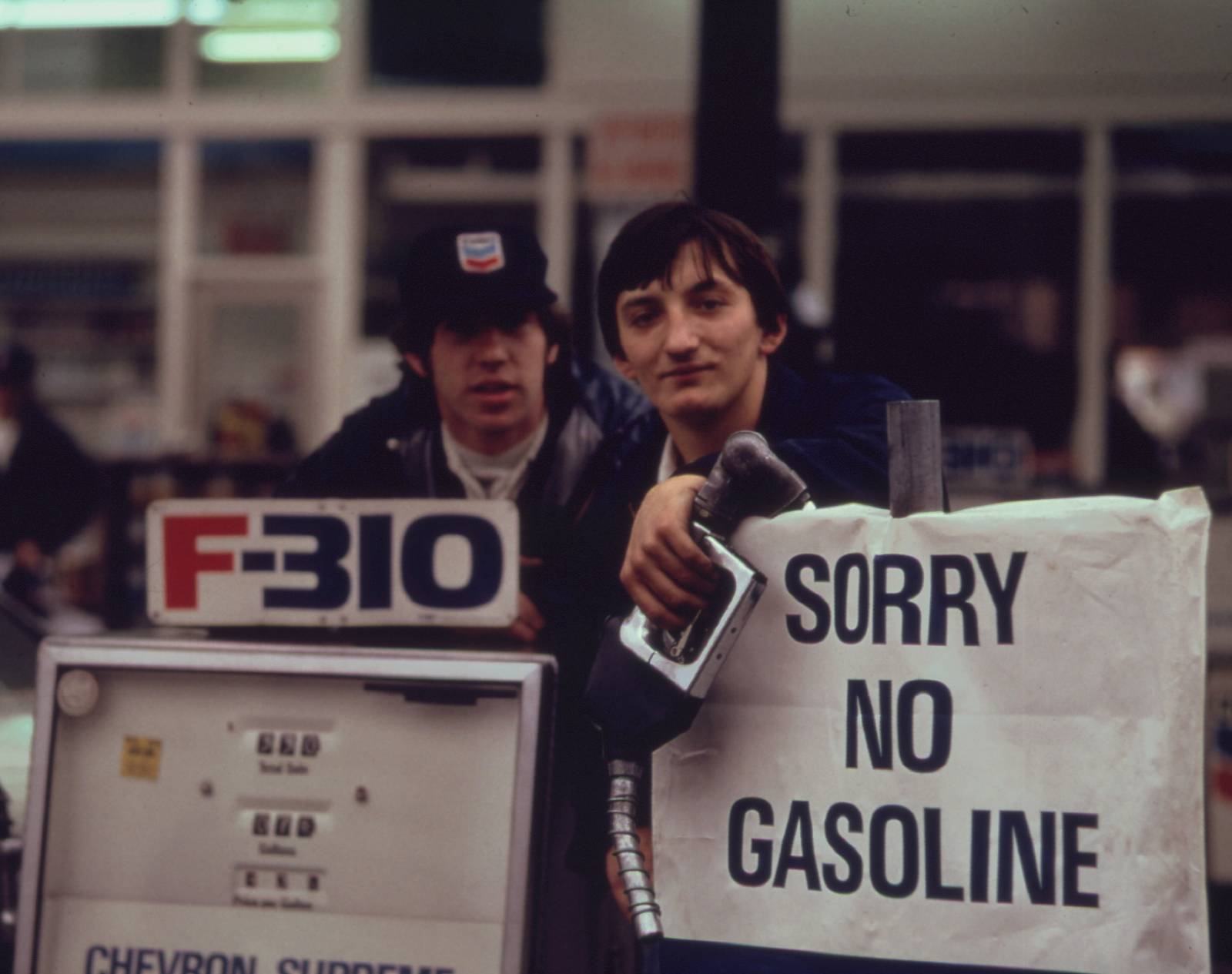
The Carter administration implemented the first solar power subsidies in the 1970s when the nation was reeling from an energy crisis that arose, in part, after the Arab states in OPEC instituted an oil embargo to protest U.S. support for Israel. But in the decades following their initial deployment, solar and wind power were still viewed as nascent technologies that could not compete with coal-fired power plants.
Gas station attendants peer over their “Out of gas” sign in Portland during a national oil shorage in 1973.
Smith Collection / Gado / Getty Images
Today, solar power is less than one-fifth of the price that it was in 2009, and the cost of wind turbines has dropped by more than half over the same period. And while constructing solar farms used to be three times more expensive than building new coal plants, it’s now cheaper to build and operate a new solar farm than to run an existing coal-fired power plant.
As a renewables-heavy grid became more viable, so too did an investment-led climate policy, one based on incentives rather than penalties.
Over the past decade, organizations like the BlueGreen Alliance and the Environmental Defense Action Fund began building coalitions to create a unified vision for a climate policy that could succeed on Capitol Hill. These groups did not agree on everything (some, for example, supported emergent technologies like carbon capture while others preferred natural solutions like reforestation), but they shared the belief that shifting the economy away from fossil fuels required more government intervention, not less.
The birth of the Sunrise Movement, a national youth-led organization launched in 2017 to fight climate change, marked a turning point in the popularity of the strategy. The group emphasized the importance of what’s called a “just energy transition” from a fossil-fuel economy to a green one, a shift that would create thousands of jobs in the renewables sector and battle climate change alongside income inequality and environmental injustice. Many of the movement’s supporters, including Representatives Alexandria Ocasio-Cortez and Deb Haaland, won their seats in the 2018 midterm elections. The group heavily influenced the Green New Deal proposal, whose omission of a carbon tax helped to sour the policy among Democratic incumbents on the Hill.
Youth activists from the Sunrise Movement participate in a rally in Washington D.C. in June 2021.
Caroline Brehman / CQ-Roll Call, Inc via Getty Images
“There is no doubt that the Sunrise Movement and their focus on the Green New Deal created energy for a massive expansion of this [incentives-first] strategy,” said Molly Prescott, a spokesperson for Senator Jeff Merkley, the Democrat from Oregon who helped push for the green tax incentives in the IRA’s failed predecessor, the Build Back Better Act. She added that the senator has supported a carbon tax in the past, but that “changing economies” as well as environmental justice advocacy groups had convinced him to focus on other climate policies in recent years.
“Twelve years ago, I watched my landmark climate legislation pass in the House and die in the Senate,” said Democratic Senator Ed Markey, one of the authors of the failed 2009 cap-and-trade bill. “I am grateful for the countless young people and all those in the climate movement who breathed new life into our fight for climate action.”
Still, the IRA’s incentives-first approach isn’t without its critics. Some experts believe that a climate policy that depends largely on subsidies with little penalty for polluters is insufficient. What is lost without a carbon tax, they argue, is economic efficiency. Since the IRA does not penalize polluters (with the exception of a fee on companies that exceed their allowable methane emissions), the dirtiest sources won’t necessarily be phased out the fastest.
To test this theory, researchers at University of California, Berkeley and the University of Chicago simulated a decarbonization of the electricity sector using a carbon tax in one case and green subsidies in another. The results were surprising: The two policies did not achieve substantially different fossil fuel reductions by the end of the decade.
But that doesn’t mean that the policies are equally effective. Severin Borenstein, a professor at Berkeley and one of the authors of the study, cautioned that what tax credits do for the electricity sector in terms of providing both innovation and efficient decarbonization may not hold true for other industries. In particular, he believes that green credits will not work as well to clean up transportation, which is responsible for the largest share of the country’s greenhouse gas emissions. That’s because the people likely to buy new electric cars have not been driving, on average, the dirtiest vehicles.
“They drive new cars, and they tend to be politically liberal, which tends to mean they don’t drive the biggest emitters,” he said. “And so in some ways, it’s just the opposite of the electricity sector where we said, ‘Look, the coal is gonna get pushed out first anyway.’ That is not true with EVs.”
Stock, the Harvard economist, acknowledged this dynamic, but added it should be balanced against the fact that when wealthy Americans buy new green technologies, they help drive down the prices for everyone else. This trend is playing out now in electric vehicles, with car manufacturers rolling out high-end electric versions first in order to finance the development of cheaper models.
“So Ford and Tesla learn to make the EVs, and then that creates the capacity to create cheaper versions for the mass market,” Stock said.
These trends not only help reduce America’s carbon footprint, but also the world’s, said David Hart, the senior fellow at the Information Technology & Innovation Foundation. Germany made a huge investment in solar power in the early 2000s, and “bought down the price” for the global market, he said, meaning that the country’s investment in solar eventually made it cheaper for everyone else. “As rich countries, that’s what we should be doing.”
Hart, along with many other policy experts, argues that the passage of the IRA does not necessarily mean a carbon tax is dead. Rather, the new legislation is just a first step in slashing the country’s carbon emissions and preventing the most disastrous consequences of climate change.
“I do think there are going to be places and times when it [the carbon tax] is going to be a crucial tool to get to the last mile, but I don’t think it should be a focus of policy,” Hart said. “The goal should be to develop these technologies with a direct funding approach. Let’s make the clean stuff cleaner and cheaper before you make the dirty stuff more expensive. That is the sort of guiding spirit [of the IRA] if you can discern one here.”
This story was originally published by Grist with the headline ‘Make the clean stuff cheaper’: Did the IRA kill the carbon tax? on Sep 6, 2022.
Before we get into today's post, I want to remind you that climate change is real. Big governments continue to poison and pollute. One of the things we all can do is plant more trees as well as saving our existing trees whenever possible. That's why Tree Services in Pensacola is doing everything to benefit the environment, while also beautifying your home's landscaping.
Officials in California are closing in on an agreement to give up a significant portion of the water the state gets from the Colorado River, bowing to an emergency demand made by the federal government earlier this summer.
Executives from two large water districts in the Golden State, which service the Los Angeles metropolitan area and the agriculture-heavy Imperial Valley, told Grist that they’re making progress on negotiations to leave roughly 10 percent of the state’s Colorado River water allocation in reservoirs next year, or at least 100 trillion gallons. The officials indicated that they may reach a deal as soon as this month, and said they believe other states will follow suit with cuts of their own, helping the federal government achieve its goal of stabilizing the Colorado’s two drought-wracked reservoirs, Lake Powell and Lake Mead.
But the deal under discussion falls far short of what federal officials have demanded: Water managers who spoke to Grist indicated that states will likely be able to cut water usage by around half of the minimum conservation target set by federal officials in June. Furthermore, many of the deal’s details are still unclear, including the size of contributions from states besides California.
Nevertheless, the agreement would be transformative for the Golden State, which has never before faced any cuts to its share of the river.If it holds, the agreement could force new water restrictions across the Los Angeles metroplex and reduce the nation’s supply of winter vegetables like lettuce and asparagus. It’s the latest sign that the climate-fueled megadrought in the West is forcing major changes to how the region uses water.
“It’s huge,” said Bill Hasencamp, who manages Colorado River resources for the Metropolitan Water District of Southern California, which services the Los Angeles area. “We’re now in a permanent shortage going forward, and we’re going to live with it.”
Even as the Colorado River crisis has reached a crescendo, forcing major cuts to water usage on the drought-ravaged waterway, California has remained untouched. The state uses by far the most water of any state that draws from the river — in part because it holds some of the most senior rights to river water, which has allowed it to draw a full share of water even as the federal government has slashed water deliveries to Arizona and Nevada for two years running.
The vast majority of the state’s 4.4-million-acre-foot water allotment is used for agriculture, and almost all that agricultural water flows to the Imperial Irrigation District, a gigantic farming organization in the southeastern part of the state that produces the lion’s share of winter vegetables grown in the United States. The remaining water flows to the Metropolitan Water District of Southern California, or the Met, which provides water to almost 20 million people in and around Los Angeles.
Thanks to the state’s strong water rights, Imperial and the Met have largely stayed out of the crosshairs of Western water shortages so far. The two districts have instituted water-savings programs on their own turf — the Met banked unused water in Lake Mead, and Imperial helped farmers install more efficient farming equipment in their fields — but they have never had to reduce the amount of water they draw from the river. A 2019 drought response agreement exempted the state from mandatory cuts under all but the worst circumstances.
This year, though, the proverbial dam broke. Inflow into the Colorado River’s two main reservoirs fell to historic lows, threatening the reservoirs’ ability to generate hydropower, and the federal government stepped in to engineer a solution. In a sudden announcement earlier this summer, U.S. Bureau of Reclamation Commissioner Camille Camimlim Touton ordered the river states to reduce their total water demand by 2 to 4 million acre feet — as much as a quarter of all usage. If the states didn’t find a way to do this by mid-August, Touton said, the federal government would step in to institute new emergency cuts of its own.
The Bureau’s emergency demands were shocking but not surprising, according to Ellen Hanak, director of the Water Policy Center at the Public Policy Institute of California.
“The fact that there’s a structural water deficit in the basin is not new news,” she told Grist. “And it’s not like [water managers] have not been thinking about stuff they could do to reduce water usage — it’s just that people have been working on a timeline for this that turns out to have really not been fast enough.”
The states blew past the federal government’s deadline, and negotiations are now in overtime. The parties met in Denver in early August and again in Salt Lake City toward the end of the month. California has emerged from those meetings as the linchpin of a deal to meet Reclamation’s demands. Since the state is the largest water user, and since it’s never taken cuts before, other states are waiting to see what it does before they commit to their own reductions. Another meeting is scheduled later this month in Santa Fe.
While early conversations among the California districts centered around a target of 500,000 acre-feet in combined cuts from Imperial and the Met, executives from both districts told Grist that the potential range of cuts has fallen since then. Hasencamp, the Colorado River manager for the Met, said that the range could go as low as 350,000 acre-feet. (An acre-foot is equivalent to about 320,000 gallons of water.)
“The numbers continue to change, to be honest with you,” said Henry Martinez, the chief executive of the Imperial Irrigation District, who said that 500,000 acre-feet is “probably too high.”
Hasencamp said that it’s very unlikely the river states will meet Reclamation’s demand for 2 to 4 million acre-feet in total savings. The states are now angling for a lower target and hoping it satisfies federal officials.
“I just don’t think it’s practical anymore,” he said, adding that a million acre-feet of savings between the states was a more realistic total number.
The proposed voluntary cuts would be painful for Imperial, in part because they would take effect as soon as next year. The farming district has spent the past decade helping farmers make their growing operations more efficient by buying sprinklers, drip irrigation infrastructure, and water retention systems, and there’s plenty of room for further improvement — for instance, farmers could shift away from water-intensive alfalfa, much of which gets exported overseas. But these new policies would take years to ramp up, so the only short-term option is to farm less land.
That raises a big question about who will pay farmers who take their land out of service, and how much compensation the farmers should receive. The Inflation Reduction Act signed last month by President Biden gives Reclamation around $4 billion in drought response funding thanks to a last-minute intervention from Senator Kyrsten Sinema of Arizona. Martinez wants to tap that money to compensate farmers for taking land out of service, but the details are thorny.
“It’s kind of a chicken and egg issue,” said Martinez. The district needs to figure out how much money it will get from Reclamation before it can figure out how many acre-feet of water it can cut and how much it can pay farmers to stop watering, but it can’t propose a funding amount to Reclamation without first figuring out how much to pay farmers to reduce their water usage. “We have not really arrived at a price,” Martinez added.
Previous voluntary conservation programs in Imperial have offered farmers close to $300 for every acre-foot of water they save, but this time growers in the district are asking for much more, Martinez told Grist. That’s in part because the overall drought in the West has jacked up prices for the crops that Imperial farmers tend to grow, which means it will cost more to induce them to stop farming.
“Markets have been very, very good for the farmers at this point,” he said, adding that farmers have to make “a comparison of getting paid X number of dollars not to plant when they can earn [high] market prices for the crops that they produce.”
Nevertheless, Martinez said, a basic outline is in place. The deal would establish a base price for water saved by any water district in the river states and add supplemental payments for hard-hit districts like Imperial, giving the district extra funding to account for the secondary impacts of the water reduction on the vulnerable farming communities in Imperial’s service area. These impacts include a loss of hydropower generation from the All-American Canal, which conveys water from the Colorado River to Imperial’s crop fields and produces electricity along the way.
Martinez told Grist he hoped to reach an agreement some time in the next month, before Imperial farmers start planting winter crops, lest the farmers sign contracts to deliver certain vegetables only to find they aren’t getting any water.
“We have communicated to the Bureau that we need something to put on the table to the farmers by the end of September at the latest,” Martinez told Grist.
Even if these voluntary talks fail, it’s only a matter of time before California sees mandatory water reductions. The drought response agreement from 2019 forces the state to take a haircut on its water allocation if the federal government declares a so-called “Tier 2b” shortage on the Colorado, which occurs when the water level in Lake Mead falls below a certain height. That seemed unlikely back in 2019, but now it looks almost certain. The federal government last month declared a Tier 2a shortage on the river, dealing further cuts to Arizona and Nevada. If reservoir levels had been even 5 feet lower, California would have taken cuts as well.
Even then, Imperial would be insulated from mandatory cuts. Because Imperial has the most senior water rights within California — having started using the river water before its neighbor districts — it wouldn’t have to fallow any land even if California took a mandatory cut. A district spokesperson told Grist that Imperial will account for only 3 percent of California’s mandatory reduction, even though it receives more than half of the state’s Colorado water.
The pain of these mandatory cuts would fall almost entirely on the Met, the water servicer for the greater Los Angeles area, which would absorb more than 90 percent of the reduction. The district has banked about a million acre-feet of surplus water in Lake Mead over the past few years, but it’s only a matter of time before those reserves run out and force the district to reduce water usage around Los Angeles. The voluntary cuts the district is negotiating with Imperial would make that happen a lot faster.
“We knew that the river was out of balance, we knew that climate change was impacting the river, and we knew that there was going to be a reckoning on the river,” said Hasencamp, “but most of us thought we would have time to adapt.” All told, the district stands to lose as much as 500,000 acre-feet between the voluntary and involuntary cuts. This would remove close to half of the district’s total Colorado River withdrawals.
The problem for the Met is that the district’s other main source of water is also in crisis. The district also imports billions of gallons every year from the so-called State Water Project, a canal system that funnels water from reservoirs in the Northern California mountains down to Los Angeles, but these reservoirs are also at historic lows thanks to the regional drought. The district is caught between a rock and a hard place: Participating in a Colorado deal will make it more reliant on an alternative water source that is also getting hammered by drought.
Hasencamp told Grist the district has a few tools it can use to save water in the near term, such as offering rebates to customers who convert grass lawns to turf. He also said that in the next few months the district’s board will likely reduce cap deliveries to member agencies, placing a ceiling on how much water cities and utilities can buy from the district. This would force each individual agency to figure out how to reduce its water consumption, such as by raising the price of water or banning outdoor lawn watering.
Still, the adjustment will be difficult, said Ed Osann, a policy analyst at the Natural Resources Defense Council who studies California water.*
“A major reduction like this would take maybe ten years to carry out if you’re trying to make for a soft landing,” Osann told Grist, “but a soft landing may not be attainable here.”
There’s no telling how long the present drought will last, and thus it’s not clear whether the cuts under discussion in California will be temporary or permanent measures. But research has shown that climate change can cause the long-term aridification of landscapes like the western United States, which could mean that low inflow to the Colorado River reservoirs will prove a persistent problem even if rainfall increases. This would ensure future shortages. If the past few years are any indication, these shortages will be painful for everyone on the river, including states like California, which have long managed to stay above the fray.
*Editor’s note: The Natural Resources Defense Council is an advertiser with Grist. Advertisers have no role in Grist’s editorial decisions.
This story was originally published by Grist with the headline Parched California prepares for first-ever Colorado River cuts on Sep 6, 2022.