If you're serious about the environment, we all know planting trees is one of the best solutions and tree removal should be a last resort which is why we're committed at Pensacola Tree Services to provide the very best for your home as well as the environment. Read more by going here.
This storywas originally published by Hakai Magazine and is reproduced here as part of theClimate Deskcollaboration.
In New Zealand, some fish species are showing up in strange places. Divers are spotting tropical triggerfish in the temperate north of the archipelago. Meanwhile, in the usually icy waters around Rakiura, fishers are landing yellowtail kingfish and Australasian snapper, which never used to venture that far south.
These shifts make sense: the ocean is warming, and New Zealand is experiencing more marine heatwaves. Last summer, sea temperatures surged 5 degrees Celsius above normal in some parts of the country. In the heat, many marine organisms, such as the tens of millions of sea sponges that bleached in Fiordland at the country’s southern tip, simply died. Others have shifted to places where the temperature suits them better.
Yet as marine species move to survive, their shifting ranges are spurring big questions for the people who catch them.
For New Zealand’s Indigenous Māori, the challenge of species moving out of their fishing area is especially pressing. Following two historic settlements with the New Zealand government in 1989 and 1992, Māori iwi, or tribes, own one-third of the commercial fishing quota in New Zealand; many iwi also hold quotas for customary cultural harvest. But these quotas are fixed to a specific territory: if the fish move out of the area in which an iwi or a collective of iwi holds the right to harvest, those iwi may lose access to that catch.
With fishing the foundation of the modern Māori economy, that’s a disruptive prospect.
But with collaborative, dynamic governance, a strong focus on equity, and increasing access to real-time information about fish populations and their movements, Māori fisheries may be well placed to navigate the changes — and offer insight to other groups across the globe in similar situations.
Tony Craig, a partner at Terra Moana, a New Zealand–based sustainability consultancy, and a researcher in an ongoing government-funded initiative on coastal ocean circulation, connectivity, and marine heatwaves called the Moana Project, says that iwi rights and interests will be unevenly impacted by species on the move. For instance, if snapper populations shift south because of warming, iwi with quotas in the north will lose out, while those with quotas farther south will benefit.
“The quota management system means that there will be winners and losers within Indigenous rights holders,” says Craig.
It’s easy to imagine the potential for inter-iwi tension. But Māui Hudson, an interdisciplinary scientist at the University of Waikato in New Zealand, a member of the Whakatōhea, Ngā Ruahine, and Te Māhurehure iwi, and a researcher in the Moana Project, says close collaboration on fisheries management between iwi means the likelihood of conflict is lessened.
“We all sit together as partners to have the kōrero [conversation] about what is happening with the fisheries,” says Hudson. If fish migration does have a material effect on regional catch, he says, Māori also already have a forum established with the New Zealand government to discuss how quotas might be adjusted “to bring some equity back into the system.”
More challenging are the implications of species on the move for Māori customary fisheries. In New Zealand, iwi hold rights to particular species in specific areas. “Some iwi have centuries-old stories around certain species of fish, which they have on the walls of their marae [meeting grounds],” says Maru Samuels, CEO of the Iwi Collective Partnership, the country’s largest iwi fishing collective. “If those fish were to move away from their doorstep due to warmer waters, that would be absolutely devastating.”
Though steps can be taken to mitigate the local effects, Hudson says that species migration “is set to become part of our future, and it’s important to lay foundations now for iwi to start thinking about what it means for them.”
For Kristina Boerder, a marine conservation researcher at Dalhousie University in Nova Scotia, the Māori situation offers a lesson for resource managers around the world.
“Fisheries and conservation management systems have been created around our perceptions of a stable marine environment,” says Boerder. But with climate change, that perception is increasingly untrue. Managers, she says, need to “adapt more dynamic measures and tools to reflect the changing conditions.”
This story was originally published by Grist with the headline For New Zealand Māori, an uncertain future as fish move away on Sep 5, 2022.
If you're serious about the environment, we all know that planting trees is one of the most effective measures, and tree removal should be a last resort. We at Pensacola Tree Services are dedicated to offering the best for your home as well as the environment, therefore we're committed to delivering it by making it as simple as possible. For responsible tree removal visit us here Pensacola Tree Services
This storywas originally published by WIRED and is reproduced here as part of theClimate Deskcollaboration.
If crops could feel envy, it’d be for legumes. Bean plants have a superpower. Or more accurately, they share one. They’ve developed symbiotic relationships with bacteria that process atmospheric nitrogen into a form that’s usable for those plants — an essential element for building their tissues, photosynthesizing, and generally staying healthy. This is known as nitrogen fixation. If you look at a legume’s roots, you’ll see nodules that provide these nitrogen-fixing microbes with a home and food.
Other crops — cereals like wheat, rice, and corn — don’t have such a deep symbiotic relationship, so farmers have to use large amounts of fertilizer to get the plants the nitrogen they need. This is very expensive. And fertilizer production is not great for the environment. It’s not easy to turn atmospheric nitrogen into a form of nitrogen that plants can absorb on their own.
“It takes a lot of energy and really high pressures and high temperatures,” says University of Illinois Urbana-Champaign plant biologist Angela Kent. “Bacteria do this at ambient temperatures and pressures, so they’re pretty special. While energy has been cheap, it’s been easy for us to overuse nitrogen fertilizers.”
Even worse, once it’s on fields, fertilizer spews nitrous oxide, which is 300 times as potent a greenhouse gas as carbon dioxide. Runoff from fields also pollutes water bodies, leading to toxic algal blooms. This is a particularly bad problem in the Midwest, where fertilizer empties into the Mississippi River and flows into the Gulf of Mexico, fueling massive blooms every summer. When those algae die, they suck the oxygen out of the water, killing any sea creatures unfortunate enough to be in the area and creating a notorious aquatic dead zone that can grow to be the size of New Jersey. Climate change is only exacerbating the problem, since warmer waters hold less oxygen to begin with.
Given all that nastiness, scientists have long been on a quest to reduce agriculture’s dependence on fertilizers by giving cereal crops their own nitrogen-fixing powers. And with the rise of gene-editing technology over the past few decades, that quest has been making progress. Last month, in the Plant Biotechnology Journal, researchers described a breakthrough with rice, engineering the plant to produce more compounds that encourage the growth of biofilms, which provide a cozy home for nitrogen-fixing bacteria, much like legumes provide nodules for their partner microbes.
“People for the last 30, 40 years have been trying to make cereals behave like legumes,” says Eduardo Blumwald, a plant biologist at the University of California, Davis who coauthored the new paper. “Evolution in that sense is very cruel. You cannot do in the lab what took millions and millions of years.”
So what’s with the evolutionary cruelty? Why can some plants — like, say aquatic ferns — fix nitrogen while others can’t?
It’s not that other species don’t get nitrogen at all. Cereal grasses use nitrogen that’s already in the soil — it comes from animal manure, as well as all the life churning in the dirt. (Lots of different bacterial groups process atmospheric nitrogen, not just the legumes’ symbionts.)
But the legumes’ bacteria grab abundant nitrogen straight from the air.
“When you have these nodules and you have this symbiotic relationship, it’s a much more effective way of getting atmospheric nitrogen,” says Joshua Doby, an ecologist at the University of Florida. “Because otherwise you have to wait for the bacteria and for other processes in the soil to turn it into ammonium.”
One theory is that the symbiotic nitrogen relationship started out long ago as a bacterial infection, and those ancestor plants derived a benefit that was carried through to future generations. Earlier this year, Doby published a study of plants throughout the United States, finding that there is a greater diversity of nitrogen-fixing species than other kinds in arid regions. That is true even if the soil isn’t nitrogen-poor. He theorizes that millions of years ago, when those areas were wetter, the plants evolved the ability to fix nitrogen, which also allowed them to grow thicker cuticles. This trait protected them against dryness when the region eventually became arid. They were pre-adapted, basically. Non-fixers, by contrast, were weeded out by rising aridity.
Another theory is that legumes might be consummate nitrogen-fixers because something in their genome predisposes them to building nodules.
But before you start feeling sorry for non-fixers, constructing nodules and hosting bacteria comes at a major cost. “It turns out that it’s very energetically expensive to actually do this,” says Ryan Folk, a biodiversity scientist at Mississippi State University who coauthored the new paper with Doby. First, a legume has to build those nodules on its roots, then it has to provide sugars to the bacteria to keep them happy.
“It’s something like 20 to 30 percent of the legumes’ photosynthetic output actually goes to the bacteria, so it’s an extraordinary price,” he says. So even though it’s less efficient for plants to get their organic nitrogen from bacteria already in the soil, it’s also less costly because symbiotic bacteria are super needy.
What Blumwald and his colleagues have done with rice is sort of halfway between the strategies of legumes and non-fixing plants. They sifted through compounds that the plant produces, testing which ones induced the formation of a biofilm.
“When bacteria form biofilms, it’s like a hippie commune — they are cozy, they are all together, they share things,” says Blumwald.
A complex layer of polysaccharides, proteins, and lipids covers the biofilm, which is not permeable to oxygen. That’s important because oxygen interferes with the bacteria’s fixing of nitrogen from the air — in legumes, the nodules keep the oxygen out.
The team landed on a biofilm-boosting compound called apigenin. They then used Crispr gene editing to silence the plant’s expression of an enzyme that breaks down this apigenin, allowing more of the compound to accumulate in the plant and extrude into the soil to create a biofilm.
“Then the bacteria started fixing nitrogen from the air to produce ammonium that the plant can uptake,” says Blumwald. “The proportion of nitrogen-fixing versus the rest of the bacteria near the root increased.” Basically, the rice plant now had its own fertilizer factory, giving it the nitrogen-fixing power denied to it by evolution.
This would seem to skirt a problem with previous attempts to get cereal crops to fix their own nitrogen, says Kent, the University of Illinois Urbana-Champaign plant biologist, who wasn’t involved in the research. People have tried to inoculate soils with nitrogen-fixing bacteria in the hope that the plants and microbes would form a partnership. But that’s been difficult, since the soil microbiome is a wildly complex ecosystem of competing bacteria.
“One thing I really liked about this paper is that it’s looking to modify the plants to make them partner with the soil microbiome better,” says Kent. “It helps to recruit the desired kind of microbes and give them a competitive advantage.”
Interestingly, scientists previously discovered a unique variety of corn in Mexico that fixes nitrogen in a similar way. The corn’s tube-shaped roots grow above ground, sheathing themselves in a bizarre mucilage — a whole lot of dripping goo. Like the biofilm around the rice roots, this mucilage houses nitrogen-fixing bacteria. The corn study authors think it would be possible to breed this trait into commercial varieties of corn.
Another problem with previous attempts with inoculation, Kent says, has been that the introduced bacteria can’t provide all the nitrogen the plants needed. A farmer would still have to apply fertilizer — but the over-application of fertilizer can actually overload natural nitrogen-fixers in the soil, sending them into hibernation. The field goes numb, essentially, as the beneficial microbiome shorts out.
A company called Pivot Bio is engineering nitrogen-fixing bacteria that don’t shut down in the presence of added nitrogen. “We break the genetic feedback loop that causes them to go into hibernation when fields get fertilized,” says Karsten Temme, the company’s CEO and cofounder.
Today, they’re launching new products in which these microbes are applied directly to seeds of corn, wheat, and other cereals. (With earlier products, they instead sprayed the bacteria as a liquid during seed planting.) Currently, the microbes can’t supply all the nitrogen these cereals need, so farmers may still need to fertilize. But Temme says the company is improving the microbes’ efficiency.
“What we see is there’s going to be a progression, where today we’re supplying a fraction of that nitrogen,” he says, “and over time, we begin to supply the majority and eventually the entirety of that nitrogen the crop needs.”
An effective biological nitrogen fixation system for rice could be “a game changer in global agriculture,” says Pallavolu Maheswara Reddy, who studies nitrogen fixation in cereals at India’s Energy and Resources Institute. That’s because the human population is growing rapidly, demanding more food and fertilizer to feed it.
“Since the advent of Green Revolution in the mid-1960s, the application of chemical nitrogen fertilizers boosted rice yields by 100 to 200 percent to match the demands of world population,” Reddy says. “In the next 30 years, we must produce nearly 50 percent more rice than what is currently produced to supplement the food requirements of an increasing human population.”
But even if scientists can just reduce the amount of fertilizer needed for agriculture, the industry would be saving some of the energy it takes to manufacture the stuff while cutting both farmers’ costs and the runoff that makes it into waterways. That’ll be especially important in parts of the world where climate change is making downpours more powerful (a warmer atmosphere in general holds more water), which will wash more fertilizer off of fields.
And just in case you’re worried about leagues of nitrogen-fixing plants spreading out of control thanks to their new superpower, Kent says there’s nothing to fear. “We don’t see legumes taking over the world,” says Kent. Nitrogen-fixing “is probably not the trait that a plant would need for becoming a super-plant.”
This story was originally published by Grist with the headline The long, leguminous quest to give crops nitrogen superpowers on Sep 3, 2022.
I'd like to take this time to remind you that climate change is real. The actions of big governments continue to pollute and poison the environment. Whenever feasible, we should all plant more trees and preserve our existing ones. That's why Tree Services in Pensacola strives to do both while also improving your home's landscaping. Read more about how they're making changes at https://treeservicespensacola.com/tree-removal-pensacola/
A looming heat wave this Labor Day weekend might threaten Western states’ power grids and their residents, with utilities already warning of rotating blackouts.
California has already seen historical heat this week, fueling wildfires that have spurred evacuations and closed a section of Interstate 5. Temperatures are expected to hit 115 degrees Fahrenheit across the southern part of the state this weekend, breaking record temperatures. According to the National Weather Service, excessive heat warnings are already in effect in central Great Basin states such as California, Utah, and Idaho. California Independent System Operator, which manages the state’s electric grid, said it will likely see the most demand for power on Labor Day and is asking residents to conserve energy to prevent more drastic measures like rotating blackouts.
“Consumers are urged to reduce energy use from 4-9 p.m. when the system is most stressed because demand for electricity remains high and there is less solar energy available,” the operator said in a statement. It’s also asking residents not to charge electric vehicles, which are growing in popularity as the state phases out gas-powered cars, during peak hours.
The ongoing drought in the West is already hitting electricity generation, causing some hydroelectric plants to pump out less power, and utility companies have had to fill in the gap with power from natural gas and coal plants, which then contribute to carbon emissions. Utilities in San Diego and Phoenix are taking aggressive steps to conserve water in the face of recent drought conditions, after a one-two-punch of extreme temperatures and diminished water supplies places increased pressure on energy producers and consumers.
Heat waves also pose a threat to public health. They disproportionately harm low-income residents, Black and Hispanic neighborhoods, and people without housing. Extreme heat kills 600 people in the United States each year.
The National Weather Service has also said that this weekend’s heat wave is poised to make nighttime temperatures hotter and more dangerous. Recent studies suggest climate change is making it harder for people to cool down at night, raising mortality rates across the globe. California and Oregon have also seen wildfires sparked by the heat wave this week, with more potentially on the horizon.
Gavin Newsom, California’s Democratic governor, declared a state of emergency on Wednesday with measures that aim to alleviate the strain on the power grid. The declaration allows residents to use backup diesel generators during periods of peak demand and approves increased electricity production. According to the Associated Press, these measures will increase air pollution in the state, but Karen Douglas, the governor’s senior energy adviser, told the AP that the priority was to keep the lights on.
This story was originally published by Grist with the headline As heat wave grips Western states, officials warn of blackouts on Sep 2, 2022.
If you're serious about the environment, we all know planting trees is one of the best solutions and tree removal should be a last resort which is why we're committed at Pensacola Tree Services to provide the very best for your home as well as the environment. Read more by going here.
After decades of fighting to end neighborhood oil drilling in California, environmental justice communities and their allies celebrated Wednesday as the state passed a bill phasing out oil and gas wells in close proximity to homes and schools.
The change was part of a sweeping package of climate bills passed by the California state legislature last night. It includes laws to codify climate neutrality goals, set rules for carbon capture, set interim targets for 100 percent clean energy by 2045, and extend the life of Diablo Canyon, a controversial nuclear power plant that has become a centerpoint of debate in the state’s energy transition. The action comes just one week after California finalized its plan to stop gas-engine car sales by 2035.
“The setback bill was our priority,” said Raquel Mason, policy manager with the California Environmental Justice Alliance. “It’s not often in my time doing this work that we get to go back to our community members with a full win.”
California is littered with 240,000 oil and gas wells and, until now, has had no statewide regulation on how close to homes, schools, and hospitals they can operate. The 2.7 million Californians who live within a half mile of the wells are at higher risk of cancer, asthma, heart disease, and adverse reproductive issues. An investigation by Grist and Capital & Main last year showed that Black, Latino, low-income, and medically underserved communities are disproportionately located near these wells in the state.
“With this bill, the government listened to community concerns and applied the setback to new wells and to the rework of wells,” said Ann Alexander, an advocate and lawyer with the Natural Resources Defense Council. Now, when neighborhood wells have to obtain rework permits, which they do every few years, they will be denied, progressively them phasing out.
As of last night, the Golden State also has a new long-term goal to decarbonize its entire economy. California’s previous legally binding emissions goals ended with a target of reducing greenhouse gas emissions by 40 percent by 2030 — a timeline it is not on track to achieve. Now, the state must get to net-zero emissions by 2045.
Net-zero means cutting emissions by some amount, and balancing out any remaining greenhouse gases with actions to suck carbon out of the atmosphere. The bill that California passed requires emission reductions of at least 85 percent.
Lawmakers also passed two bills that dictate how California can achieve this. The first carbon neutrality-related legislation sets down guardrails for developing technologies that capture carbon dioxide from the smokestacks of industrial facilities, as well as “direct air capture” plants that would suck carbon from the atmosphere. The Air Resources Board, a state agency that regulates greenhouse gas emissions, will have to develop monitoring and reporting systems to ensure that these kinds of projects are actually reducing emissions, and create a public database for tracking their deployment. This bill also requires that the captured carbon cannot be injected into oil fields to increase oil production — a practice that is common today.
The second requires the state to establish new targets for enhancing carbon sinks on natural and working lands, like forests and wetlands. Notably, it separates these targets from the state’s carbon offset market, which enables major polluters in California, like refinery operators, to buy carbon credits from forestry projects to offset their emissions. The program has long been controversial, as it allows dirty industries to keep emitting and the integrity of the carbon credits has been called into question. The natural and working lands bill specifies that any projects receiving state funding for helping to achieve the new goals will not be allowed to generate carbon credits.
In the last hours of the legislative session Wednesday, as California entered a state of emergency heat wave, the vote on Diablo Canyon loomed. California’s last nuclear power plant, operated by Pacific Gas & Electric, or PG&E, the state’s largest private utility, supplies 10 percent of the state’s electricity and was slated to shut down both reactors by 2025.
For months, Governor Gavin Newsom has been laying the groundwork to keep the power plant open, based on concerns that cutting a major power supply at a time when the power grid is increasingly strained by heat waves might lead to blackouts.
Opponents of Diablo Canyon raised safety concerns as the aging facility has no permanent place to store nuclear waste and will require expensive updates when funding could instead be spent on renewable energy. The bill that passed last night will grant a $1.4 billion bailout loan to PG&E, extend the life of Diablo Canyon to at least 2030, and allow it to seek a renewed license until 2045.
Governor Newsom had asked legislators to develop and pass his climate agenda and the Diablo Canyon extension just a few weeks before the end of the legislative session. In the past, the state’s oil lobby and the building trade unions shut down initiatives similar to the ones proposed; this year saw some labor divisions, with individual unions representing electrical, utility, pipe trades, and sheet metal workers coming out in support of the package even while the building trades’ collective lobby stood against it. “They were handing out leaflets in the legislature focusing on aspects that they argue would create jobs,” Assemblymember Al Muratsuchi told Grist last week.
Except for one bill, all of the points in the package passed. A proposal that would have cut the state’s greenhouse gas emissions to 55 percent below 1990 levels, instead of 40 percent, by 2030 was voted down in the assembly. One reason could be because, at the moment, as reported in CalMatters, the state is not on track to reach its current target.
This story was originally published by Grist with the headline Drilling setbacks, net-zero, and a nuclear lifeline. Here’s what just happened in California. on Sep 1, 2022.
If you're serious about the environment, we all know planting trees is one of the best solutions and tree removal should be a last resort which is why we're committed at Pensacola Tree Services to provide the very best for your home as well as the environment. Read more by going here.
The United States doesn’t have any federal laws that say electric utilities have to switch to carbon-free power. We don’t yet have any national rules mandating the sale of electric vehicles or plans to phase out oil and gas drilling. Despite years of talk about a tax on carbon, we don’t have that either. What we do have, when it comes to regulations that address climate change, is a decidedly duller but still effective tool called the social cost of carbon, or SCC.
The social cost of carbon is a dollar amount that approximates the cost to society of adding — or the benefits of not adding — 1 metric ton of carbon dioxide to the atmosphere. It is underpinned by scientific models that look deep into the future to estimate what that CO2 will mean in terms of lost lives, reduced crop yields, and damage caused by rising seas. The government uses this number as one of several key metrics to evaluate the costs and benefits of policies that affect greenhouse gas emissions, like fuel economy standards for vehicles or oil and gas leasing plans. It makes decisions that increase carbon output look a lot more expensive than those that do the opposite.
But perhaps not expensive enough. A new study published in the journal Nature on Thursday found that the social cost of carbon should be more than three times higher than the $51 dollar figure the Biden administration currently uses.
“We are vastly underestimating the harm of each additional ton of carbon dioxide that we release into the atmosphere,” said Richard Newell, president of the nonprofit research firm Resources for the Future and one of the authors of the study, in a press release. “The implication is that the benefits of government policies and other actions that reduce global warming pollution are greater than has been assumed.”
The study arrives as the administration’s plans to re-evaluate this crucial metric have stalled. One of Biden’s first executive actions called for publishing a new social cost of carbon by January 2022 along with recommendations for improving the way it is calculated. Progress was delayed by lawsuits, and the administration has not announced a new timeline for the update. In the interim, the government is using a social cost of carbon of about $51, relying on the methodology used by the Obama administration.
“This Administration remains committed to accounting for the costs of greenhouse gas emissions as accurately as possible,” a spokesperson for the White House’s Office of Management and Budget told Grist. “We continue to assess how best to account for these costs in regulatory and budgetary contexts in the future.”
The new study finds that each ton of carbon dioxide emitted costs society about $185 in today’s dollars. To arrive at that number, the research team followed the recommendations laid out by a 2017 report by the National Academy of Sciences, an independent advisor to the federal government, that identified flaws in the Obama-era methodology. For example, the National Academies report noted that much of the climate research that fed into the official social cost of carbon, such as papers estimating the cost of agriculture and public health-related impacts of climate change, was from the 1990s and early 2000s. Experts have also criticized the government’s method for not adequately accounting for the range of uncertainty in the underlying climate and economic models.
Kevin Rennert, director of the federal climate policy initiative at Resources for the Future and one of the lead authors of the new study, said he and his co-authors used updated climate models and estimates for population and economic growth that better account for the uncertainty of those predictions. They also incorporated the latest science on translating changes in the climate system into damages in the economy, bringing in expertise from different disciplines. For example, another one of the authors, Kevin Cromar, an associate professor at New York University’s school of medicine, convened 26 public health experts and climate economists last year to improve estimates of how each 1 degree Celsius (1.8 degree Fahrenheit) increase in temperature will affect mortality around the world.
“That’s been a really fundamental piece of our work to try to have those with subject expertise feeding into the process,” said Rennert. They found that their estimate of deaths related to climate change was the largest factor driving up the social cost of carbon, contributing about $90 to the $185 total.
Tamma Carleton, an economist at the University of California, Santa Barbara who was not involved with the study, said it “marks a substantial improvement upon SCC estimates previously developed by the U.S. government, underscoring the importance of keeping policy values in line with the scientific frontier.” Carleton is part of another team assessing the costs of climate change.
The authors note that even their estimate is conservative. Their model does not account for a number of costs associated with rising temperatures, like biodiversity loss, reduced labor productivity, increased conflict and violence, and climate-related migration. But in addition to calculating a new social cost of carbon, they created a model and software that other researchers can download and run for free, enabling other subject matter experts to “to write a very small piece of code that represents their research and feed it into the broader community that is building these models,” said Rennert.
“These tools will make it easy for future scientists that haven’t even thought about the social cost of carbon yet to bring their expertise to this very important problem in a transparent way,” he added. “That is what is going to continue to evolve the science.”
This story was originally published by Grist with the headline The most influential calculation in US climate policy is way off, study finds on Sep 1, 2022.
If you care about the environment, you know that planting trees is one of the best things you can do. Trees help the environment by taking in carbon dioxide and giving oxygen. If you have to get rid of a tree, make sure to only do it a last resort. At Pensacola Tree Services, we are dedicated to helping your home and the environment. We are committed to delivering the best possible service for both. Simply go here for more info Tree Removal in Pensacola
“We are basically sitting in an oven, slow-cooking,” said Demetrius Cotchery, who is incarcerated in Alabama’s Childersburg Community Work Center, a prison that lacks air conditioning despite outdoor temperatures that hover above 90 degrees Fahrenheit in summer. “People are very, very agitated because of the heat.”
As record-breaking heat waves make headlines across the country this summer, well over 100,000 people in the U.S. South sit locked inside state prisons with no air conditioning. At the Buckingham Correctional Facility outside of Richmond, Virginia, even the unairconditioned facility’s ventilation system was broken much of the summer, according to Chad Miller, who is incarcerated there and works with the building and grounds crew. (When contacted by Grist, Virginia’s corrections department disputed this claim.) Miller recently witnessed another prisoner fainting from heat stress.
In Texas, where temperatures inside state prisons regularly hit 110 degrees F, some prisoners work seven days a week to implement the state’s heat mitigation policies, by, for example, distributing water and ice. Marcus Teamer, who is incarcerated at the Byrd Unit in Huntsville, has been scolded when other prisoners pass out from the heat, for failing to hand out water fast enough. One day, he began to feel dizzy himself and developed chest pain while working. His fiancé, Tonya Grimes, worries that heat sensitivity exacerbated by his blood pressure medicine makes him especially vulnerable.
“The main topic of conversation on a hot day is why we don’t have AC,” Teamer told Grist.
Texas lawmakers have repeatedly failed to pass legislation funding universal air conditioning in state prisons, even as climate change exacerbates stifling conditions. However, people incarcerated in other parts of the U.S. may soon see some relief from extreme heat. A handful of southern states that once seemed unlikely to budge on prison cooling — including North Carolina, Mississippi, and Louisiana — are now taking steps to invest in climate control. All three states include areas where the heat index will spike to 125 degrees F at least one day annually by 2053, according to recent data from the First Street Foundation, a nonprofit research group.
Some prisoner advocates, however, argue that the solution to increasingly hot prison conditions is to incarcerate fewer people through policies like sentencing reforms, rather than pouring more money into mass incarceration — particularly given the disproportionate incarceration of people of color. The fact that tens of millions of dollars’ worth of investment in air-conditioned incarceration is coming from the American Rescue Plan Act, the federal coronavirus relief bill signed by President Biden last year, has further raised eyebrows.
AP Photo / Rogelio V. Solis
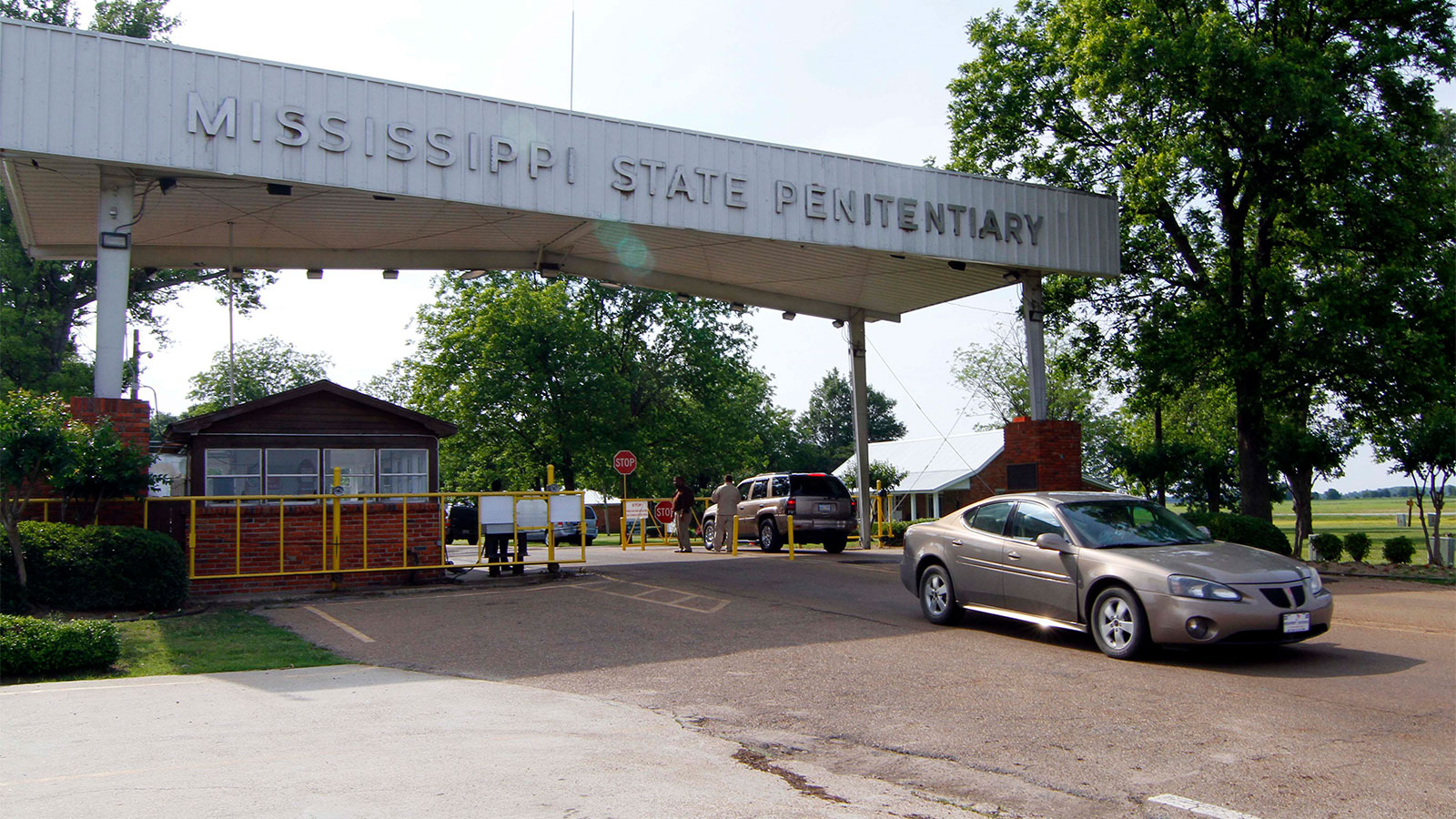
After a Department of Justice investigation last spring documented temperatures as high as 145 degrees F inside a Mississippi prison, the state’s head of corrections announced that his department would install air conditioning in all of Mississippi’s prisons. North Carolina’s legislature approved $30 million for prison air conditioning last fall. All of North Carolina’s air conditioning spending and part of Mississippi’s will come from American Rescue Plan funds. Other states are taking smaller steps: The secretary of Louisiana’s corrections department, Jimmy LeBlanc — who fought a lawsuit filed by death row prisoners arguing for cooling and used to claim that maintaining air conditioners would be too expensive — recently began pressing for funding to air condition the state’s prisons.
The secretary has cited corrections officer staffing shortages — a nationwide phenomenon — as a reason for the request. “You got correctional officers changing clothes three times per day,” he said. LeBlanc has directed around $2 million appropriated in the last legislative session to hire engineers to determine the cost of installation, and he has also dipped into the department’s repairs budget to begin installing cooling in dorms for people ages 60 to 90.
Virginia and Texas prison officials point out that they, too, are adding more air conditioning every year. Virginia’s Department of Corrections recently added 100 air-conditioned beds to a section of the Haynesville Correctional Center, and it has set aside more than $32 million for air conditioning upgrades in 2023, according to Director of Communications Benjamin Jarvela. (As for allegations about the broken ventilation system at the Buckingham Correctional Facility, he told Grist, “With the exception of one fan, all are in working order and have been. We are currently sourcing parts for the single disabled and will have it back online as soon as those parts have been located.”)
The Texas Department of Criminal Justice expects to add about 6,000 air-conditioned beds by the end of 2023, according to recent testimony that executive director Bryan Collier gave to members of the Texas House of Representatives. Although the agency has already created a plan to fully air-condition all facilities, it estimates the installation would cost $1.1 billion, a total that some advocates say is inflated and that has not been granted by Texas’s Republican-controlled legislature. Last year, prisoner advocates fought for American Rescue Plan funds to be allocated for prison air conditioning, but the measure failed without support from the legislature or Republican Governor Greg Abbott.
Everywhere, change is coming too slowly for those suffering in the heat. In Virginia and Texas, large swaths of the incarcerated populations — around 5,700 out of 25,000 in Virginia and 79,000 out of 120,000 in Texas — remain vulnerable to extreme heat. In Louisiana, the installation process is expected to take years to complete, even if funding is approved. In North Carolina, where 15,400 incarcerated people lack air conditioning, the state has already come under fire for failing to begin renovations months after funding was made available. Meanwhile, in northern states, where prisoners are less acclimated to increasingly severe heat waves, the air conditioning debate is just getting off the ground.
The moves toward prison air conditioning can be credited partly to summers that are becoming increasingly brutal due to climate change. An investigation by The Intercept found that a third of U.S. prisons are located in counties that have historically seen more than 50 days annually with a heat index over 90 degrees F. By the end of the century, that proportion will balloon to a full three quarters.
Rising prison temperatures don’t just threaten prisoners — they also endanger thousands of corrections employees in southern states. Lawmakers and state officials, including in Mississippi and Louisiana, have repeatedly pointed out a need to retain staff as justification for new prison air conditioning. Across the U.S., prison employees have quit in droves since 2020, forcing corrections departments to take drastic actions to manage increasingly dangerous and restrictive conditions for prisoners. Some corrections union officials have cited extreme heat, alongside poor pay and benefits, as a reason behind the prison staffing shortage.
Grimes herself used to work soaked in sweat in an unairconditioned prison kitchen, and she quit in part due to the stifling conditions and their impact on prisoners like her fiancé. “I refused to be a part of it,” she told Grist.
A hot prison climate also means legal liability for states. Texas and Louisiana have both spent more than $1 million fighting heat-related lawsuits from incarcerated people and their families. Mississippi’s legal pressure comes directly from the federal government. In the wake of massive cuts to corrections department funding over the past decade, Mississippi facilities saw an increase in violent deaths, gangs taking control of prisons, and staff vacancy rates reaching around 50 percent — all culminating in a deadly, weekslong riot in January 2020. The following month, the U.S. Department of Justice’s Civil Rights Division launched an investigation into the Mississippi State Penitentiary at Parchman and three other state prisons.
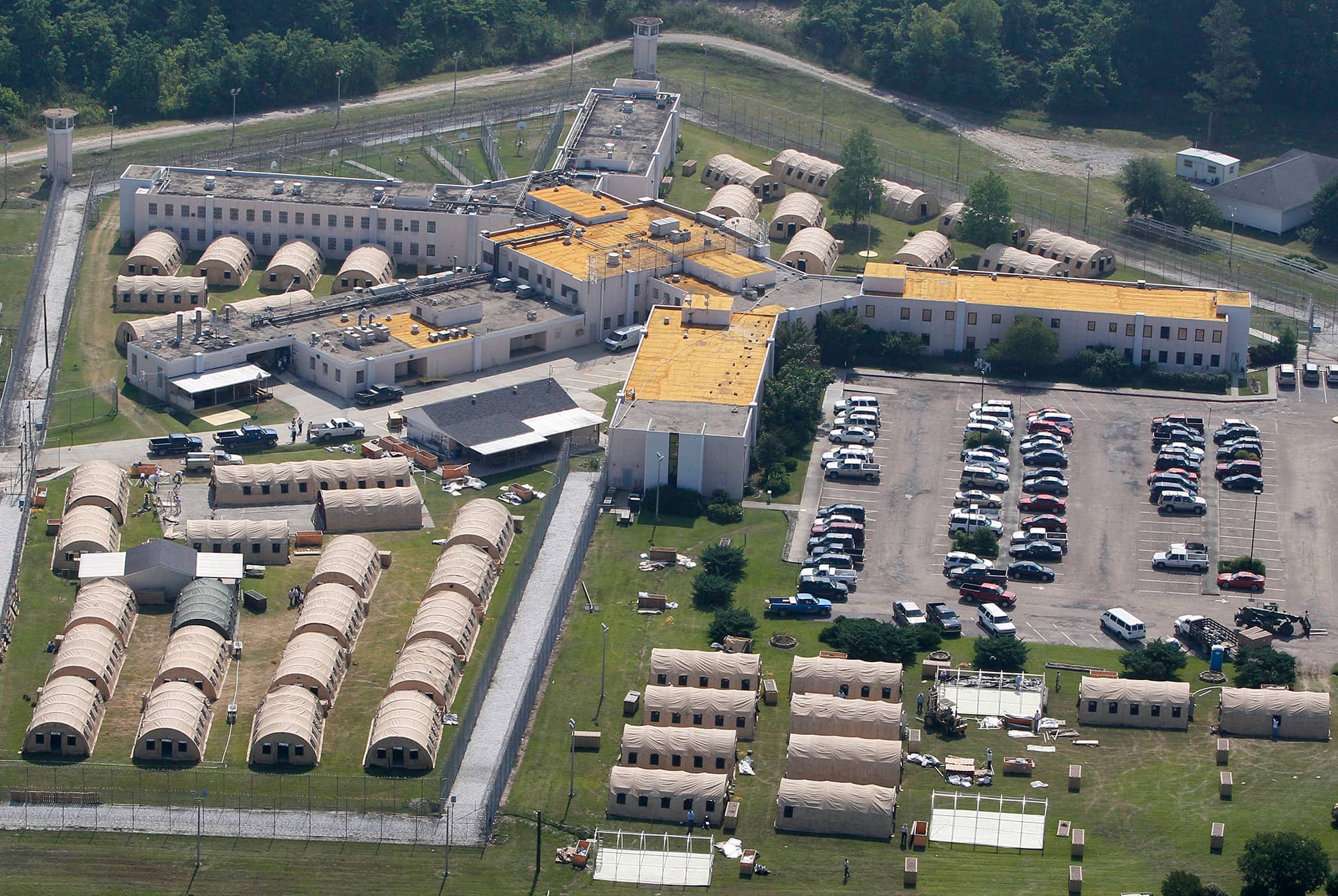
An aerial view of the Louisiana State Penitentiary at Angola. AP Photo / Patrick Semansky
The department’s report on Parchman, released last April, identified extreme heat as one of the factors behind unconstitutionally dangerous conditions. Investigators reviewed temperature logs for the penitentiary’s largest housing unit, which can hold up to 1,500 people, and found heat reaching above 100 degrees F on two-thirds of the recorded dates. (Investigators did not say what time period they reviewed, and the Department of Justice declined Grist’s requests for comment.) “The highest temperature in that unit was recorded at the dangerously hot 145.1 degrees,” the report stated.
Faulty infrastructure and neglect from prison staff was at times more to blame than the weather outside, the report indicated. One harrowing passage described the February 2021 suicide of a man who had spent years in restrictive housing, which is made up of isolated cells housing one or two people. In the week leading up to his death, he had begged corrections officers to turn down the heat. Records showed that temperatures hovered well above 120 degrees that week, despite the mild weather outside.
The report concluded that extreme heat in restrictive housing contributed to “harsh environmental conditions” constituting cruel and unusual punishment — a violation of the Constitution’s Eighth Amendment. The Justice Department warned that if its concerns weren’t rapidly addressed, the federal government would sue Mississippi. The state appears to have acted on that threat: In response to inquiries from Grist, a corrections department official said that, thanks to work completed this year, 70 percent of Parchman’s population is now air-conditioned.
The Mississippi Department of Corrections appears to see using American Rescue Plan Act funds to pay for air conditioning as a way to avoid further federal scrutiny. “We’ll dodge maybe the Justice Department and save the state of Mississippi a whole lot of money,” Department of Corrections Commissioner Burl Cain told the local NBC affiliate WLBT. According to the department official who answered Grist’s inquiries, $4 million of those federal funds will go to HVAC projects at Parchman alone.
Prisoner advocates say the federal government could do more to push states to ensure that prisoners are not suffering in extreme heat. “We support more federal investigations of prison facilities. A lot of prisons are in terrible shape and the federal government carries a big hammer,” said Molly Gill, vice president for policy of Families Against Mandatory Minimums, a nonprofit that pushes for shorter sentences and better prison conditions.
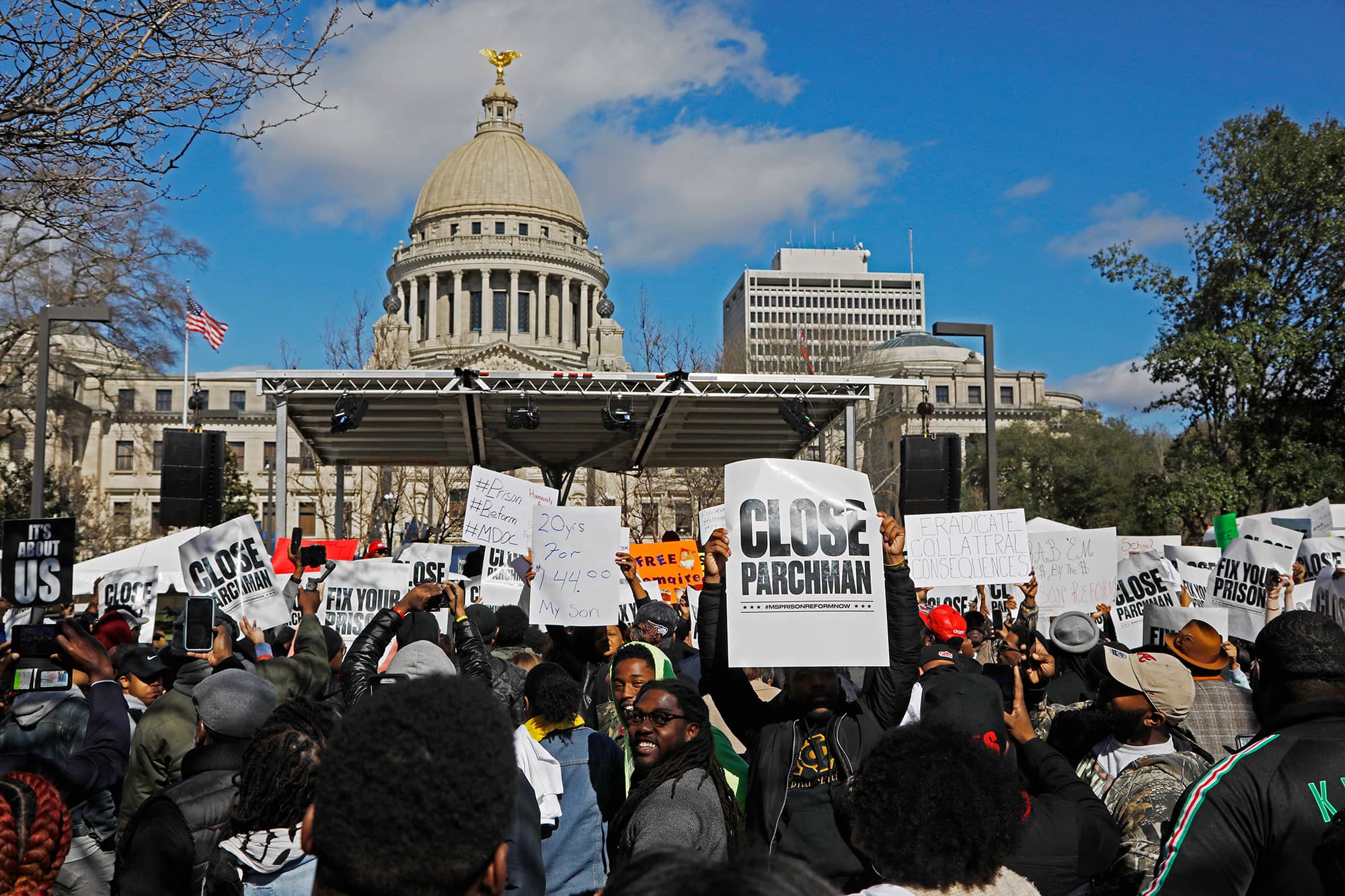
Several hundred people gather in front of the Mississippi Capitol in Jackson to protest the state’s prison conditions in January 2020. AP Photo / Rogelio V. Solis
Gill added that more federal funding for prison air conditioning can make it easier for states to get approval for politically unpopular prison investments. “Some lawmakers see it as a thankless task to improve prison conditions,” she said. In June, for example, Florida Governor Ron DeSantis vetoed $840 million in funding for a new climate-friendly prison and prison hospital, which would have been air conditioned and built to withstand hurricanes.
To Sandra Hardee, director of North Carolina Citizens United for Restorative Effectiveness, which advocates for people who are incarcerated, air conditioning investments can’t come soon enough. “Funding for AC should have been done years and years ago,” she said. “To know that so many people were forced to live in those stagnant conditions in prison for so long — that’s dehumanizing.”
However, others have raised concerns that funding prison air conditioning means pouring new money into a mass incarceration system that locks away more people per capita than any other nation in the world. Particular criticism has been reserved for Alabama, which recently approved construction of two new 4,000-bed, air-conditioned prisons, using $400 million in American Rescue Plan funds.
As in Mississippi, Alabama’s road to new investment started with a 2019 Justice Department investigation that described uncontrolled violence, severe understaffing, and overcrowded, crumbling prisons. Alleging that Alabama didn’t act fast enough to address the problems, the Justice Department sued.
In response, the state promised to open new prisons that would have been privately financed and operated. Although the Justice Department investigation did not mention extreme heat, air conditioning was part of the plan and intended to address issues cited by the department: Reporters at the Montgomery Advertiser found that more assaults at state prisons occur in the dog days of July than any other time of year.
A coalition of grassroots organizers and national organizations called Communities not Prisons fought back, helping convince the banks behind the projects to pull out. The plans seemed dead before the influx of American Rescue Plan funds revived them.
The projects are now facing two funding-related lawsuits, arguing that the funding would violate American Rescue Plan rules and that the state didn’t conduct sufficient community consultation or review of the environmental impacts of the project. U.S. Treasury Department rules governing American Rescue Plan funds suggest that the “construction of new correctional facilities as a response to an increase in rate of crime” is ineligible. Nevertheless, 20 counties in 18 states plan to use the federal money to build or expand prisons, according to reporting by The Nation.
“Using federal dollars earmarked for COVID relief funds to finance part of a prison construction plan should have been unconscionable to Alabama lawmakers,” wrote Lauren-Brooke Eisen, director of the Brennan Center’s Justice Program in an op-ed for The Hill. “The state should instead invest resources in diverting people away from the criminal legal system and supporting drug treatment, mental health programming, and re-entry service.”
The Treasury’s rules do appear to support states using funds for air conditioning, repeatedly mentioning improvement of ventilation in congregate settings as an acceptable way to use the money.
To Cotchery, incarcerated at Alabama’s Childersburg Community Work Center, what’s most desperately needed is a pathway for people locked in the state’s hot prisons to walk out the door and live a good life with their loved ones. “Instead of $400 million in buildings, I would spend $20 million on programs,” he said. “When people leave an Alabama prison they’re not better people. You put them in a cage and poked them the whole time.”
In Texas, Teamer laughed when asked if it would be better to reduce sentences than to invest in air conditioning. “I’m all for letting people out. I’ve been locked up 21 years, since I was 15 years old,” he said. “But I’m in Texas, and I know that’s not gonna happen.”
This story was originally published by Grist with the headline Prison air conditioning is coming too slowly for those who need it most on Sep 1, 2022.
If you're serious about the environment, we all know planting trees is one of the best solutions and tree removal should be a last resort which is why we're committed at Pensacola Tree Services to provide the very best for your home as well as the environment. Read more by going here.
On Tuesday, a federal appeals court kicked two Trump-era offshore oil leases in the Gulf of Mexico back to the Department of the Interior, citing the agency’s failure to examine their full environmental impact. The decision, made by the U.S. Circuit Court of Appeals for the District of Columbia, concerned drilling rights auctioned off back in 2018 for over 150 million acres of federal waters.
The appeal largely hinged on the sales’ alleged failure to comply with the National Environmental Policy Act, or NEPA, which requires the federal government to consider the environmental effects of major projects. Environmental groups including Healthy Gulf, the Sierra Club, and the Center for Biological Diversity argued the Interior Department’s Bureau of Ocean Energy Management, or BOEM, “failed to fully analyze the risks that the immense sales posed to people, wildlife, and the environment,” according to a press release from Earthjustice, which represented the groups.
While a lower court initially found the lease sales’ environmental analysis to be adequate, the D.C. Circuit Court found at least one flaw with the process.
“We hold that Interior adequately considered the option of not leasing, reasonably refused to consider potential future regulatory changes, and unreasonably refused to consider possible deficiencies in environmental enforcement,” wrote Judge Gregory Katsas in the opinion.
The ruling doesn’t halt oil production in the contested areas. According to Earthjustice, the Interior Department will have to reconsider “the full environmental costs associated with auctioning off U.S. public waters to the fossil fuel industry.” Still, environmental groups are celebrating the new decision as a net victory for Gulf Coast communities.
“Offshore oil drilling doesn’t start and stop in the offshore environment,” said Dustin Renaud, communications director for Healthy Gulf. He took Tuesday’s ruling as a sign that the federal government will have to look closer at similar projects’ effects both locally and globally — via contributions to climate change.
“A full assessment of impacts borne by the oil and gas companies on Gulf communities is long overdue,” said Healthy Gulf Executive Director Cynthia Sarthou in a statement. “We welcome this ruling as a great step for BOEM to face the generational impacts offshore leasing has had on low-income communities, fishing communities, and communities of color in terms of public health, environmental degradation, and climate impacts.”
This story was originally published by Grist with the headline Court sends 2 Gulf oil leases back to the Department of the Interior on Sep 1, 2022.